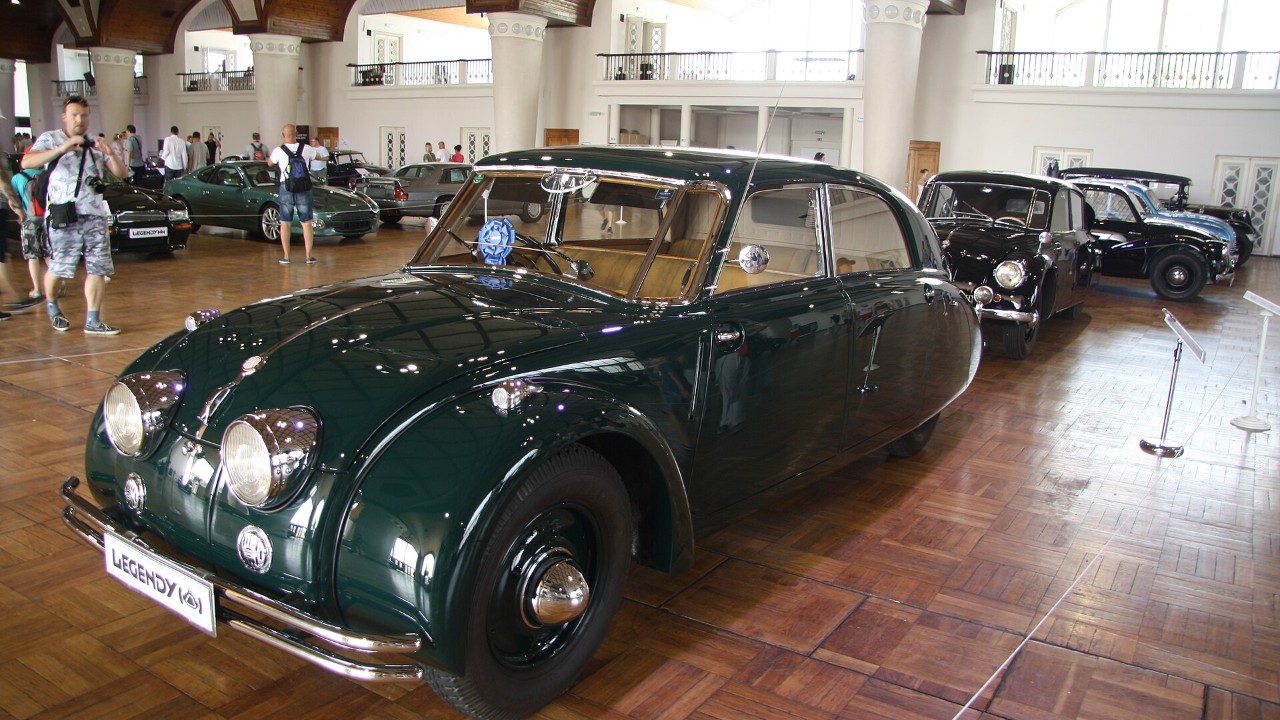
The Tatra 77 began with a dust problem. Czechoslovakia’s gravel roads threw up clouds behind every car, and Tatra’s engineers wanted a body that would leave less of a mess. By 1934, that idea had turned into a teardrop-shaped sedan with its engine in the tail and a fin down its back.
Sources differ on exactly where it ranks, but the claim is a strong one. Several curators and historians put the 77 at or near the very start of aerodynamic production cars. In other words, this was not a show car or a record machine. Tatra sold it to paying customers.
Here is how the shape came together, what sat under it and what the numbers actually show.
Why the Tatra 77 was shaped by the wind
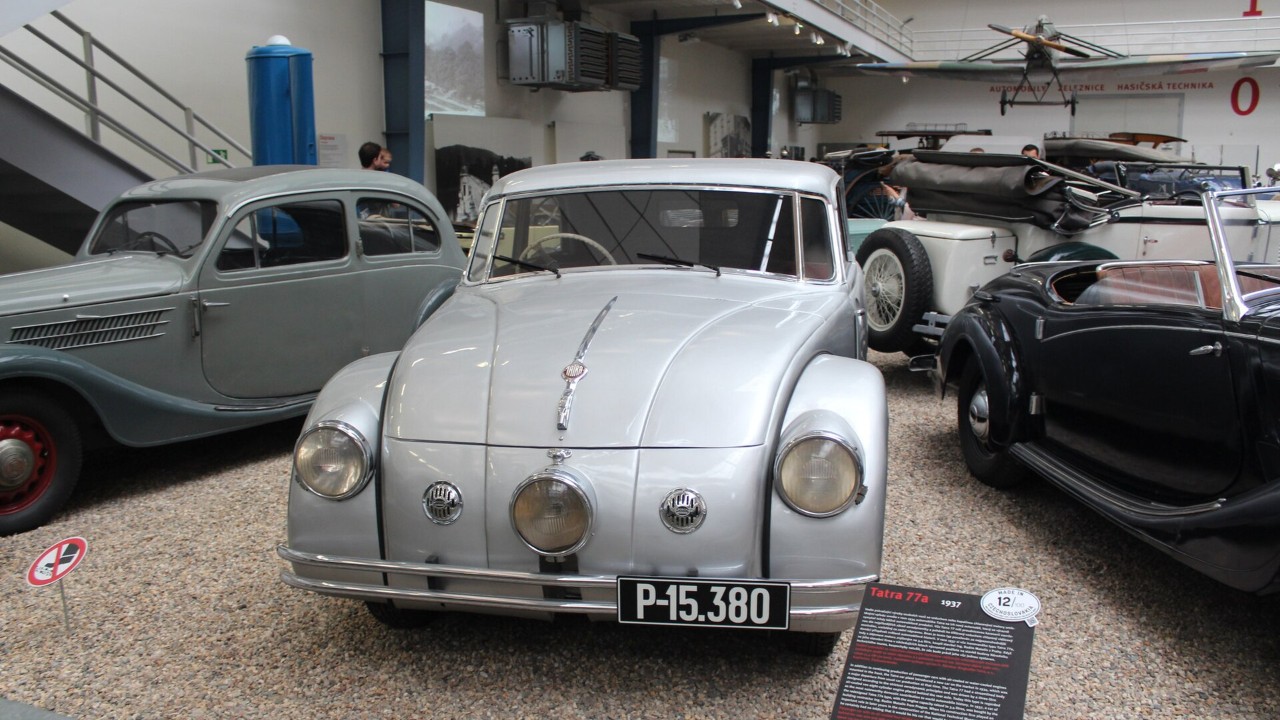
The Swiss Museum of Transport in Lucerne owns a 1934 Tatra 77 limousine. Its collection record explains that Tatra built a streamlined prototype in 1931 because of “the dust problem on the gravelled roads.” The museum lists Hans Ledwinka as the car’s constructor.
That 1931 car was the experimental V570, according to the Revs Institute in Florida. The Revs history adds that the 77 then moved the engine behind the rear axle. As a result, the car sat lower and the cabin gained room. Ledwinka worked with his son Erich and with engineer Erich Übelacker, the institute says.
The outside came from an aviation man. Paul Jaray, a former Zeppelin designer, helped shape the body through his Streamline Coachwork Company in Switzerland, according to the Revs Institute. Meanwhile, Hagerty describes the finished silhouette as “reminiscent of an airplane wing,” with a large rear fin for stability.
How slippery was it, really?
This is where the sources split. The Revs Institute reports a drag coefficient “as low as 0.245” for a 1:5 scale model. By comparison, it says ordinary cars of the 1930s usually measured “well over 0.5.” However, the institute also notes that the full-size car needed scoops and vents to cool the engine, which cost some of that efficiency.
Other sources quote lower figures. The Southward Car Museum in New Zealand credits the later 77A with “an exceptionally low coefficient of drag of 0.212.” Conceptcarz gives both 0.21 and 0.212 on the same page. Because nobody agrees on the exact number, the safest reading is the Revs one: a model tested at roughly half the drag of a typical car of its day.
Even the “first” claim comes with qualifiers. For example, the Southward Car Museum calls the 77 “the first serial-produced truly aerodynamically designed automobile.” The Revs Institute says it is “generally considered the very first aerodynamic production road car.” Hagerty is more careful, saying only that Tatra saw the benefits of streamlining “before most manufacturers.”
The air-cooled V8 in the Tatra 77’s tail
The streamlined body only worked because the engine moved out back. According to the Revs Institute, the 77 used an air-cooled V8 of just under 3.0 liters, built from aluminum and magnesium alloys. It had overhead valves, hemispherical combustion chambers and a single carburetor, and it made 60 horsepower at 3,500 rpm.
The Swiss museum’s own car tells a slightly different story. Its record lists 2.970 liters and 45.5 kW at 3,200 rpm, with a top speed of 150 km/h. The Revs history, on the other hand, gives a claimed top speed of 140 km/h, and Hagerty says 90 mph. Either way, a large sedan cruising near 90 mph on 60 horsepower shows what the shape was doing.
Underneath, the car was advanced for its time as well. For instance, the Revs Institute describes a pressed-steel backbone chassis, independent front suspension by twin transverse leaf springs and hydraulic drum brakes at all four corners. The Swiss museum puts its car at 1,700 kg and 500 cm long, with seats for five passengers plus the driver.
From the Prague show to the 77A
Tatra showed the car to the press on March 5, 1934, at the Prague Auto Salon, according to Conceptcarz. The Revs Institute adds that it also appeared at the Berlin and Paris motor shows. It even raced. The institute says a 77 finished fourth overall in the 1000 Czechoslovak Miles, a touring-car event run on public roads.
Next came the updated 77A. According to the Southward Car Museum, it grew to 3,380 cc and 75 horsepower and gained three headlamps. On several cars, the center lamp turned with the steering wheel. Hagerty dates the 77A to 1935, while the Revs Institute says 1936.
Production was small either way. Hagerty counts 249 cars of both versions from 1934 to 1938. The Revs Institute gives 255 in all, and it says as few as twenty survive today.
Where the Tatra 77 stands now
The design has kept its pull with museums. London’s Victoria and Albert Museum put a Tatra 77 in its exhibition “Cars: Accelerating the Modern World,” Radio Prague International reported. The show ran until April 2020. Curator Brendan Cormier called the car “more or less non-negotiable” for the show. The exhibition displayed 15 cars, and the Tatra came on loan from a private Czech collector.
Survivors are also valuable. According to the Revs Institute, a restored 77A sold at a Gooding auction in 2019 for $412,000. Meanwhile, the 1934 car in Lucerne, chassis number 23052, sits in the Swiss Museum of Transport’s collection, painted dark red.
More from Fast Lane Only