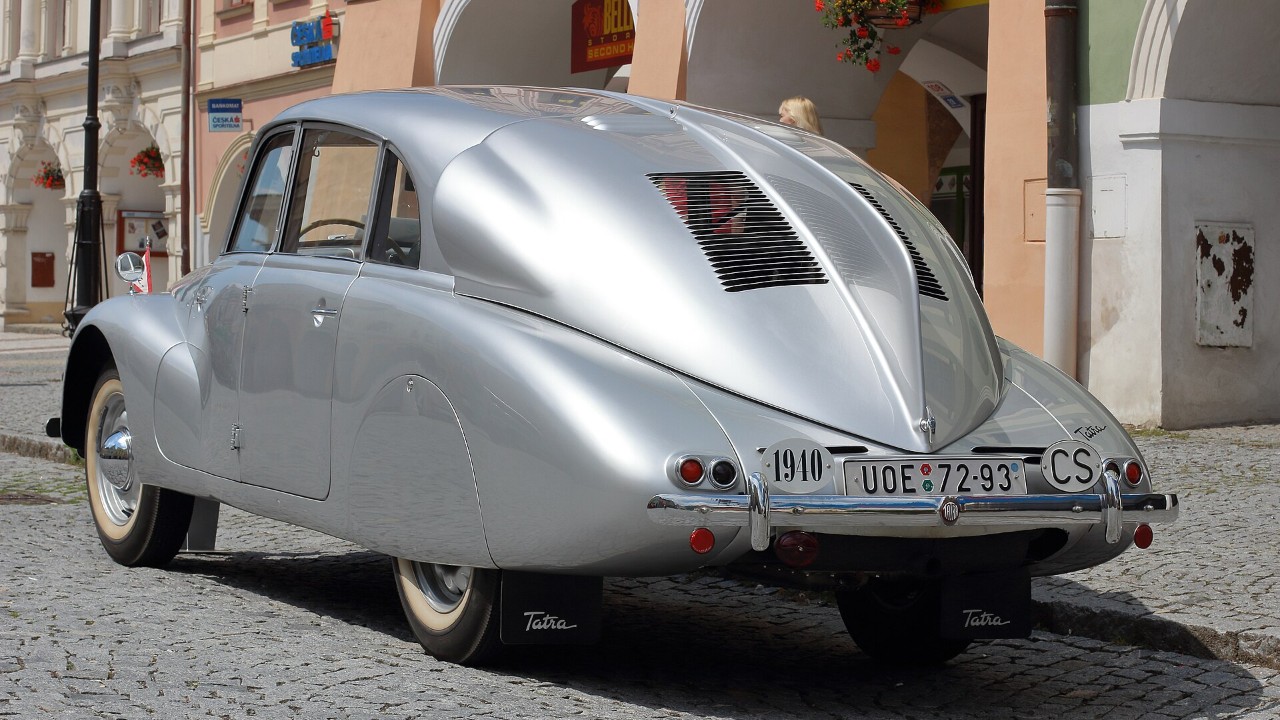
The Tatra T87 arrived in 1936 with its engine in the tail and a fin running down its back. That engine was an air-cooled V8 of 2,969 cc. Meanwhile, the body around it followed the science of airflow rather than fashion. Tatra, the Czechoslovak maker, built the car until 1950.
Putting a V8 in the tail of a full-size sedan was a bold call in 1936. Here’s how the engineers did it, what the car made, and what one brings at auction now.
The answer starts with three men. Austrian-born engineer Hans Ledwinka led the design, with help from Czech engineer Erich Übelacker. Meanwhile, the body’s shape followed aerodynamic principles worked out by Hungarian engineer Paul Jaray.
Who built the Tatra T87, and why it looks like that
Those three names come from RM Sotheby’s catalog for a 1948 Tatra T87 it sold at Monterey in 2015. The same catalog credits the car with a 0.36 drag coefficient. For context, Classic & Sports Car notes that most large cars of the time sat around 0.50.
Ledwinka, according to Classic & Sports Car, was an engineer who believed form should follow function. So the T87’s shape was not styling for its own sake. In fact, the smooth nose, the long tapering tail and the central fin all served the airflow.
The fin had a specific job. Classic & Sports Car says that the “spectacular central fin was an attempt to reduce lift.” Similarly, the two spare tires in the front compartment helped counter lift by adding weight up front.
How the air-cooled V8 fit in the tail
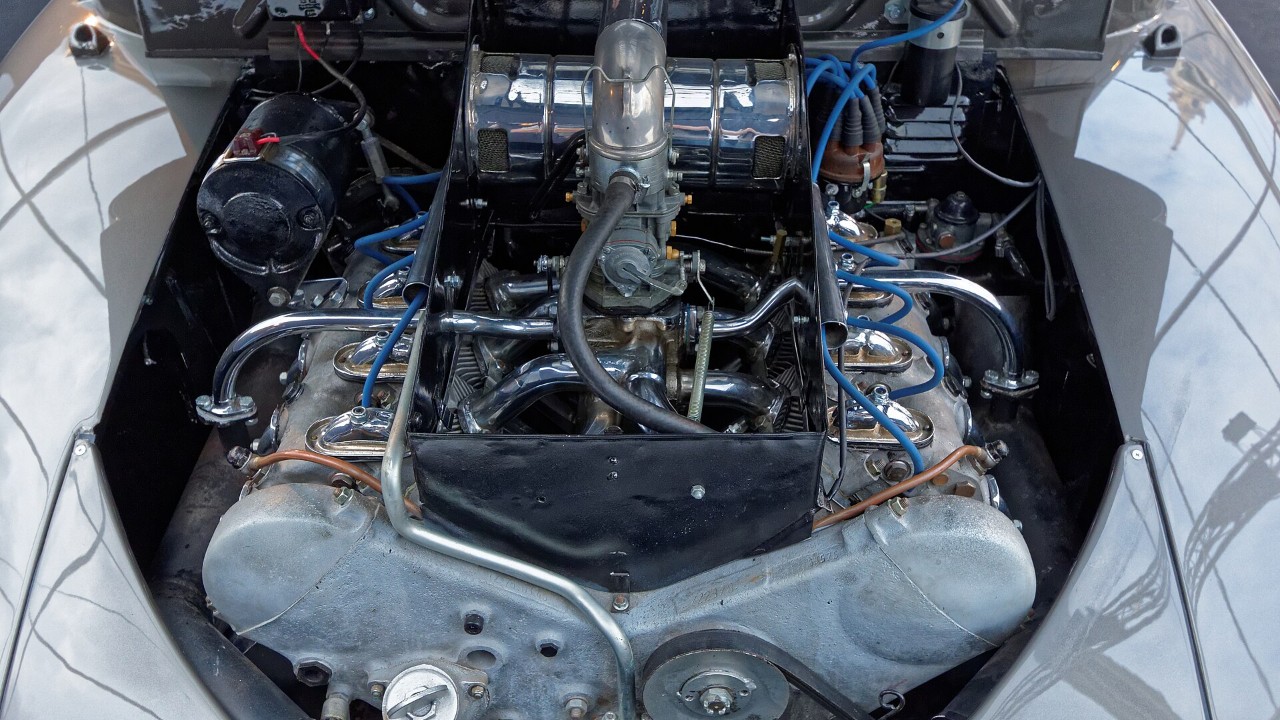
The T87 mounted its V8 at the rear, according to RM Sotheby’s, and cooled it with air rather than water. Silodrome also notes the car had independent suspension on all four wheels and seated five.
The engine itself was a 2,969 cc V8 with one overhead camshaft per cylinder bank, according to Classic & Sports Car. That magazine adds that each aluminium cylinder head was cast individually. Silodrome goes further and describes the engine as a magnesium-alloy SOHC V8. Magnesium, Silodrome explains, is lighter than a comparable aluminum alloy.
Air cooling saved weight as well. As Silodrome puts it, the engine “uses air-cooling rather than a heavier liquid-cooling set up.” Power went through a four-speed manual gearbox, according to the RM Sotheby’s listing.
What the Tatra T87 engine made, and the numbers that disagree
Horsepower is where the sources split. RM Sotheby’s lists 85 bhp for the 1948 car it sold. By contrast, Classic & Sports Car gives 74 bhp at 3,500 rpm. Because the two disagree, we report both and credit each to its source.
Either way, the shape mattered as much as the engine. RM Sotheby’s credits it with a top speed of 100 mph. Meanwhile, Classic & Sports Car puts the figure at 103 mph. Silodrome adds that the car could reach 100 mph while returning around 20 mpg.
Weight helped too. Classic & Sports Car says the T87 weighed 3,020 lb, or 1,370 kg. That was 880 lb less than the T77 that came before it. Under the body sat a backbone chassis, a U-section tube with the floor pan welded to it.
Where the luggage went, and how it drove
With the engine in the back, the luggage had to go somewhere else. According to Classic & Sports Car, the T87 carried bags in two boxes behind the rear seats, which the magazine calls “not-terribly accessible.” Up front, the compartment held the two spare tires.
The ride, however, earned praise. Classic & Sports Car describes a “smoothness of ride that anticipates – and indeed surpasses – the Citroën DS.” It also mentions “the gentle purr of the V8 and the barest minimum of wind noise.”
There was a catch. The rear suspension used swing axles, and Classic & Sports Car warns that drivers had to avoid lifting off the throttle mid-corner. Even so, the magazine says the car was “capable of being driven hard.”
The Tatra T87’s influence and its famous owners
Tatra built about 3,000 of the cars between 1936 and 1950. Classic & Sports Car counts 3,023, while Silodrome counts 3,056. The design was based closely on the earlier T77, Silodrome notes, but with a number of important upgrades.
The T87 also left a mark on the German people’s car. Silodrome reports that its design is said to have caught the eye of Ferdinand Porsche and served, unofficially, as inspiration for that project. As a result, according to Silodrome, Volkswagen paid Tatra 1,000,000 Deutsche Marks in an out-of-court settlement in 1965.
Owners included some famous names. RM Sotheby’s lists King Farouk of Egypt, Czech president Klement Gottwald and the Pulitzer Prize-winning novelist John Steinbeck. The 1948 Tatra T87 that RM Sotheby’s offered at Monterey in 2015 sold for $132,000.
More from Fast Lane Only
- Unboxing the WWII Jeep in a Crate
- 15 rare Chevys collectors are quietly buying
- 10 underrated V8s still worth hunting down
- Police notice this before you even roll window down
This article was created with the help of AI and was reviewed and edited by Fast Lane Only editors before publication.