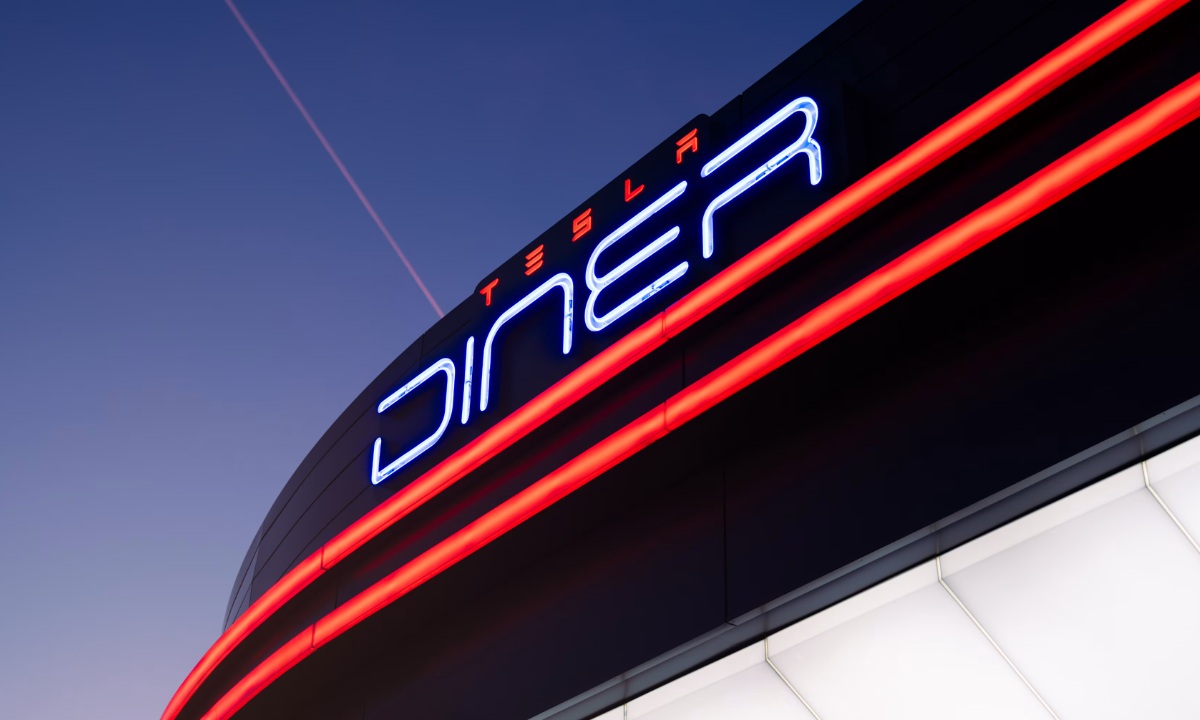
The first Tesla Diner opened in Los Angeles as a kind of rolling commercial for the future, a place where drivers could charge their cars, watch movies and eat burgers under neon lights. Within months, the same space that had drawn lines of fans and influencers was so quiet that reports described it as closer to a deserted rest stop than a buzzy flagship. The rapid shift from viral attraction to half‑empty curiosity says as much about the limits of hype as it does about Tesla’s ambitions in food and entertainment.
At launch, the project looked like a carefully staged proof of concept for how electric charging, dining and media could blend into one seamless experience. By the end of its first half year, it had become a case study in what happens when novelty fades faster than the business model can adjust.
A retro-futurist billboard for the Tesla brand
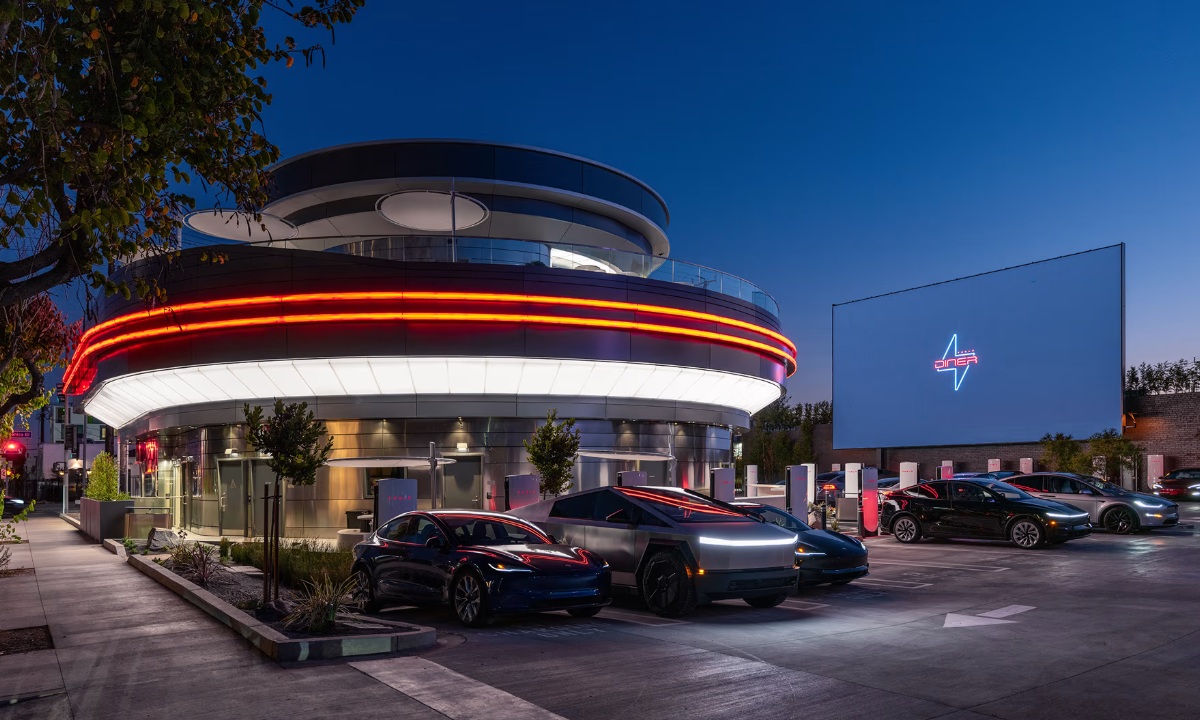
From the start, the Tesla Diner was designed less like a neighborhood restaurant and more like a physical extension of the company’s marketing. The site at 7001 Santa Monica Blvd in West Hollywood promised visitors a place to “Eat, Charge, Watch,” with the location open 24/7 and pitched as a venue where guests could even “Host an Event.” The core idea was simple and seductive: drivers would plug in at a large Supercharger hub, grab food in a retro‑styled diner and watch content on towering outdoor screens while their cars topped up.
The scale of the build underscored how seriously Tesla treated the concept. The complex included 80 charging stalls and two 66-foot megascreens looping short films and feature‑length movies, turning what is usually a utilitarian stop into a kind of drive‑in theater. It was also framed as Tesla’s first combined diner and charging station, a flagship that could be replicated elsewhere if the formula worked. In practice, that meant the restaurant was never just about burgers and shakes, it was a live demonstration of how the company imagines the future of refueling and leisure for its customers.
From launch-day lines to a quiet pit stop
In its first weeks, the diner’s biggest asset was not its menu or its screens but its novelty. Reports from the opening period described long lines of customers eager to experience a restaurant tied to one of the world’s most closely watched brands, with the Tesla name alone enough to turn a roadside stop into a destination. The idea of eating at a diner owned by the richest person in the world quickly became a social media talking point, and early visitors treated the site like a pop‑culture event as much as a place to charge a car.
That initial surge did not last. Within roughly six months, coverage of the same location described a very different scene, with the once‑packed venue now characterized as an “empty pit stop” where the hype had clearly cooled. Accounts of the Hollywood site noted that the novelty of the concept seemed to have worn off in just a few months, leaving a spotless but noticeably underused space. What began as a viral sensation had settled into a slower, more ordinary rhythm, and the gap between the launch‑day buzz and the day‑to‑day reality became impossible to ignore.
Menu cuts, format shifts and a shrinking ambition
The speed of the comedown showed up first in the food. Less than a month after opening, the Tesla Diner in LOS ANGELES had already begun cutting back its offerings, trimming items like the Shirley Temple and Creamsicles and scaling down from an initial “all‑day” menu. Overnight service was also pared back, with the restaurant limiting what had been a full menu between midnight and 6 a.m. to a narrower set of options. For a concept that had marketed itself as Open 24/7, the early retrenchment signaled that demand was not matching the original projections.
By late in the year, the changes went beyond recipes and operating hours. The Tesla Diner in Hollywood was reported to be undergoing major changes just months after opening, despite the company’s effort to position it as a long‑term anchor for the site. The Tesla Diner had only been open a short time when plans surfaced to change formats, including a shift in how the drive‑thru would operate and a refocus on a new restaurant concept that could arrive as soon as Jan. One key figure publicly stated, “I am leaving the Tesla Diner project to focus on a new restaurant,” a line that captured how quickly the original vision was being rethought. What began as a bold, all‑in experiment was already being carved back into something more conventional.
When the vibe turns “dystopian”
As the crowds thinned, the atmosphere at the Hollywood site became a story in its own right. Visitors described a strange disconnect between the glossy, retro‑futuristic design and the sparse number of diners actually using it, with one widely shared characterization calling the Tesla Diner in Hollywood “a dystopian concept” after the initial hype died down. The same neon‑lit booths and massive screens that had looked aspirational in early photos now read as slightly eerie when they played to nearly empty parking rows.
Other accounts echoed that sense of dissonance. Reporters who visited after the rush noted that the diner was spotless and visually impressive but felt oddly underpopulated, more like a showroom than a functioning neighborhood hangout. The combination of 80 charging stalls, two 66-foot screens and a heavily branded environment made sense when the place was packed with fans, but with only a handful of cars plugged in, the scale could feel out of proportion to the actual use. In that context, the “dystopian” label was less about any single design choice and more about the mood created when a space built for spectacle is left mostly to itself.
What Tesla’s stalled experiment reveals about EV culture
For Tesla, the diner’s trajectory from viral hit to subdued curiosity raises uncomfortable questions about how far the brand can stretch beyond cars. The company has long treated its Supercharger network as a strategic advantage, and the Hollywood project tried to turn that infrastructure into a lifestyle destination. Yet within about six months, reports from Jan described the restaurant venture as having “stalled,” with the once‑buzzy diner having gone largely quiet. Internal focus appeared to be shifting away from the original concept, even as the charging hardware on site remained a core part of Tesla’s ecosystem.
From my perspective, the experiment highlights a tension at the heart of EV culture. Drivers clearly value fast, reliable charging, and a clean place to grab food or coffee while they wait is a logical extension of that need. But the Tesla Diner shows that building an 80‑stall, neon‑soaked complex with two 66-foot screens is not enough on its own to sustain a restaurant business once the novelty wears off. The Hollywood site still functions as a Supercharger hub and a billboard for the brand, yet its rapid slide from viral sensation to quiet pit stop suggests that even Tesla cannot rely on hype alone to keep a dining room full.
More from Fast Lane Only: