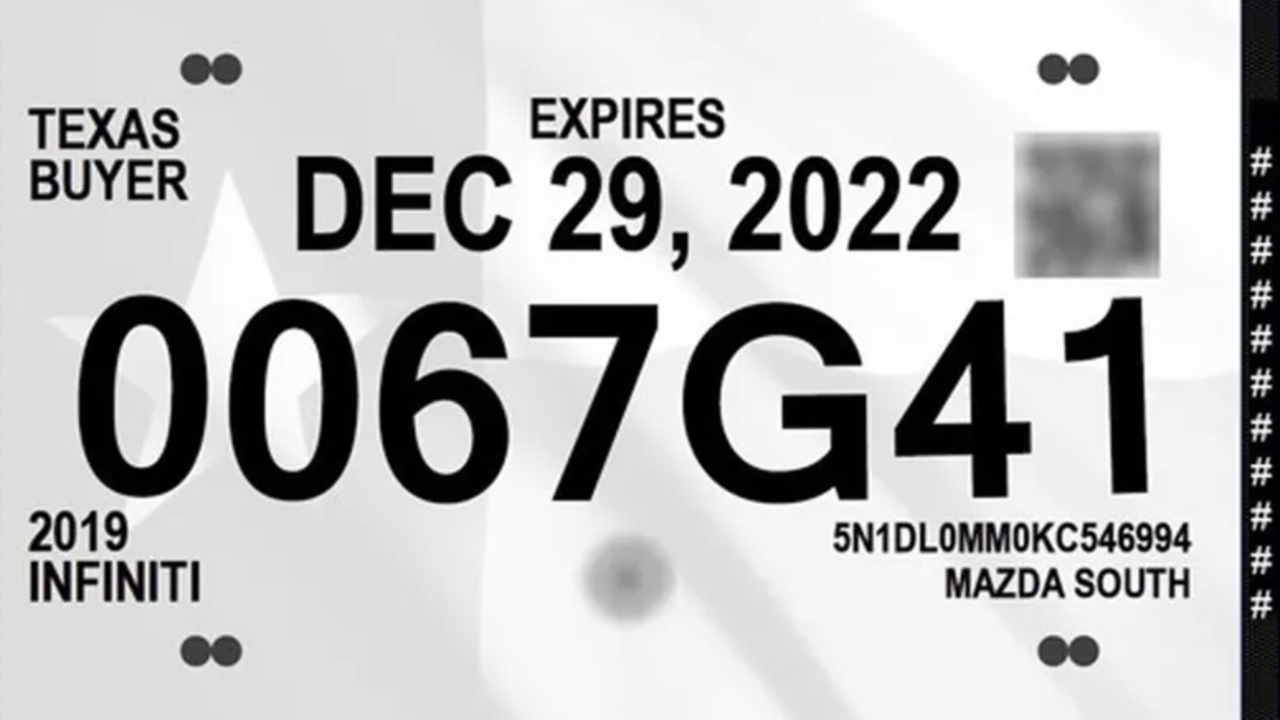
Texas officials spent years trying to choke off a booming trade in bogus paper temporary tags. The state finally killed most paper plates in favor of metal last summer, promising clearer roads and fewer ghost cars. Instead, the fraud has simply changed format, and the fake plate crisis is now etched in aluminum rather than printed on cardstock.
From toll roads to online marketplaces, counterfeiters have adapted with startling speed. Law enforcement, regulators, and ordinary buyers are now racing to keep up with a new wave of metal lookalikes that are harder to spot at a glance and just as useful to people who want to drive untraceable vehicles.
From paper to metal, and a problem that refused to die
Texas did not abandon paper tags on a whim. State leaders moved after years of abuse in which criminals could generate convincing temporary registrations on a home printer, then use them to mask stolen cars, dodge tolls, or disappear after violent crimes. During the 2023 legislative session, lawmakers approved House Bill 718, which required that most buyers receive permanent metal plates at the point of sale instead of flimsy paper slips that could be forged in minutes, a change the Texas Department of Motor Vehicles later detailed for dealers and the public.
Under that law, House Bill 718 directed that All licensed dealers issue metal license plates to buyers when a vehicle is sold, rather than sending them onto the road with temporary paper tags. State guidance for officers in the “Texas License Plate Changes, Guide for Law Enforcement” explained that, effective in early July, Texas would eliminate most paper temporary tags and replace them with metal plates tied directly to a vehicle’s registration record. Police departments and local agencies echoed the shift, noting that One-Trip Permits, 30-Day Permits, Dealer Agent Tags, and Dealer vehicle specific tags would be converted from paper to metal as part of a broader push to improve public safety.
Warnings came early, and they were accurate
Even before the last paper tag was issued, some Texas officials predicted that fraud would not disappear, it would migrate. In ARLINGTON, toll authorities and law enforcement warned that with paper tags going away in Texas, Toll evaders would likely pivot to fake metal plates, using them to slip through toll gantries and evade identification. They understood that as long as a plate, whether paper or metal, could be made to look legitimate from a distance, it would remain a powerful tool for people who wanted to hide their vehicles in plain sight.
Those concerns were not limited to toll roads. Police and regulators recognized that the same dynamics that made paper tags attractive to car thieves and organized crews would apply to metal counterfeits. As Texas prepared to roll out the new system, local news segments and law enforcement briefings stressed that the change would make it harder to print a tag on a home computer, but would not, by itself, stop criminals from copying plate designs or stealing real plates to clone. The question was never whether bad actors would try to adapt, but how quickly they would do it and how much damage they could cause before the state adjusted again.
Fake metal plates arrive, fast and brazen
The answer came within weeks. By early fall, constables and investigators were already sounding alarms that, only two months after Texas eliminated paper tags, counterfeiters were producing fake metal temporary plates that mimicked the new design closely enough to fool casual observers and some automated systems. Investigative reports described how these plates were being used on stolen vehicles and cars involved in serious criminal activity, reviving the same public safety fears that had driven the paper tag crackdown.
More recent accounts have reinforced that the problem has not faded. Earlier this month, coverage of the issue noted that Texas eliminated paper tags, but criminals are now using fake metal license plates instead, with Police reporting that stolen vehicles and cars tied to violent offenses are again circulating with bogus identifiers. A separate analysis framed it bluntly: Last year, Texas banned temporary paper tags in an effort to thwart counterfeit license plates. Unfortunately that effort has proved only partly successful, because the fraud has simply shifted to metal plates that can be bought, sold, and swapped with relative ease.
Online car sales and the new consumer risk
The rise of fake metal plates is not just a law enforcement headache, it is a consumer protection problem. Last year, Texas got rid of paper tags, trying to combat fraud, but now the issue has moved to metal plates, a shift that has particular implications for people buying used cars online. When a seller can bolt a convincing counterfeit plate onto a vehicle and present a plausible story, it becomes easier to pass off a stolen car, a flood damaged truck, or a vehicle with a hidden salvage history to an unsuspecting buyer who may never realize the plate itself is part of the deception.
Consumer advocates have long warned about these risks in other contexts. In one widely cited case, Basinger bought a flooded pickup that had traveled from Florida to Texas, only discovering the extent of the damage after the sale and eventually hiring a lawyer to negotiate with the dealership. He later urged shoppers to follow NICB guidance, including using the NICB VIN Check to see whether a vehicle has been reported as stolen or salvaged and having a trusted mechanic examine the car before money changes hands. Those same precautions are now even more critical in a world where a metal plate, which once signaled permanence and legitimacy, can itself be a forgery.
How Texas and drivers can respond
State agencies are trying to keep pace. The Texas Department of Motor Vehicles has published detailed instructions for dealers on House Bill 718 implementation, including how to issue and record metal plates so that each one is tied to a specific vehicle and buyer. The “Texas License Plate Changes, Guide for Law Enforcement” walks officers through the visual differences between legacy plates, new designs, and remaining paper permits, arming them with reference points to spot anomalies during traffic stops. Local police departments have also used social media to remind drivers that, effective in early July, Texas is making a major change to improve public safety by replacing a range of paper permits with metal temporary registration insignia.
Yet the state’s efforts can only go so far without help from drivers and buyers. Law enforcement agencies that investigate stolen vehicle scams on platforms like Facebook Marketplace and Instagram have urged people to slow down and scrutinize both the car and its paperwork. One widely shared advisory on Facebook Marketplace stolen vehicle scams urged shoppers to trust their instincts when a price seems unrealistically low, meet in a police station parking lot, and look closely at the vehicle itself. Number three on that checklist was to inspect for Broken windows, damaged locks, or glass fragments inside the car, all telltale signs of tampering that no license plate, real or fake, can hide. Combined with NICB VIN checks and a healthy skepticism of sellers who refuse to share identification or title documents, those steps offer one of the few reliable defenses ordinary Texans have while the state races to contain a crisis that has simply changed materials, not motives.
More from Fast Lane Only