The first-generation Dodge Charger arrived in 1966 as the muscle car era was just taking shape, yet it did not simply follow the template that Pontiac, Chevrolet, and others were sketching out. It combined a fastback roofline, four-bucket-seat interior, and serious big-block power in a way that felt closer to a concept car than a showroom model. That blend of style and speed helped the Charger carve out its own identity and set the stage for one of Detroit’s most recognizable performance nameplates.
Looking back, the 1966 Charger stands out not only for its distinctive design but also for how aggressively Dodge used it to push into NASCAR, chase young buyers, and prove that Chrysler could build a dramatic, high-performance coupe that could stand with anything from General Motors or Ford.
Setting the Stage: Muscle Cars Before the Charger
By the mid-1960s, American performance was shifting from full-size cruisers to midsize and intermediate coupes with serious V8 power. Pontiac’s GTO, Chevrolet’s Chevelle SS, and Ford’s Fairlane GT were defining what a muscle car looked like: relatively plain two-door bodies with big engines and straightforward interiors.
Chrysler had performance hardware, especially the 426 cubic inch Hemi V8, but it lacked a dramatic showcase to match the marketing punch of those rivals. The company had already experimented with sporty full-size models and concept fastbacks, yet its image still leaned conservative compared with the youth-focused pitch coming from Pontiac and Chevrolet. The Charger would become Dodge’s answer to that problem, a halo car meant to project speed, modern style, and racing credibility in one package.
A Radical Shape for a New Nameplate
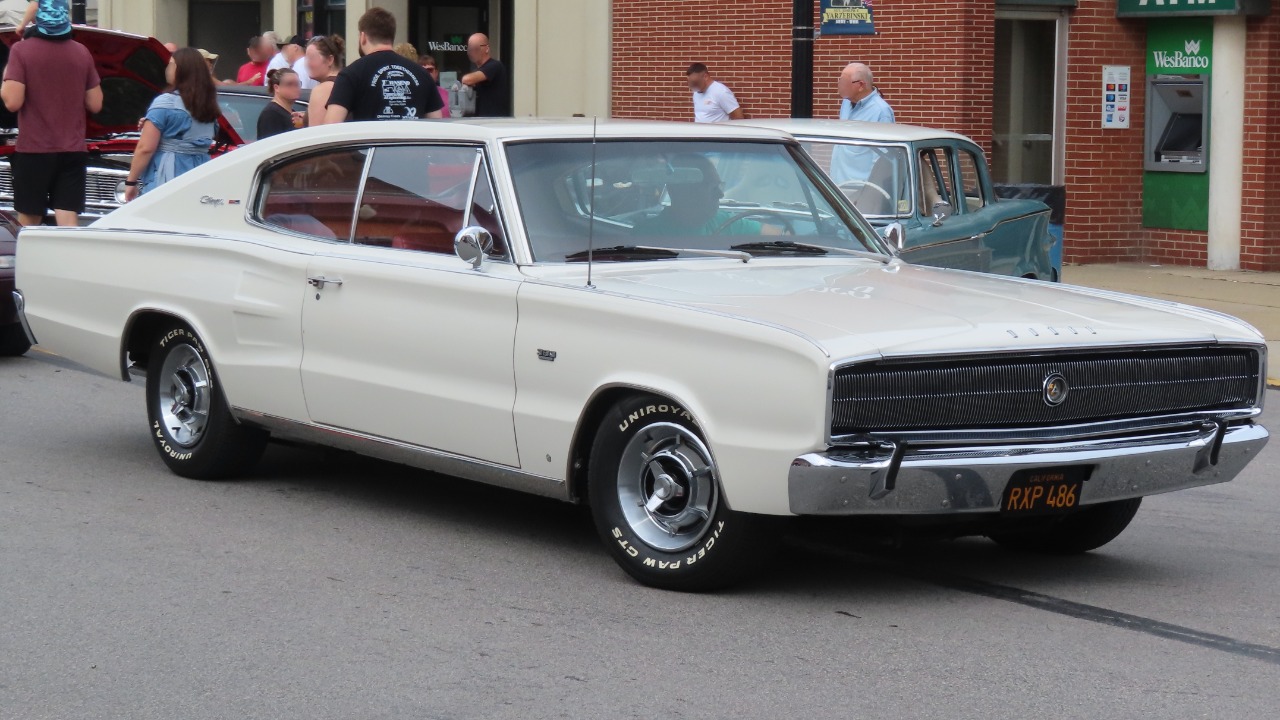
The 1966 Charger was based on the midsize Dodge Coronet, but the sheet metal above the beltline made it look like something entirely different. Designers gave it a full-length fastback roof, a nearly horizontal rear window, and a long, unbroken sweep from the roof down to the tail. The front fascia carried a wide, full-width grille with hidden headlamps that rotated out of sight when not in use, giving the car a clean, almost menacing face at night.
Unlike many competitors that shared obvious body panels with sedans, the Charger’s profile looked purpose-built for speed. The fastback was not just a styling flourish; it connected the car to the aero-minded thinking that would soon dominate NASCAR. While some rivals, such as the Buick Wildcat, evolved from earlier full-size performance coupes into more understated muscle-era forms, the Charger arrived as a sharply focused statement. That contrast helps explain why the Charger looked more like a concept car while other performance nameplates, including the Buick Wildcat, still carried traces of their luxury roots.
Inside the 1966 Charger: Four Buckets and a Full-Length Console
The interior of the 1966 Charger pushed just as hard as the exterior. Instead of a conventional front bench and simple rear seat, Dodge fitted four individual bucket seats separated by a full-length center console. The rear buckets folded flat to extend the cargo area under the fastback, which turned the car into a kind of high-speed liftback long before that term became common.
The dashboard featured a sweeping instrument panel with round gauges and, on many cars, electroluminescent lighting that glowed at night in a futuristic green. This cockpit-like layout reinforced the idea that the Charger was not a dressed-up family car, but a dedicated driver’s machine. In an era when many muscle cars still used basic interiors borrowed from cheaper models, the Charger’s cabin felt more like a personal luxury coupe combined with a performance car, a mix that helped it stand apart.
Powertrain Choices and the Arrival of the Street Hemi
Under the hood, the 1966 Charger offered a range of V8s, starting with a 318 cubic inch small-block and moving up through 361 and 383 cubic inch big-blocks. The real headline, however, was the availability of the 426 cubic inch Hemi V8 in street form. This engine, originally developed for racing, had already established a fearsome reputation on the track. Bringing it into the Charger turned the car into one of the most serious performance machines available from any manufacturer.
The 426 Hemi used hemispherical combustion chambers, large valves, and high-flow heads to produce immense power for the time, and it quickly became a legend among enthusiasts. Period figures often quoted the engine’s rating conservatively, but its real-world performance made clear that the Charger Hemi was a different kind of street car. Surviving examples of the 1966 Charger 426 are now treated as rare, high-value collectibles precisely because so few buyers were willing to pay for such an extreme package when it was new.
The combination of a sleek fastback body and the Hemi’s brute force created a personality that felt more specialized than many rivals. While some muscle cars focused on affordable performance, the Hemi Charger leaned into exclusivity and raw capability, which helped cement its reputation even if it limited sales volume.
From Showroom to Speedway
Dodge did not intend the Charger to be simply a stylish street car. The company saw it as a way to improve its fortunes in stock car racing, where aerodynamics and high-speed stability mattered as much as horsepower. The fastback roof and clean sides gave the Charger an advantage at high speeds compared with more upright sedans, and the 426 Hemi provided the power needed to compete on long ovals.
Racing versions of the Charger helped Chrysler refine both engine and chassis setups that would influence later performance models. The early NASCAR experience also revealed that the first fastback design, while better than earlier shapes, still had room for improvement at extreme speeds. Those lessons eventually led to more radical aero cars, but the 1966 Charger marked the moment when Dodge committed to using a dedicated performance coupe as its racing flagship rather than relying on traditional sedans.
Sales Reality and Market Position
In the showroom, the 1966 Charger did not outsell the more conventional muscle cars from General Motors or Ford, yet it achieved something arguably more important for Dodge: it shifted the brand’s image toward youth and performance. Buyers who wanted a more dramatic car than a Coronet or Polara could now step into a Charger and get a distinctive shape, upscale interior, and serious power.
Production numbers for Hemi-equipped cars remained low, in part because the option was expensive and the engine’s temperament was more demanding than the milder big-blocks. That scarcity is one reason collectors now prize original Hemi Chargers. At the same time, the availability of more affordable V8s meant that the Charger could still attract buyers who wanted the look and some of the performance without committing to the most extreme engine.
Why the First Charger Looked So Different
The Charger’s styling choices did not happen in a vacuum. Dodge and Chrysler had been experimenting with fastback and jet-inspired design themes in concept cars, and the company needed a visual statement that could pull attention away from rivals. The full-width grille with hidden headlights, the long hood, and the nearly vertical tail panel with full-width taillights all contributed to a look that felt more unified than many contemporaries.
That design also made the Charger more flexible in terms of future evolution. The basic proportions, with a long hood and short deck, could be adapted to later generations without losing the identity that the 1966 model established. Modern histories of the Dodge Charger often point back to the first generation as the moment when the nameplate’s core themes of bold styling and strong engines came together in a recognizable form.
The Charger Legacy Begins
The 1966 Charger did not instantly define the entire muscle car category, but it did plant several seeds that would grow in the late 1960s and early 1970s. The commitment to big-block power, the willingness to push dramatic styling, and the close relationship to racing all became central to Dodge’s performance identity. Later Chargers would refine those ideas, but the first car set the tone.
Over time, the Charger name would move through multiple body styles and market roles, from classic two-door muscle to personal luxury coupe and eventually to modern four-door performance sedan. The long-running Charger legacy only makes sense when viewed in light of the 1966 original, which established that the badge stood for something more aggressive and distinctive than a typical midsize car.
How the Charger Compared With Its Contemporaries
In the broader muscle car field, the 1966 Charger occupied an unusual niche. It was not as affordable or straightforward as a basic GTO or Chevelle SS, and it did not lean into compact dimensions the way a Plymouth Barracuda or Ford Mustang did. Instead, it straddled the line between personal luxury coupe and pure muscle car.
That positioning meant the Charger appealed to buyers who wanted comfort and style along with speed. The four-bucket-seat layout and extensive trim options made it feel more upscale than some stripped-down rivals. At the same time, the availability of engines like the 383 and 426 Hemi gave it performance credibility that full-size luxury coupes could not match. The Charger’s blend of attributes helped widen the definition of what a muscle car could be, beyond the simple formula of a small body and the biggest possible engine.
Evolution After 1966 and the Long Shadow of the First Generation
The Charger evolved quickly after its debut. Later first-generation cars and the second-generation redesign adjusted styling, improved aerodynamics for racing, and responded to shifting market tastes. Yet many of the core cues that enthusiasts now associate with the Charger nameplate trace directly back to the 1966 model: a bold face, a dramatic roofline, and a focus on V8 power.
Modern retrospectives on Charger history often emphasize how unusual it was for a single nameplate to move from two-door fastback to long-running four-door sedan while still maintaining a performance image. That continuity rests on the foundation laid by the first Charger, which established that the badge represented more than a specific body style. It stood for a certain attitude and level of performance that Dodge has tried to preserve even as regulations, fuel prices, and consumer preferences changed.
Why Enthusiasts Still Look Back to 1966
Today, the 1966 Charger occupies a special place in enthusiast circles. Collectors value its rarity, especially in Hemi form, and restorers appreciate the way its design captures a transitional moment between early 1960s jet-age styling and the more muscular forms that followed. Owners of surviving cars often highlight the unique interior layout and the sense that the Charger feels more like a concept brought to life than a typical production coupe.
Historical overviews of the Charger nameplate consistently treat the 1966 model as a starting point for everything that came later. Even as later generations introduced iconic shapes of their own, particularly the late 1960s and early 1970s cars, the first Charger remains the reference for how bold Dodge was willing to be at the beginning of its muscle car push.
More from Fast Lane Only
- Unboxing the WWII Jeep in a Crate
- 15 rare Chevys collectors are quietly buying
- 10 underrated V8s still worth hunting down
- Police notice this before you even roll window down
*Research for this article included AI assistance, with all final content reviewed by human editors.