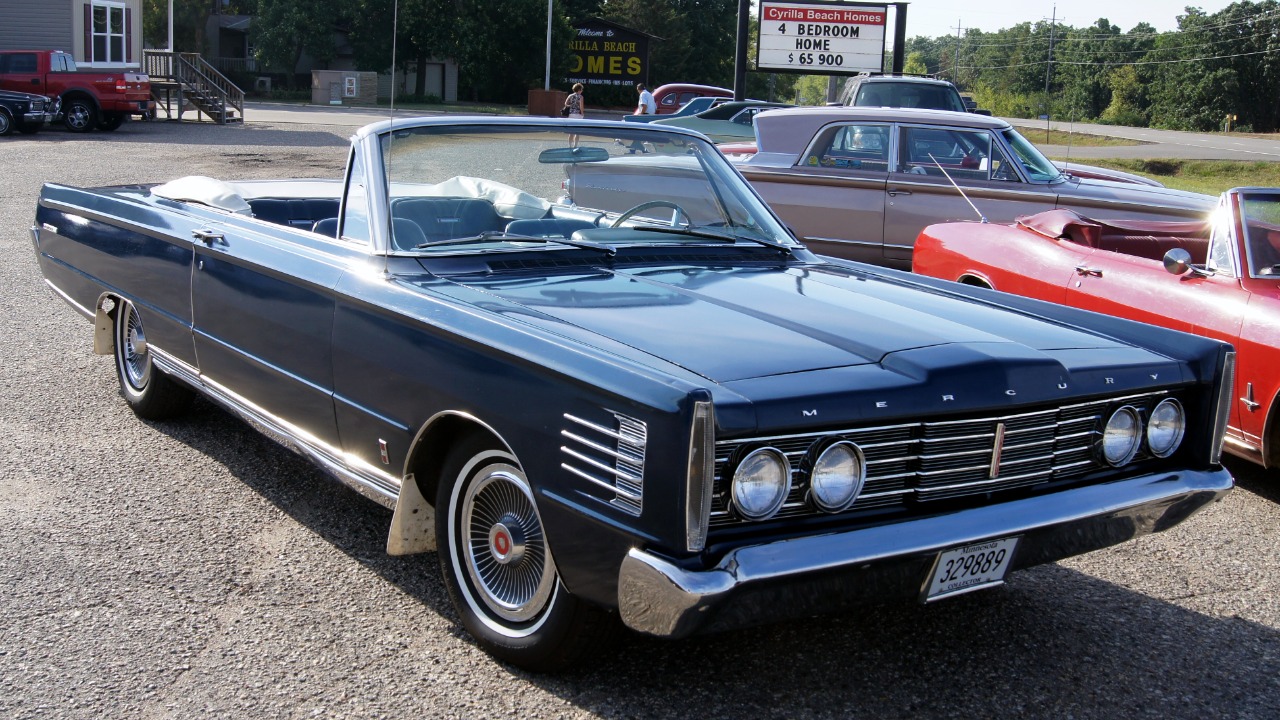
The 1965 Mercury Park Lane arrived at a moment when American buyers were starting to ask for more than brute power and chrome. They wanted quiet cabins, soft seats, and the kind of upscale feel that had once been reserved for the most expensive luxury sedans. In that climate, Mercury pushed its full-size flagship upmarket, turning the Park Lane into a rolling argument that comfort and performance could share the same driveway.
What fascinates me about this car is how deliberately it chased that balance. The Park Lane did not abandon big-block muscle or imposing dimensions, but it wrapped them in plush materials, thoughtful details, and a visual kinship with the era’s most prestigious domestic luxury models. In doing so, it captured a shift in American taste that still echoes in today’s crossovers and luxury trims.
The Park Lane steps into the luxury spotlight
By the mid‑1960s, Mercury wanted a clear flagship, and the Park Lane became it. As the top of the brand’s full‑size range, it was positioned as the highest‑priced, premium trim, and As the line that carried the most equipment and the most formal styling. That status was not just about price; it was about signaling that Mercury could offer a near‑luxury experience to buyers who were not ready to jump to a different showroom. The Park Lane’s long, straight body sides and restrained ornamentation fit neatly into that mission, giving it a more dignified presence than some of its flashier contemporaries.
Mercury leaned into that image by aligning the Park Lane with the era’s domestic luxury benchmark. Period marketing described Mercury as “most elegant” and emphasized that All Park Lane models were now presented in the Lincoln Continental tradition, a deliberate attempt to borrow some of that prestige. The connection was more than a slogan, since the car’s squared‑off rooflines and clean side surfaces echoed the formal look that defined Lincoln Continental design at the time. For buyers, the message was clear: this was the Mercury that aspired to the same comfort and refinement as its more expensive corporate cousin.
Comfort first, from carpet to door panels
Inside, the Park Lane made its case with materials and details that went beyond basic full‑size expectations. Factory literature lists PARK LANE STANDARD EQUIPMENT INCLUDES items that were not universal in the segment, such as cut‑pile nylon carpeting and upscale upholstery paired with the Marauder performance hardware, and it specifies a Super 390 V‑8 rated at 300 horsepower, written as 300 in the brochure. That combination of soft surfaces underfoot and serious power under the hood captured the car’s dual mission: to feel luxurious at a standstill and confident at highway speeds.
The sense of comfort extended to the touch points that owners used every day. Surviving examples show door panels finished in well padded black vinyl, with bright trim and hardware that give the cabin a substantial feel, and one detailed description notes that the panels house chrome window cranks and additional cranks for the wing windows, all set into solid structures that have resisted invasive rust in the frame over time, as seen on a preserved Marauder hardtop. Those small touches matter, because they are what separate a merely big car from one that genuinely feels upscale when you close the door and settle in for a long drive.
Big‑block power without sacrificing civility
Even as Mercury chased comfort, it did not walk away from performance. Under the hood, the Park Lane relied on a 390 cubic‑inch V‑8, and period descriptions of surviving cars still highlight that 390 as a central part of the car’s appeal. The engine’s displacement and output gave the heavy convertible and hardtop models the authority to merge, pass, and cruise at modern traffic speeds, which was essential if Mercury wanted buyers to feel that they were getting both luxury and capability. The fact that the same brochure that touts carpeting and trim also spells out the Super 390 V‑8 at 300 horsepower shows how tightly the brand linked comfort and strength.
That balance still resonates with enthusiasts who drive these cars today. In one modern video, a host takes a 1965 Mercury Park Lane convertible with a 390 under the hood for a relaxed cruise, remarking on how enjoyable it is to simply roll along in such an absolutely beautiful car, and the clip, shared in late Oct, underscores how the Mercury Park Lane still invites unhurried driving. Another enthusiast listing notes that There will be plenty of people who want to go for a ride in this six‑person convertible, a nod to the way the big V‑8 and soft ride make the car as much a social space as a machine, with Under the hood doing as much to sell the experience as the upholstery.
Full‑size space, mid‑60s style
Size was another part of the Park Lane’s comfort equation. The car sat firmly in the full‑size category, with a long wheelbase and generous overhangs that translated into real interior room. Enthusiast commentary describes the 1965 Mercury Park Lane as a full‑size car with style, space, and serious power, and notes that it was Offered as a hardtop, sedan, or convertible, which meant buyers could choose the body style that best matched their idea of comfort. Whether someone wanted the quiet solidity of a closed roof or the open‑air feel of a drop‑top, the underlying promise was the same: plenty of room to stretch out.
That space was wrapped in a look that fit neatly into the stylish mid‑60s lineup of American cars. The Park Lane’s long hood, formal rooflines, and restrained use of brightwork gave it a presence that felt more tailored than flamboyant. Inside, later discussions of the broader Park family note that Interiors were plush with high‑end trim, full carpeting, and optional AM/FM stereo, and that Interiors like these appealed to buyers who wanted performance without sacrificing luxury. Even if those comments span multiple years, they capture a throughline that was already clear in 1965: Mercury’s big cars were meant to feel like comfortable living rooms on wheels, not stripped‑down speed machines.
In the shadow of icons, but built for real life
One reason the 1965 Park Lane can be overlooked today is that it lived in the shadow of more famous performance icons. Muscle cars grabbed the headlines, while the Park Lanes of the world quietly served families and commuters who valued comfort as much as quarter‑mile times. Later enthusiasts have pointed out that Though overshadowed by muscle cars, the Park models still attracted buyers who wanted performance without sacrificing luxury, and that logic applies neatly to the 1965 flagship. It was not the car for drag‑strip bragging rights; it was the car for getting home rested after a long highway run.
The broader culture of the mid‑1960s only sharpened that divide. While Jan and Ali were making headlines in the ring, with Ali knocking out Sunny Lon in their rematch and the controversial Phantom Punch entering sports lore, and while Jim Clark was dominating circuits as a Scottish racer, the Park Lane was aimed at a different kind of hero, the everyday driver who wanted a calm, capable companion. A period film clip that frames the 1965 Mercury Parklane as now in the Lincoln Continental tradition captures that contrast, and a modern upload of that material on Jim Clark and his era helps place the car in its broader cultural moment. In that context, the Park Lane’s quiet confidence feels less like an afterthought and more like a deliberate answer to a noisy, fast‑changing world.
More from Fast Lane Only: