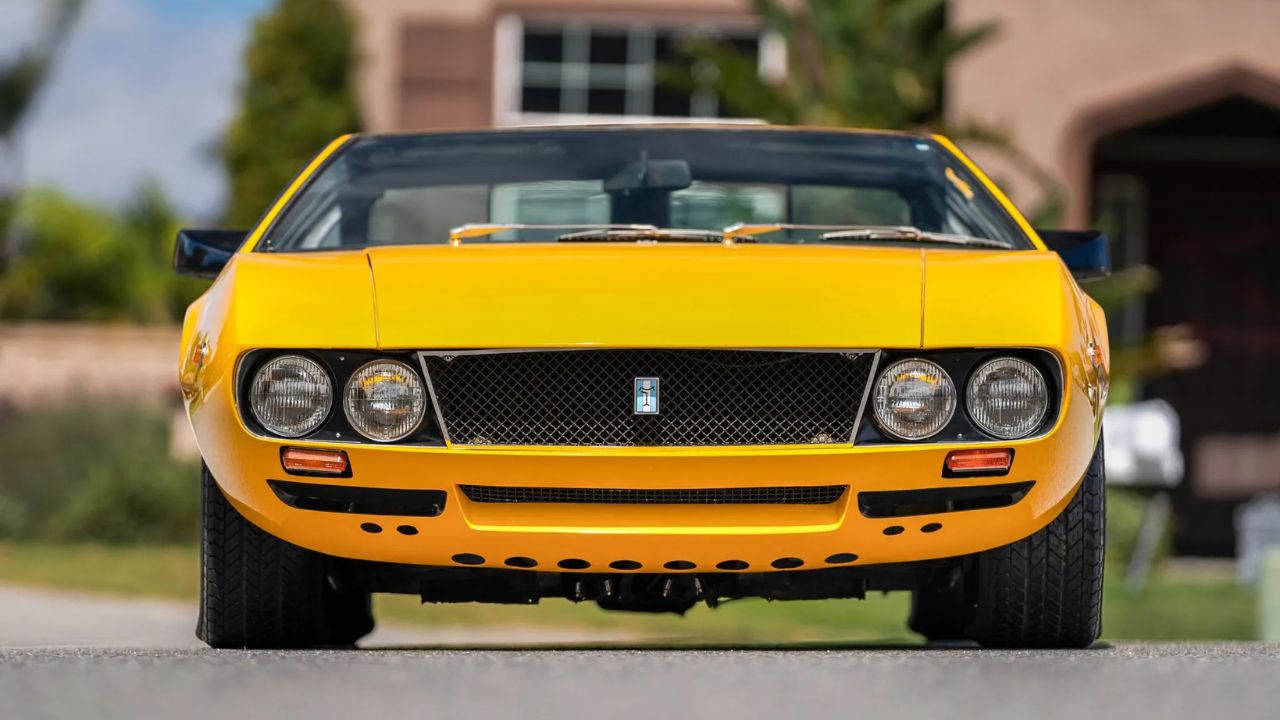
The 1969 De Tomaso Mangusta occupies a rare space in automotive history where sculpture and speed share equal billing. Built in small numbers and shaped by one of Italy’s most influential designers, it distills the late‑1960s fascination with mid‑engine performance into a low, dramatic form that still looks startlingly modern. For collectors and drivers alike, it represents a moment when a boutique manufacturer tried to fuse Italian style with American power in a package that remains both alluring and flawed.
What happened
Interest in the De Tomaso Mangusta has surged as collectors search beyond the familiar names of Ferrari, Lamborghini, and Porsche. A recent listing of a 1969 Mangusta highlighted just how far the car has come from obscure curiosity to blue‑chip classic. Finished in a period‑correct color with a carefully preserved interior, the car drew attention not only for its condition but also for what it represents: a short‑lived experiment that captured the ambition of Alejandro de Tomaso and the flair of designer Giorgetto Giugiaro.
The Mangusta arrived in the late 1960s as De Tomaso’s bold move into the world of mid‑engine sports cars. The company had already produced smaller, more specialized machines, yet the Mangusta was conceived as a serious performance car aimed at the same clientele who might consider a Lamborghini Miura or a Ferrari 275 GTB. Production remained limited, with only a few hundred examples built over several years, which has helped turn surviving cars into prized artifacts of that era.
At its core, the Mangusta was a transatlantic hybrid. De Tomaso sourced a Ford V‑8, a decision that balanced cost, reliability, and power in a way that more exotic Italian engines often could not. The engine sat behind the driver, ahead of the rear axle, in keeping with the new mid‑engine orthodoxy that had already transformed racing and was beginning to reshape road‑car design. The car’s name, which translates to “mongoose,” hinted at a rivalry with the Shelby Cobra and signaled De Tomaso’s intent to build something capable of standing up to established performance legends.
Visually, the Mangusta stood apart for its bodywork. Giugiaro, then working at Ghia, wrapped the chassis in a low, sharp‑edged shell with a long, pointed nose and a cabin pushed far forward. The most distinctive element was the pair of gullwing‑style rear engine covers that opened like a split clamshell, turning routine maintenance into a theatrical moment. The Mangusta sat extremely low, with a wide stance and a beltline that seemed to rise only slightly from nose to tail, giving it a profile more like a prototype racer than a road car.
The car that recently surfaced for sale crystallized those design traits. Its proportions, from the wedge‑like front to the truncated tail, remained intact, underscoring how little the Mangusta’s shape has aged. Details such as the slim chrome bumpers, delicate side glass, and simple, round gauges inside the cabin spoke to a period when safety regulations and mass‑production constraints had not yet dulled the edges of sports‑car design. Even at a standstill, the car projected a sense of motion and drama that helps explain why collectors now treat it as a piece of functional art.
Why it matters
The renewed attention around the Mangusta matters because it highlights a broader shift in how enthusiasts value classic cars. For years, the market focused on more famous badges, leaving smaller manufacturers like De Tomaso in a kind of historical shadow. As prices for the best‑known Italian and German exotics climbed, collectors began to look for cars that delivered similar emotional impact with a different story. The Mangusta fits that brief, combining a recognizable Ford powertrain with Italian coachwork and a backstory that ties into both racing and design history.
From a design perspective, the Mangusta marks a turning point between the rounded forms of early 1960s sports cars and the sharp, angular language that would dominate the 1970s. Giugiaro’s work on the car foreshadowed the wedge aesthetic he later refined on models such as the Maserati Bora and the Lotus Esprit. The Mangusta’s low nose, crisp character lines, and almost flat surfaces gave it a futuristic look at the time, and those same qualities now read as a clear statement of where sports‑car styling was headed.
The car also illustrates how small manufacturers navigated the tension between artistry and practicality. De Tomaso chose a Ford V‑8 not only for cost reasons but also to make the car easier to live with for buyers who might be intimidated by the complexity of a hand‑built Italian engine. Parts availability and serviceability were real selling points, particularly for customers in North America. That decision created a contrast between the Mangusta’s exotic appearance and its relatively straightforward mechanical heart, a combination that still appeals to owners who want the drama of an Italian coupe without the same level of mechanical risk.
Performance figures from period tests placed the Mangusta firmly in the upper tier of its contemporaries. The car’s power output and top speed compared favorably with rivals from Ferrari and Lamborghini, although its chassis and weight distribution drew mixed reviews. Much of the criticism centered on the car’s tendency toward tricky handling at the limit, a byproduct of its rear‑biased weight and suspension setup. For modern collectors, those quirks are part of the car’s character, but they also serve as a reminder that not every beautiful object of the era was fully resolved dynamically.
Rarity amplifies the Mangusta’s significance. With production numbers far below those of more mainstream exotics, each surviving car carries a larger share of the model’s history. Many examples have been modified, neglected, or lost over the decades, which makes well‑preserved or carefully restored cars especially valuable. The recent auction spotlighted how a clean, original‑spec Mangusta can command serious attention, both from seasoned collectors and from younger enthusiasts discovering the marque for the first time.
The car’s place in De Tomaso’s own trajectory adds another layer of importance. The Mangusta set the stage for the later Pantera, which would refine the formula of Italian design plus Ford power and reach a wider audience through a closer relationship with Ford. Without the Mangusta’s lessons in packaging, engineering, and market positioning, that later success might not have materialized in the same way. In that sense, the Mangusta functions as both a design statement and a developmental stepping stone.
The interior of the Mangusta reinforces its dual identity as both a driver’s tool and a style object. The cabin is compact, with a low roofline and a high central tunnel, yet the layout is straightforward. Large analog gauges sit directly in front of the driver, while simple switchgear and minimal ornamentation keep the focus on driving. Original cars often retain period details such as wood‑rimmed steering wheels, slender seats, and thin‑pillar glass that floods the cockpit with light. These features capture a level of simplicity that later, more heavily regulated cars could not maintain.
For historians of automotive culture, the Mangusta also captures the mood of its time. The late 1960s saw a surge of optimism around performance technology, with mid‑engine layouts migrating from the racetrack to the road. Manufacturers experimented freely with materials, shapes, and mechanical concepts. The Mangusta’s bold silhouette, dramatic engine access, and unapologetically low stance align with that spirit of experimentation. At the same time, the car’s limited production and eventual replacement by the Pantera reveal the economic constraints that boutique makers faced when trying to compete on a global stage.
The car’s growing profile in auctions and private sales has another effect: it pushes restoration standards higher. Owners who once viewed the Mangusta as a niche curiosity now approach it with the same level of care applied to more famous exotics. That means greater attention to correct finishes, original components, and factory specifications. As more information circulates about chassis numbers, build variations, and period colors, the model’s history becomes clearer and more accessible, which in turn supports its long‑term value.
What to watch next
The immediate question for observers is how far the Mangusta’s market trajectory will go. Prices have already moved upward as awareness grows, yet the car still sits below the most expensive Italian exotics of its era. If demand continues to rise, especially among younger collectors who value distinctive design and a compelling story, the Mangusta could close some of that gap. Much will depend on how many high‑quality examples reach public auctions versus trading quietly in private sales.
Another area to watch is how owners balance originality and usability. Some Mangustas have been modified to address known handling issues or to improve cooling and reliability. These changes can make the cars more enjoyable on modern roads, yet they also move them away from factory specification. As values climb, the tension between preservation and modification will intensify. Collectors may increasingly favor cars that retain their original configuration, while drivers who prioritize road manners might continue to pursue discreet upgrades.
The availability of parts and specialist knowledge will also shape the Mangusta’s future. While the Ford V‑8 simplifies engine maintenance, the rest of the car relies on components that are far less common. Bodywork, interior trim, and specific chassis parts can be difficult to source or reproduce correctly. As more restoration shops gain experience with the model, and as owners share technical information, the barrier to bringing tired cars back to life should gradually fall. That, in turn, could increase the number of Mangustas seen at events and on the road.
Attention from major concours and classic‑car gatherings is likely to grow as well. The Mangusta already appears at high‑profile shows, but it has not yet reached the saturation level of some contemporaries. Curators and judges who want to showcase the diversity of late‑1960s design may feature the car more prominently in themed classes that highlight mid‑engine innovation or the work of Giugiaro. Each such appearance enhances the model’s cultural visibility and reinforces its status as more than a curiosity from a defunct brand.
On the design front, the Mangusta’s influence is being rediscovered by a new generation of stylists and enthusiasts. The car’s clean surfaces, minimal ornamentation, and strong proportions align with a broader appreciation for analog, driver‑focused machines. As modern manufacturers experiment with retro‑inspired models, elements reminiscent of the Mangusta’s wedge profile and dramatic engine access may surface in concept cars or limited‑run specials. Even if those echoes remain subtle, the renewed conversation around the Mangusta helps keep mid‑century Italian design in the spotlight.
There is also the question of how the Mangusta will fit into a collector landscape that is gradually adapting to electrification and changing attitudes toward combustion engines. For some buyers, the appeal of a classic V‑8 sports car may grow stronger as such cars become more distinct from contemporary offerings. The Mangusta’s blend of visual theater and mechanical simplicity positions it as a compelling counterpoint to modern, technology‑laden performance cars. That contrast could become one of its strongest selling points in the years ahead.
Moe From Fast Lane Only: