The 1969 Ford Galaxie 500 arrived at a moment when American highways were long, fuel was cheap, and drivers expected to cross states in a single sitting. It was not the flashiest Ford of its era, yet it was engineered, trimmed, and marketed for the kind of distance work that turned family vacations into thousand-mile tests of comfort. Today, that focus on relaxed speed and durability helps explain why the Galaxie 500 has shifted from background player to quiet favorite among long-haul classic enthusiasts.
Viewed from half a century away, the car captures a specific idea of travel: big-displacement power, a softly tuned chassis, and a cabin meant to be lived in for hours. The 1969 model in particular sits at the crossroads of full-size luxury and emerging muscle, making it a revealing study in how Detroit built cars to devour interstate miles.
Big-body Ford, big-country mission
Ford launched the Galaxie line at the start of the 1960s as its full-size flagship, a car that would sit above the Fairlane and Falcon in size, price, and presence. Earlier versions had already proven that the formula worked. By the mid decade, the Galaxie 500 badge signaled a higher trim level with more chrome, more sound insulation, and more power, a combination that helped the model earn a reputation as a comfortable high-speed cruiser on American freeways.
Performance variants showed that the basic platform could handle serious work. In 1963, Ford offered an R-code 427 cubic inch V8 in the Galaxie 500, a factory drag-strip weapon that hid its capability under a bench seat and formal roofline. Cars like the R-code Galaxie proved that the chassis, brakes, and driveline could cope with sustained high speeds, whether on a quarter-mile strip or a turnpike.
By 1969, the Galaxie 500 had grown into a long, low, and relatively cleanly styled full-size car. It rode on a wheelbase that stretched over 119 inches, with a body that pushed past 210 inches overall. That footprint was not a styling indulgence. It allowed Ford engineers to package a spacious interior, a large trunk, and a stable, forgiving suspension that suited long interstate runs more than tight city streets.
Engines tuned for the open road
The powertrain choices in 1969 tell a clear story about intended use. Buyers could select from a range of big-block V8s, starting with a 351 cubic inch engine and climbing through 390 and 428 cubic inch options. These engines emphasized torque over peak horsepower, which made sense for a car expected to carry four or five people, luggage, and perhaps a boat or camper behind it.
Contemporary accounts of Galaxie ownership highlight how these engines worked in real life. Instead of screaming at high revs, they pulled smoothly from low rpm, which meant fewer downshifts and less fatigue for the driver. The availability of tall rear axle ratios further reduced engine speed at highway cruise, cutting noise and vibration. For families who might spend eight hours between fuel stops, that quiet, unhurried character mattered as much as acceleration times.
Ford’s earlier racing efforts with the 427-powered Galaxies also fed back into durability. Long-term storage finds, such as a 427 Galaxie 500 brought back to life after decades, show how stout the big-block hardware could be when maintained. While the average 1969 Galaxie 500 buyer did not order a racing engine, they benefited from a parts bin and engineering culture shaped by high-stress use.
Ride comfort as a design priority
Where smaller muscle cars chased cornering grip, the 1969 Galaxie 500 prioritized isolation. The car sat on a full perimeter frame with coil springs and soft shock tuning that soaked up expansion joints and patched pavement. Period road tests described a floating sensation at speed, with steering that felt light but predictable. Body roll in corners was noticeable, yet that trade-off paid dividends in straight-line comfort.
The cabin followed the same philosophy. Wide bench seats in many Galaxie 500s created a living-room feel, with generous legroom front and rear. Upholstery choices leaned toward durable vinyl or cloth rather than fragile performance fabrics. Sound deadening materials in the floor, firewall, and doors helped mute both engine and road noise, a key factor in reducing fatigue on long trips.
Ford’s attention to highway usability extended to small details. Large, clear gauges were easy to read at a glance, and the long hood and fenders provided a stable visual reference at speed. On many cars, air conditioning, power steering, and power brakes turned cross-country drives into manageable chores rather than endurance tests. These were not exotic technologies, but their integration into a full-size package created a car that excelled at sustained travel.
Body styles that matched long-distance life
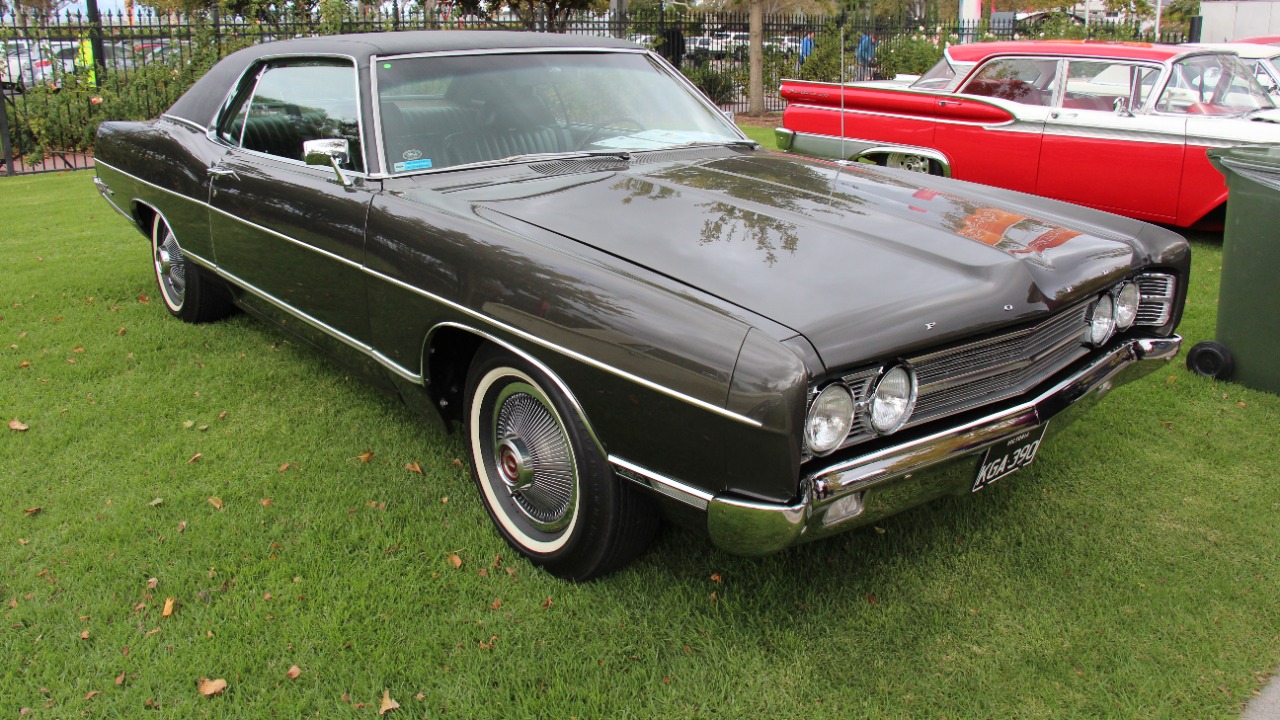
The 1969 Galaxie 500 lineup covered sedans, hardtops, and convertibles, but the fastback-inspired XL SportsRoof captured the era’s blend of style and practicality. The XL package added bucket seats, sportier trim, and a more aggressive roofline, yet it still sat on the same long wheelbase and shared the same generous trunk. A well-preserved 1969 XL SportsRoof illustrates how the model could look almost like a personal luxury coupe while still functioning as a true full-size tourer.
Drivers who wanted open-air travel could choose the convertible, though the hardtop and sedan remained more common for long-distance use. Their fixed roofs provided better insulation, less wind noise, and greater structural rigidity, all useful qualities when a car spends more time on freeways than on local boulevards.
The Galaxie 500’s sheer size also translated into practical cargo space. Families could load suitcases, coolers, and camping gear into the trunk without resorting to roof racks or trailers. That capacity, combined with the car’s towing capability, made it a favorite for vacationers hauling small boats or pop-up campers.
Highway heritage and the muscle car shadow
Despite its strengths, the Galaxie 500 has often lived in the shadow of smaller, more famous Fords. Enthusiast attention tends to gravitate toward Mustangs and Torino-based muscle cars, which offer sharper handling and a stronger connection to drag racing and street performance. Commentators have described the Galaxie 500 as a kind of forgotten muscle-adjacent model, a car with serious power options that rarely gets mentioned alongside the headline-grabbing nameplates. One analysis of Ford’s performance history even labels it the muscle car nobody, precisely because its full-size dimensions and comfort focus do not fit the usual narrative.
That relative obscurity has had side effects. For years, Galaxie 500 values lagged behind more compact performance cars, even when equipped with big-block engines. Collectors chasing quarter-mile legends often overlooked the full-size Fords, leaving them to budget-minded enthusiasts who appreciated their highway manners more than their resale potential.
Yet the model’s reputation as a capable long-distance car never fully disappeared. Stories of owners driving Galaxies across multiple states, sometimes towing additional weight, helped sustain a quiet fan base. Those drivers valued the car’s stability at speed, its forgiving ride, and its ability to carry people and cargo without drama.
Market signals from earlier Galaxies
Recent market data on early 1960s Galaxies hints at how collectors are reassessing the entire line. A review of 1960 to 1964 models found that values for certain configurations, especially well-optioned Galaxie 500s, have climbed significantly over the past decade. Analysts tracking Galaxie values describe a clear upward trajectory, driven by renewed interest in full-size American cruisers and nostalgia for early space-age styling.
While that data focuses on earlier years, it influences perceptions of the 1969 generation. As collectors price out early 1960s cars, some turn to later Galaxies as more affordable entry points into the same basic experience. They still get a big-body Ford with a torquey V8 and a highway-friendly ride, but at a lower acquisition cost and with slightly more modern safety and comfort features.
Market observers also note that full-size sedans and hardtops often trail their two-door performance counterparts in value, which can make the 1969 Galaxie 500 a practical choice for enthusiasts who want to drive rather than speculate. The car’s long-distance strengths become a selling point rather than an afterthought.
Enthusiast builds that highlight distance capability
Modern owners are not limited to stock configurations. Some have rebuilt Galaxie 500s specifically as long-haul machines, upgrading suspension components, brakes, and drivetrains while preserving the car’s essential character. A notable example involves a mid 1960s Galaxie 500 built to drive from coast to coast, with its owner focusing on reliability, fuel capacity, and comfort features rather than raw performance. That project, documented as a coast-to-coast build, underscores how the platform lends itself to serious distance use.
Such builds often retain the original bench seats or period-correct upholstery, but add modern sound systems, overdrive transmissions, and upgraded cooling systems. The result is a car that can cruise at contemporary freeway speeds with reduced engine stress and lower cabin noise, all while maintaining the visual presence of a classic full-size Ford.
These projects also highlight the availability of parts and community knowledge. Because the Galaxie 500 shared components with other Ford models of its era, owners can source mechanical pieces without the scarcity issues that plague some low-volume classics. That practicality encourages drivers to put real miles on their cars rather than keeping them as static showpieces.
Design language built for the interstate
The 1969 Galaxie 500’s styling reflects its highway mission. The body features long, horizontal lines that visually emphasize length and stability. The front fascia is broad and relatively uncluttered, with a wide grille that suggests width and presence in the rearview mirrors of slower traffic. The rear quarters taper gently, helping the car look poised rather than bulky.
Inside, the dashboard sweeps across the cabin in a gentle arc, with controls clustered within easy reach of the driver. The layout favors straightforward ergonomics over novelty. Large steering wheels and column shifters on many cars leave the front bench open, which enhances comfort on long trips and allows passengers to shift positions as fatigue sets in.
Compared with more flamboyant designs of the late 1950s, the 1969 Galaxie 500 feels restrained, almost minimalist for its size. That restraint suits a car intended to disappear into the background of a long journey, providing a stable and predictable environment rather than constant visual drama.
From family workhorse to collectible cruiser
As the decades have passed, many original Galaxie 500s have disappeared through rust, accidents, or simple neglect. Survivors often come from families that used the cars for exactly the sort of long-distance work they were built to handle. Barn-find stories, like the rediscovery of long-stored Galaxie 500s that return to the road with minimal mechanical drama, reinforce the model’s reputation for durability.
Enthusiast coverage has helped raise the car’s profile. Features on the Galaxie 500 as a classic worth revisiting emphasize its blend of comfort, style, and understated performance. Writers point out that while it lacks the sharp-edged image of smaller muscle cars, it offers a driving experience that suits real-world roads and modern traffic conditions surprisingly well.
More from Fast Lane Only
- Unboxing the WWII Jeep in a Crate
- 15 rare Chevys collectors are quietly buying
- 10 underrated V8s still worth hunting down
- Police notice this before you even roll window down
*Research for this article included AI assistance, with all final content reviewed by human editors.