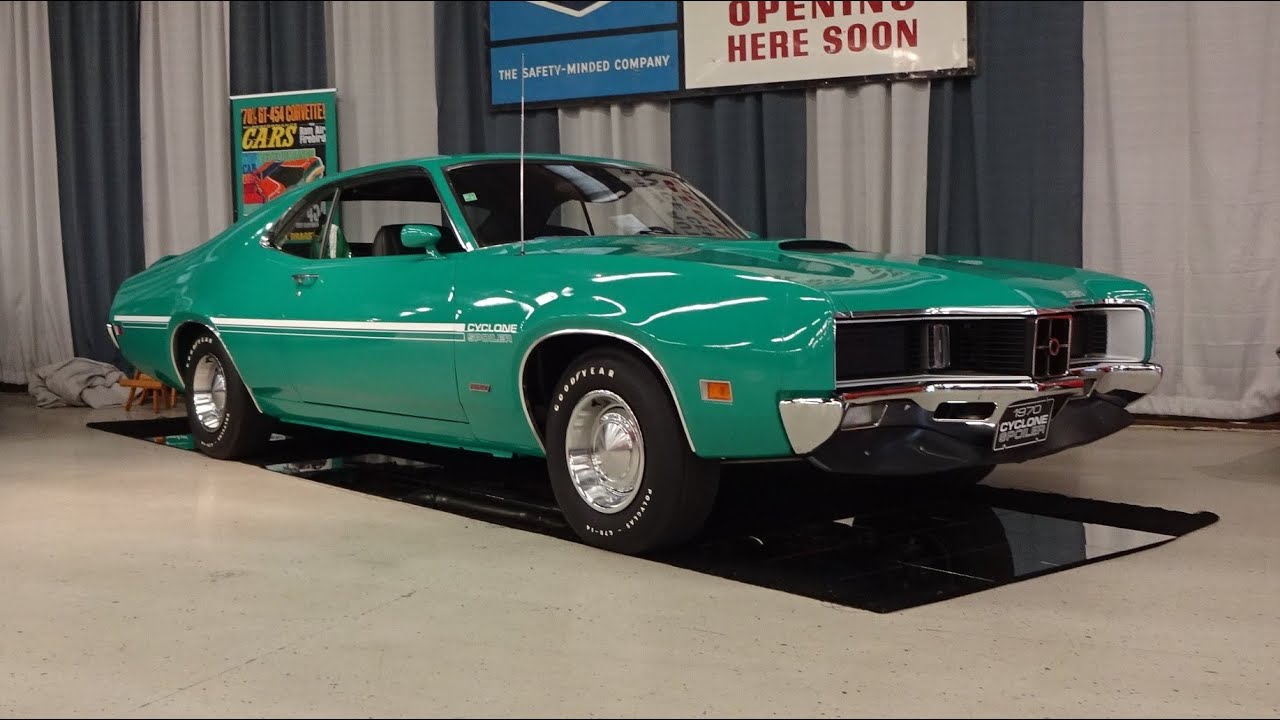
The 1970 Mercury Cyclone Spoiler occupies a curious niche in muscle car history. On paper it had the power, aerodynamics, and racing pedigree to stand alongside the era’s legends, yet it slipped into obscurity while its Ford cousins soaked up the spotlight. Built to chase stock car trophies as much as boulevard bragging rights, it was engineered less as a vanity project and more as a purpose-built rocket.
More than half a century later, that mix of speed and intent is finally getting the attention it missed when new. From NASCAR-inspired bodywork to ultra-rare Super Cobra Jet hardware, the Cyclone Spoiler now looks like one of the clearest examples of how Detroit tried to turn racing technology into something a customer could actually buy.
What happened
Introduced for 1970, the Mercury Cyclone Spoiler was the brand’s most aggressive take on the intermediate muscle formula. Based on the Cyclone, the Spoiler package added a wind-cheating nose, rear spoiler, bold striping, and a menu of serious big-block engines that pushed it directly into the orbit of Ford’s Boss Mustangs and Torino Talladegas. Period figures for the 429 cubic inch V8s routinely topped 350 horsepower, and the car’s long, pointed front end made clear that straight-line speed was its primary mission.
Contemporary coverage and later retrospectives describe the Cyclone Spoiler as Mercury’s forgotten counterpart to the better known Ford heroes. One detailed review of Mercury’s forgotten muscle notes that the car shared its engine family and much of its performance DNA with the Boss Mustang, yet never earned the same name recognition. While Ford pushed the Mustang as the brand’s halo performance car, Mercury tried to carve out its own niche with a more mature, full-size-feeling missile that still had track credibility.
At the top of the range sat the 429 Super Cobra Jet, a heavily fortified version of Ford’s big-block built for sustained high rpm punishment. In Cyclone Spoiler trim, this engine could be paired with a Drag Pak style setup that included a performance rear axle ratio, heavy-duty cooling, and components tuned for quarter-mile launches. A deep dive into one surviving 429 Super Cobra car describes factory hardware such as the oil cooler, four-bolt main block, and aggressive camshaft that made the SCJ package far more than a cosmetic upgrade.
Production numbers were low from the start. Reports on an ultra-rare Cyclone Spoiler highlight how few cars left the factory with the full 429 Super Cobra Jet and Drag Pak combination, especially when combined with specific colors and options. Exact totals vary by configuration, but every credible account places these cars at the thin edge of Mercury’s already limited muscle output in 1970.
The Cyclone Spoiler’s purpose-built character extended beyond the showroom. Law enforcement agencies also saw potential in the car’s straight-line performance. A report on a decaying Cyclone Spoiler police describes a car ordered with heavy-duty hardware for highway duty, then left to rot in a bayou alongside first-generation Chevrolet Camaros. The existence of a Cyclone in police trim underscores how the model’s speed was not just for weekend drag strips but also for real-world pursuit work.
Despite this capability, the Cyclone Spoiler faded quickly from the public eye. Insurance costs for high horsepower cars spiked, emissions regulations tightened, and the broader muscle market began to cool. Mercury, already positioned as a more upscale and conservative brand within Ford’s portfolio, shifted focus away from such overtly aggressive models. The Cyclone name itself would not survive much longer, and the Spoiler package became a short-lived experiment rather than a long-term fixture.
Why it matters
The 1970 Cyclone Spoiler matters today because it captures a specific moment when American manufacturers tried to turn racing technology into something street legal yet still usable as a family car. It is a time capsule of how far Detroit was willing to go in pursuit of speed, even under a more restrained badge like Mercury. While Ford’s own NASCAR specials and pony cars grabbed the headlines, the Cyclone Spoiler quietly carried similar hardware in a package that looked more like a full-size highway bruiser.
Modern rankings of forgotten performance icons often place the Cyclone Spoiler among the fastest muscle cars of its era. One survey of forgotten 1960s and lists the model alongside better known heavy hitters, emphasizing how its quarter-mile times and trap speeds matched or beat cars that now command far more attention and money. The combination of a torquey 429, steep axle ratios, and relatively slippery bodywork gave the Cyclone Spoiler the kind of straight-line performance that still reads as serious today.
From a design standpoint, the car shows how Mercury tried to differentiate itself within the Ford family. While the Mustang leaned on compact proportions and youthful marketing, the Cyclone Spoiler presented a longer, more aggressive front clip and a pronounced rear spoiler that owed as much to stock car racing as to showroom fashion. The nose cone and integrated grille treatment were not just styling flourishes; they were attempts to reduce drag and improve stability at the kind of speeds that big-block intermediates could reach on long American highways and oval tracks.
The Super Cobra Jet version, in particular, has become a touchstone for collectors who value engineering depth over sheer production volume. The SCJ package represented a factory acknowledgment that some buyers wanted a car that could survive repeated hard launches and sustained high-speed runs. Features such as the external oil cooler and strengthened internals were not common on typical street cars, and their presence on a Mercury-branded coupe shows how thoroughly performance fever had spread by 1970.
Rarity also shapes the car’s modern significance. With production of the Cyclone Spoiler already limited and the SCJ subset even smaller, surviving examples are now prized both for their scarcity and for the story they tell about Mercury’s ambitions. The contrast between pampered show cars and the neglected police interceptor sinking into the bayou underlines how thin the line can be between collectible artifact and forgotten workhorse. Two cars built with similar intent can meet radically different fates depending on ownership, maintenance, and simple luck.
For enthusiasts, the Cyclone Spoiler challenges the usual hierarchy of muscle car legends. It asks why some cars, like the Boss Mustang, became household names, while others with comparable performance and more focused purpose drifted into obscurity. Marketing budgets, motorsport exposure, and brand positioning all played roles. Mercury never had the cultural cachet of Ford’s pony car, and the Cyclone name did not carry the same emotional weight. Yet when measured purely on hardware and intent, the Spoiler belongs in the same conversation.
The car also illuminates how law enforcement and performance engineering intersected at the height of the muscle era. Agencies that ordered Cyclone Spoilers for highway patrol duty were effectively betting on big-block power and aerodynamic tweaks to keep up with increasingly fast civilian traffic. That decision reflects a time when the line between a street racer and a police interceptor could be as thin as a few option codes and a different paint scheme.
In the broader narrative of automotive history, the 1970 Cyclone Spoiler serves as a reminder that speed alone does not guarantee long-term fame. Context, timing, and brand identity matter just as much. The car arrived near the end of the first muscle wave, just as external pressures were about to reshape the industry. Its aggressive styling and big power were slightly out of step with the coming focus on fuel economy and emissions, which meant that later generations saw it less on the road and more in old photographs and scattered survivor stories.
What to watch next
Interest in the 1970 Mercury Cyclone Spoiler has grown as collectors and historians reexamine cars that once lived in the shadow of better known nameplates. Auction listings for well documented SCJ examples now attract attention that would have been unthinkable when these cars were simply used performance machines. As more enthusiasts look beyond the standard roster of Chevelles, Chargers, and Mustangs, models like the Cyclone Spoiler stand to benefit from a reassessment of what defines a significant muscle car.
One area to watch is how surviving police-spec and high-option cars are treated as restoration candidates. The bayou-sunk interceptor shows the worst-case scenario, where valuable hardware is left to decay beyond realistic rescue. At the same time, stories of carefully preserved or painstakingly restored Cyclone Spoilers illustrate how much effort some owners are now willing to invest in saving these machines. The gap between those extremes will shape how many examples remain for future generations.
Documentation and provenance will also become more important. Because production numbers were low and factory records can be fragmented, verifying an authentic SCJ or Drag Pak Cyclone Spoiler requires careful attention to casting codes, build sheets, and period-correct components. As values rise, so does the incentive to clone or misrepresent cars, which means buyers and historians will need to rely on detailed research rather than surface appearances.
From a cultural perspective, the Cyclone Spoiler may continue to gain visibility as media projects, museum exhibits, and enthusiast events broaden their focus beyond the usual icons. When a car with this level of performance and purpose starts appearing more often at major shows or in curated collections, it challenges audiences to rethink what the muscle era looked like. The presence of a Mercury among the more familiar GM and Ford stars adds texture to that story and highlights how competitive the field really was.
There is also room for renewed technical appreciation. As more builders and restorers highlight the engineering behind the 429 Super Cobra Jet and its supporting hardware, the Cyclone Spoiler can serve as a case study in how manufacturers balanced durability and raw power. The car’s role as both street machine and potential competition platform makes it a useful reference point for anyone studying the evolution of American V8 performance in the late 1960s and early 1970s.
Looking ahead, the biggest factor in the Cyclone Spoiler’s legacy will likely be how enthusiasts choose to use the cars that remain. Some owners will continue to keep mileage low and focus on preservation, treating their Spoilers as static investments or museum pieces. Others may lean into the car’s original mission and keep driving them hard on drag strips and open roads. Each approach carries tradeoffs for wear, originality, and public visibility, but together they ensure that the car’s story does not freeze in place.
As the collector market matures and younger enthusiasts gain influence, there is a good chance that interest will continue to shift toward distinctive, purpose-driven models that offer more than just a familiar badge. The 1970 Mercury Cyclone Spoiler fits that description precisely. It was built for speed, shaped by racing, and constrained by its moment in history. Whether parked under bright auction lights or half-buried in a swamp, it represents a version of American performance that was as serious about purpose as it was about style.
More From Fast Lane Only: