The 1975 Pontiac Firebird Trans Am arrived at a difficult moment for American performance cars, yet it managed to adapt without surrendering the visual drama that made it a street icon. Power numbers fell, regulations multiplied, and rivals faded, but the Trans Am kept its attitude intact and even sharpened its identity.
Viewed today, the 1975 model marks a turning point where the Firebird shifted from pure muscle machine to style-forward grand tourer, while still offering enough performance and personality to remain credible with enthusiasts.
What happened
By the mid 1970s, federal emissions rules, unleaded fuel, and new safety standards had reshaped the American car market. General Motors responded by detuning engines, adding catalytic converters, and recalibrating gearing across its lineup. The Pontiac Firebird and its Chevrolet Camaro sibling entered what many enthusiasts call their “smog era,” when output figures dropped sharply and quarter-mile bragging rights became harder to claim.
For Pontiac, the 1975 Firebird Trans Am was the first of the second-generation cars to rely fully on catalytic converters and lower compression ratios. The legendary 455 cubic inch V8 that had powered earlier Trans Ams was on borrowed time, and the high-compression, high-lift cam combinations of the early 1970s were no longer viable under tightening regulations. In response, Pontiac engineers shifted focus from raw horsepower to drivability, torque, and refinement. They reworked cam profiles, exhaust routing, and ignition curves to keep the car responsive even as official horsepower ratings slid downward.
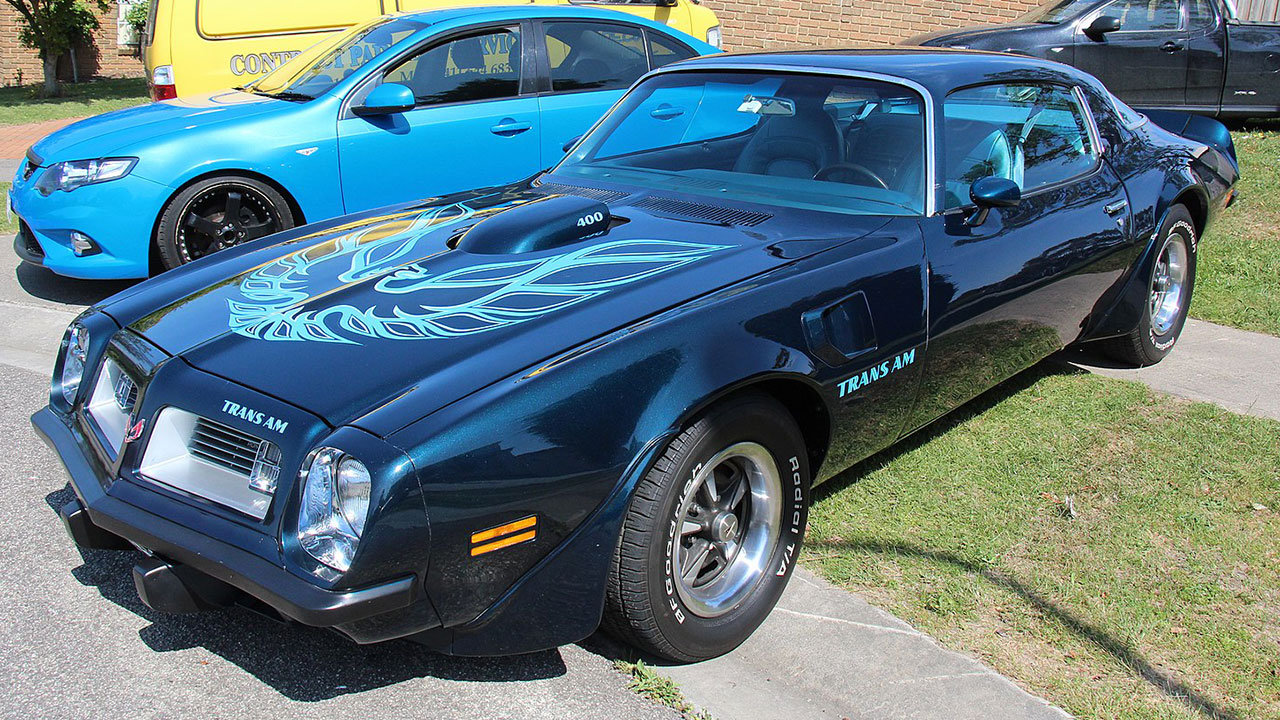
Styling became more important than ever. The 1975 Trans Am retained the aggressive Endura nose, the shaker hood scoop, and the muscular fender lines that separated it from more modest Firebird trims. It also continued the bold graphic treatments that had already become a signature of the model. The “screaming chicken” hood decal, a defining symbol of the Trans Am identity, remained available in vivid colors and large scale, turning the car into a rolling billboard for Pontiac performance. Those visual cues signaled continuity at a time when the mechanical package was in flux, and they helped anchor what enthusiasts understood as the true meaning of the Trans Am badge.
The chassis also evolved in quiet but meaningful ways. Pontiac refined suspension tuning to balance ride comfort with cornering stability, taking advantage of the Firebird’s relatively low stance and wide track. Revised spring rates, anti-roll bars, and tire choices helped the 1975 Trans Am feel more planted than some earlier, more powerful versions. The result was a car that might have given up straight-line dominance but gained a more modern, all-around character.
Why it matters
The 1975 Trans Am sits at the center of a broader story about how American pony cars survived their darkest days. As emissions rules tightened and fuel prices rose, many performance models either vanished or retreated into mild appearance packages. The Firebird and Camaro, however, stayed in production, in part because General Motors found ways to keep them desirable even when raw numbers no longer impressed on paper. Analysts who have looked at how the pair survived their darkest point to a mix of styling continuity, incremental engineering improvements, and a clear sense of identity.
For the Trans Am, that identity was anchored in a few key ingredients. The car kept its rear-wheel-drive layout, long hood, and short deck proportions, which preserved the classic muscle-car silhouette. Pontiac also leaned into visual theatrics: flared wheel arches, front and rear spoilers, functional or semi-functional air intakes, and that unmistakable hood bird. In addition, the brand cultivated a performance image through option packages that bundled suspension upgrades, limited-slip differentials, and performance tires, allowing buyers to spec a car that still felt serious even if the brochure horsepower figure looked modest compared with earlier years.
This strategy mattered for more than nostalgia. By keeping the Trans Am recognizable and aspirational, Pontiac maintained a bridge between the original muscle era and the performance resurgence that would follow in the late 1970s and 1980s. The 1975 model helped carry the torch through a regulatory transition, so later cars could capitalize when technology caught up and allowed higher output within the new rules. Without that continuity, the Firebird nameplate might have disappeared or returned as a very different kind of car.
The 1975 Trans Am also shows how styling can become a form of resistance. Enthusiasts who bought the car knew that a showroom-stock example no longer dominated drag strips, yet they still gravitated to its aggressive look and heritage cues. The car’s presence, from the shaker scoop to the honeycomb wheels, signaled a refusal to let performance culture fade. Owners could modify engines, swap cams, or tune carburetors, but they needed a platform that still looked the part. Pontiac delivered that platform, even in a constrained environment.
Today, collectors and historians often reassess mid-1970s Trans Ams with more sympathy than they once did. While earlier judges dismissed them as pale reflections of their predecessors, current perspectives recognize the engineering work that went into balancing emissions compliance with usable performance, as well as the design discipline that kept the car instantly recognizable. The 1975 model, in particular, stands as a case study in how to evolve under pressure without losing the core of a brand.
What to watch next
Interest in mid-1970s Trans Ams has been rising as collectors look beyond the obvious high-water marks of the muscle era. Auction results and enthusiast forums show growing appreciation for cars that combine classic styling with more approachable performance and, often, lower entry prices. The 1975 Trans Am fits that profile, offering the look and feel of a second-generation Firebird with a slightly more relaxed demeanor that can make it easier to live with on modern roads.
Future attention is likely to focus on originality and specification. Cars that retain factory-correct graphics, interiors, and drivetrain combinations tend to attract the most serious interest, especially if they include desirable options such as upgraded suspension packages, distinctive color schemes, or rare wheel designs. At the same time, the 1975 Trans Am remains a popular canvas for tasteful modifications, including period-correct engine upgrades that restore some of the power lost to mid-1970s regulations while preserving the stock appearance.
There is also a broader cultural arc to watch. As younger enthusiasts discover the Firebird through media, games, and online communities, they often encounter later second-generation cars first, since those models appear frequently in pop culture. That exposure can lead them back to earlier and less celebrated years like 1975. The car’s combination of dramatic styling, analog driving feel, and manageable performance suits a generation that values character as much as outright speed.
From a historical perspective, the 1975 Trans Am will likely continue to gain recognition as a transitional figure. It marks the point where Pontiac proved that a performance badge could survive regulatory upheaval through design, branding, and careful engineering rather than brute force. As emissions and efficiency standards evolve again in the current era, manufacturers face similar questions about how to preserve identity while adapting to new constraints. The way Pontiac handled the Firebird in the mid 1970s offers a useful reference, even for companies now working with electric powertrains and advanced electronics.
For enthusiasts, the lesson is straightforward. The 1975 Pontiac Firebird Trans Am may not top the charts for factory horsepower, but it delivered continuity of style, a credible driving experience, and a strong sense of occasion at a time when many performance cars vanished altogether. That resilience, more than any single specification, explains why the model still commands attention and why its evolution is remembered as progress rather than retreat.
More From Fast Lane Only: