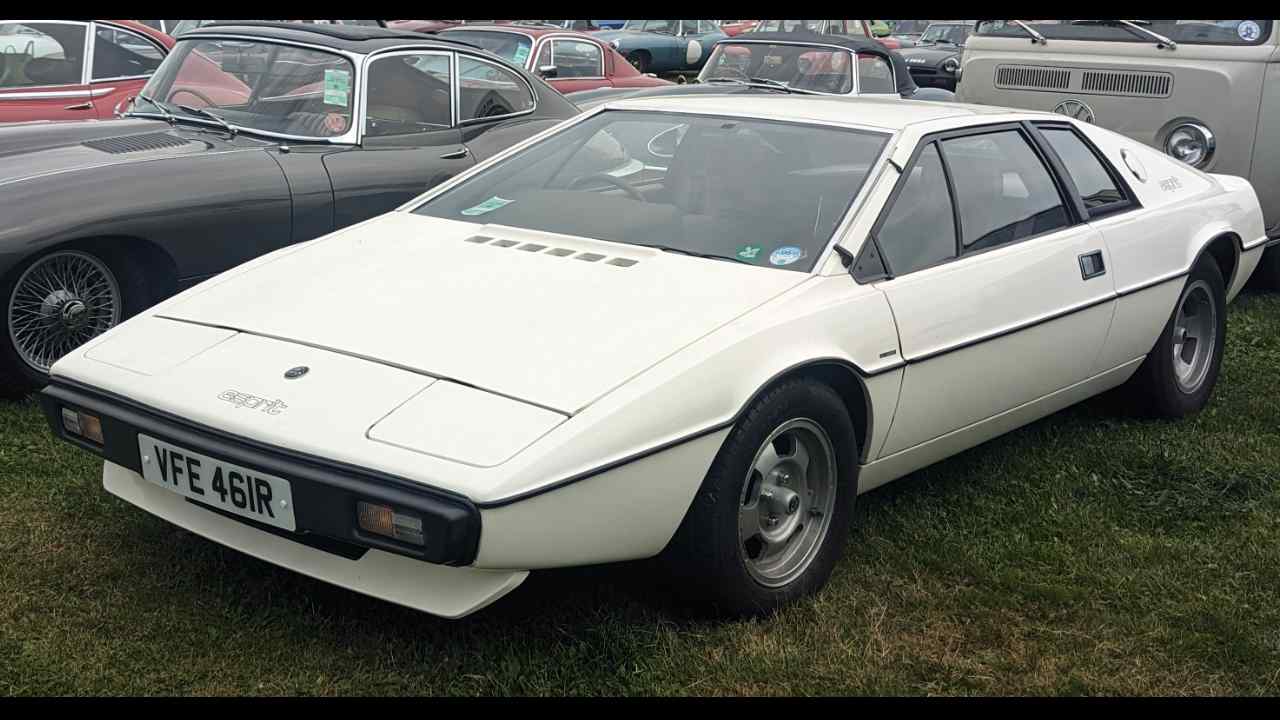
The 1976 Lotus Esprit arrived as a sharp-edged wedge of fiberglass and ambition, built around a simple idea: light weight, precise steering, and a chassis tuned for drivers who cared more about apexes than straight-line bragging rights. Its styling and movie cameos tend to grab the spotlight, but the car’s lasting reputation comes from how it behaves on a twisting road.
Nearly half a century later, enthusiasts still talk about the first Esprit as one of the clearest expressions of Colin Chapman’s philosophy of adding performance by subtracting mass. The original Series 1 did not have huge power or lavish luxury, yet it turned into corners with a clarity that many newer cars still struggle to match.
What happened
By the mid 1970s, Lotus wanted a flagship road car that would move the company beyond its earlier Europa and Elan models. The Esprit project started with a wedge-shaped concept sketched by Giorgetto Giugiaro and evolved into a mid-engined sports car built on a steel backbone chassis with a fiberglass body. The production car that reached buyers in 1976 used Lotus’s 2.0‑liter four-cylinder engine, placed behind the seats and ahead of the rear axle, to keep weight centered and low.
The basic ingredients were familiar to anyone who followed Lotus in motorsport. Its chassis used double wishbones and coil springs at the front, with a sophisticated rear suspension layout designed to keep the contact patches flat under load. The body shell was bonded to the backbone, which increased torsional rigidity without adding much mass. Period figures put the early Esprit at roughly 1,000 kilograms, significantly lighter than most contemporary rivals that chased similar performance.
This recipe gave the Esprit a very specific character. Contemporary testers described steering that felt immediate and accurate, along with a front end that responded cleanly to small inputs. The car’s mid-engine balance meant it could change direction quickly yet remain stable through long sweepers. Where some sports cars of the era leaned heavily on wide tires and brute force, the Esprit relied on geometry and low weight.
Later generations would build on that foundation. Updates through the 1980s and 1990s added turbocharging, revised suspension, and more power, but the underlying layout remained the same. The Esprit stayed mid-engined with a backbone chassis and composite body, preserving the agility that defined the original 1976 car. Enthusiast guides that look across the full production run still trace the car’s reputation for handling back to those first Series 1 examples that set the template for the platform.
This continuity is why modern buyers who study whether a classic Esprit is worth owning often focus on how the earliest cars drive. Even when they compare later turbocharged variants or the more refined models of the 1990s, they tend to treat the 1976 layout as the benchmark for the line’s dynamics. The car’s combination of lightness, steering feel, and mid-engine balance continues to shape how the Esprit is judged in the broader history of sports cars.
Why it matters
The first Esprit arrived in a decade when many performance cars were being blunted by emissions rules and weight gain. Against that backdrop, Lotus doubled down on Chapman’s mantra that a lighter car can brake, turn, and accelerate more effectively than a heavier one. The 1976 Esprit embodied that idea, and its handling became a reference point for later Lotus models and for other manufacturers that studied how to make mid-engined cars feel approachable rather than intimidating.
Modern overviews of Lotus history routinely place the Esprit among the company’s most significant road cars. Lists of the best Lotus models highlight the way the Esprit translated racing lessons into a usable road package, noting how its mid-engine layout and low mass gave it a level of agility that still stands out among classic Lotus cars. That reputation matters because it shapes how collectors and drivers value early examples today, especially the 1976 Series 1 that launched the nameplate.
For many enthusiasts, the Esprit represents a shift in how supercar-style performance could be delivered. It was exotic in layout and styling, yet it used a relatively small displacement engine and a focus on chassis tuning to deliver speed. That approach influenced later mid-engined cars that prioritized balance and communication over raw power figures. The Esprit showed that a car did not need a twelve-cylinder engine or towering rear wing to feel special on a mountain road.
The car’s cultural impact also amplifies its technical achievements. Appearances in high-profile films introduced a wide audience to the Esprit’s wedge profile and mid-engine stance. Those scenes often focused on spectacle, but they reinforced the idea that the Esprit belonged in the same conversation as more expensive Italian exotics. Underneath that image, however, was a car that earned respect from drivers who cared about steering feel and chassis feedback.
Contemporary buying guides that look at the Esprit across its many iterations still emphasize how the chassis behaves. Detailed breakdowns of the model’s evolution point out that even as later versions gained more power and equipment, the underlying appeal remained the way the car turned in and the confidence it gave a driver when driven hard. One such guide to the Esprit’s development traces that character directly back to the original Series 1 and its lightweight backbone construction.
Enthusiast-oriented reviews that revisit the Esprit today often compare it with modern sports cars that rely heavily on electronics and wide tires to manage their mass. In that context, the 1976 car feels refreshingly simple. There is no adjustable drive mode, no electric power steering, and no complex stability system. Instead, the driver interacts directly with the mechanical layout, which makes the quality of the underlying engineering more obvious. When a car that simple still feels composed and responsive decades later, it strengthens the case that its handling was genuinely well judged from the start.
The Esprit’s later life further reinforces the significance of the original chassis. As the model evolved into turbocharged and higher-performance versions, Lotus refined suspension geometry and damping but kept the same basic structure. Reviews of the more powerful variants, including the highly regarded S4 and S4s, often note that the car’s ability to handle additional power without losing balance comes from the strength of the original design. One assessment of the Esprit S4s describes how the later car’s composure and balance feel like a mature expression of the same qualities that defined the 1970s versions.
This continuity also affects how the Esprit is positioned among collectable classics. Buyers who want a car that feels alive on a back road often rank the Esprit alongside icons like the Porsche 911 and Ferrari 308. Guides that explain why an Esprit might be worth buying today emphasize not only its styling and rarity but also the way it rewards a committed driver. One such overview of reasons to buy points to its handling and driver involvement as key factors that separate it from more common sports cars of the same era.
There is also a historical thread that links the Esprit to later Lotus legends such as the Elise and Exige. Those cars pushed the lightweight philosophy even further, yet they built on the idea that a Lotus road car should feel like a precision tool rather than a blunt instrument. Retrospectives that look at the Esprit’s legacy often highlight how it bridged the gap between the earlier, more delicate Elan and the stripped-back Elise that would arrive in the 1990s. The 1976 car sits at the start of that lineage, which gives its handling qualities broader significance in the brand’s story.
From a technical perspective, the Esprit also illustrates how chassis tuning can offset modest power. The early 2.0‑liter cars did not produce especially high output, yet they could carry speed through corners that left heavier, more powerful rivals struggling. That lesson remains relevant for modern engineers who face tightening emissions rules and weight from safety equipment. The Esprit shows that a car can feel quick and engaging if it communicates clearly and allows the driver to use all of its performance without fear.
For owners and restorers, the handling reputation shapes how these cars are maintained and modified. Suspension bushings, alignment settings, and tire choices are treated as central to preserving the character that made the Esprit special. Many specialists advise staying close to original geometry and spring rates, since the car’s balance can be upset by aggressive changes. That respect for the factory setup speaks to how well the original engineers tuned the car for real-world roads rather than just test tracks.
What to watch next
Interest in analog sports cars has been rising, and the 1976 Esprit sits squarely in that trend. Collectors who once focused on more obvious exotics are paying closer attention to cars that offer direct steering and relatively simple mechanicals. As that demand grows, early Esprit values are likely to reflect not only their rarity but also their reputation as engaging drivers’ cars. Buyers who want the purest expression of the model’s handling often look specifically for Series 1 examples, which keeps those cars in the spotlight.
Yet the Esprit’s age means that condition varies widely. Prospective owners need to pay attention to the structural integrity of the backbone chassis and the quality of any past repairs to the fiberglass body. Suspension components that contribute to the car’s handling, such as bushings and dampers, may require careful refurbishment to restore the original feel. As more specialists document best practices for these cars, the pool of well-sorted examples should grow, helping preserve the driving experience that enthusiasts associate with the name.
The broader market for classic Lotus models is also evolving. As later cars like the Elise and Exige gain recognition among collectors, attention often flows backward to the models that shaped the brand’s identity. The Esprit occupies a crucial spot in that history as the company’s flagship road car for nearly three decades. How the market values early Esprits will likely influence perceptions of Lotus as a maker of serious drivers’ cars, rather than simply a niche brand with a few cult favorites.
There is also a question of how modern reinterpretations of the Lotus philosophy will connect to the Esprit’s legacy. As the industry shifts toward electrification, Lotus has begun to develop heavier, more complex vehicles that rely on battery packs and sophisticated electronics. Enthusiasts who grew up with the 1976 Esprit as a benchmark for lightness and simplicity will be watching to see whether newer models can deliver similar clarity in their handling, even with very different hardware.
In that context, the original Esprit serves as both inspiration and yardstick. Its success came from a clear focus on weight, balance, and feedback, rather than from luxury or straight-line numbers. If future Lotus models manage to recapture that spirit, they will likely be judged against the way a well-sorted 1976 Esprit flows along a challenging road. The car’s reputation for precise, confidence-inspiring handling gives it a lasting voice in conversations about what a true driver’s car should feel like.
More From Fast Lane Only: