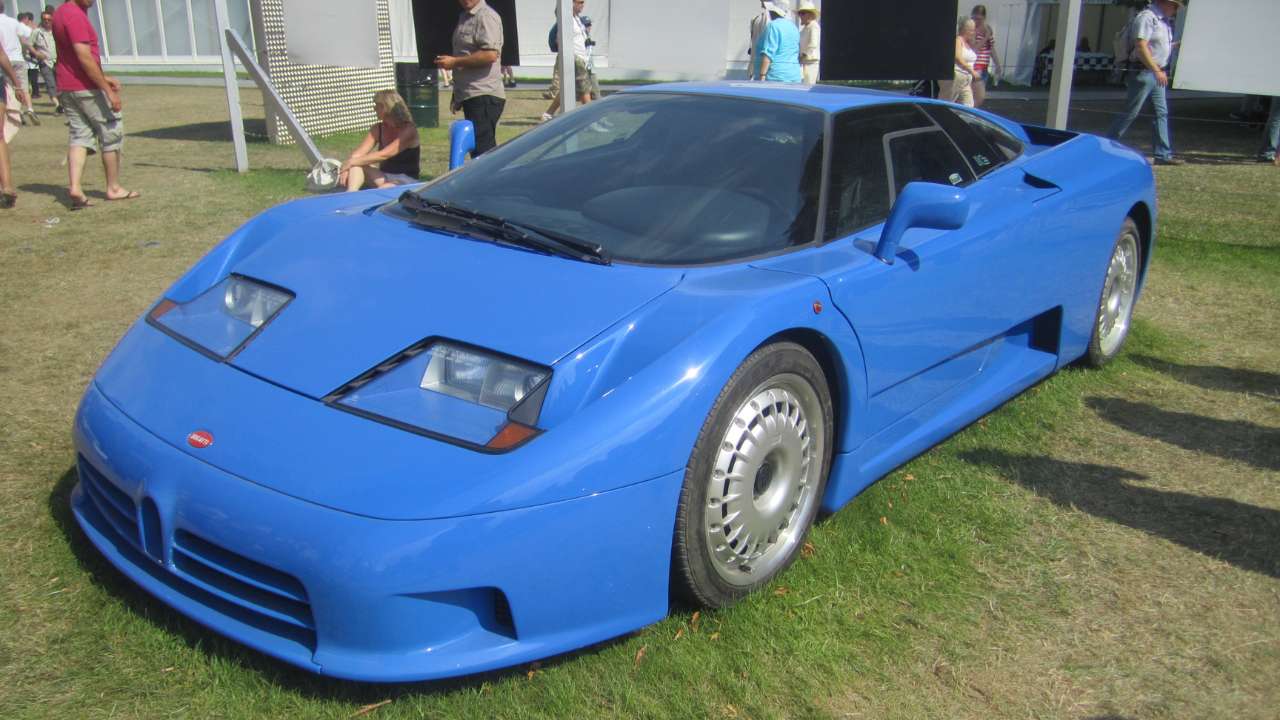
The Bugatti EB110 arrived in 1991 as a technical statement from a revived marque, packed with solutions that looked more like a concept engineer’s wish list than a production brief. Quad turbocharging, a carbon-fiber chassis, and advanced all-wheel drive turned the car into a rolling laboratory that previewed how modern hypercars would be built.
Three decades later, the EB110 still reads like a checklist of ideas that the rest of the industry took years to normalize. Its story is not only about an exotic supercar, but also about how an ambitious engineering project helped define what “cutting edge” would mean for performance cars in the decades that followed.
What happened
The EB110 was the centerpiece of Romano Artioli’s effort to resurrect Bugatti as a modern supercar manufacturer. Under his leadership, the company set out to create a car that could match the most advanced machinery of the early 1990s and then go a step further. The result was a mid-engined coupe with a 3.5‑liter V12 that used four small turbochargers, feeding power to all four wheels through a six‑speed manual gearbox.
Instead of relying on traditional steel or aluminum, Bugatti commissioned a carbon‑fiber monocoque chassis, produced with aerospace know‑how. At the time, that kind of structure had barely appeared in road cars, and the EB110’s tub was among the first full carbon shells to reach series production. The car’s layout placed the V12 longitudinally behind the cabin, with the gearbox mounted ahead of the engine, which helped centralize mass and allowed a relatively compact rear overhang for such a powerful machine.
The powertrain itself was a dense package of technology. The 3.5‑liter V12 used five valves per cylinder and four turbochargers, a configuration that allowed high revs and rapid boost response. Contemporary figures list output around 560 horsepower for the standard EB110 GT, with torque delivered through a permanent all‑wheel‑drive system that split power between front and rear axles. This combination gave the car supercar performance but also a degree of stability that rear‑drive rivals struggled to match on imperfect roads.
The EB110’s all‑wheel‑drive layout used a center differential and viscous coupling to manage slip, an approach that gave the car a more neutral balance than many earlier performance cars that simply added driven front wheels without a sophisticated torque split strategy. The system worked with wide, staggered tires and carefully tuned suspension geometry to provide strong traction without overwhelming understeer.
Beyond the GT version, Bugatti developed a lighter, more powerful EB110 Super Sport. This model turned up the boost, trimmed weight with additional carbon components, and sharpened the chassis. The Super Sport’s power figure climbed significantly over the GT, and period testing credited it with a top speed that pushed into the region of the fastest road cars of the day. Its bodywork added larger air intakes and a more prominent rear wing to keep the car stable at very high speed.
The EB110’s engineering character was not just about raw numbers. The V12’s behavior at high rpm became one of its defining traits. On a modern dyno, recordings capture the engine spinning to 8,700 rpm, where the combination of induction noise, turbo whistle, and mechanical valvetrain clatter creates a distinctive sound that still feels exotic compared with later, more muted forced‑induction engines. That high‑revving nature showed how Bugatti’s engineers had designed the V12 as a racing‑inspired unit rather than a low‑stress torque motor.
The car’s structure and drivetrain were wrapped in a body that combined sharp wedges with soft curves, a reflection of early 1990s Italian design. Marcello Gandini contributed to the initial styling, and although the final production shape evolved from his first proposal, the finished car still carried his influence in its angular side profile and crisp cut lines. The scissor doors, the glass engine cover, and the distinctive horseshoe grille gave the EB110 a presence that matched its mechanical ambition.
Inside, the EB110 balanced luxury with purpose. Leather and high‑quality trim sat alongside a compact instrument cluster, a gated shifter, and deeply bolstered seats. The cabin layout reflected the car’s dual mission: it had to feel like a Bugatti, with comfort and refinement, but also like a focused supercar that encouraged the driver to exploit the full reach of the V12 and the all‑wheel‑drive system.
Production numbers remained low. The complexity of the car, the cost of its materials, and the economic climate of the early 1990s limited how many EB110s Bugatti could sell. The company built a small run of GT and Super Sport models before financial pressures forced the factory in Campogalliano to close. That short production window only amplified the car’s mystique among collectors and engineers who saw it as a bold experiment cut short.
Why it matters
The EB110 matters because it previewed the formula that would later define modern hypercars. Its combination of carbon‑fiber construction, all‑wheel drive, and highly stressed forced‑induction power foreshadowed the approach used by later Bugatti models and by other manufacturers chasing extreme performance. At a time when most supercars still relied on steel frames and rear‑wheel drive, the EB110 treated advanced materials and complex drivetrains as non‑negotiable parts of the package.
Romano Artioli’s project also revived the Bugatti name in a way that connected heritage with innovation. The EB110’s designation referenced Ettore Bugatti’s 110th birthday, tying the car directly to the brand’s prewar history. At the same time, the engineering team pursued solutions that had little precedent in earlier Bugattis. The result was a car that respected tradition while making clear that the reborn company would compete on technology rather than nostalgia alone. Detailed retrospectives on the car’s development describe how Artioli’s vision centered on using cutting‑edge materials and construction methods to reestablish Bugatti as a leader in performance engineering.
The carbon‑fiber monocoque is one of the clearest examples of that approach. In the early 1990s, carbon tubs were mostly associated with Formula 1 and a handful of ultra‑low‑volume road cars. By committing to a full composite structure, Bugatti accepted high development and manufacturing costs in exchange for stiffness and weight benefits that would become standard only many years later. The EB110’s tub, built using aerospace processes, gave the car a torsionally rigid core that allowed the suspension to work precisely and the body panels to carry less structural load.
The drivetrain philosophy was equally forward‑looking. The decision to use four small turbochargers instead of one or two larger units showed a focus on throttle response and drivability. Smaller turbos spool faster, which reduces lag and makes the engine feel more linear. Combining that with a high‑revving valvetrain created a power delivery that blended the urgency of a naturally aspirated engine with the torque of forced induction. Modern recordings of an EB110 on a chassis dynamometer capture how cleanly the V12 sweeps through the rev range to its 8,700 rpm peak, a sign of careful calibration and strong internal components that can tolerate sustained high rotational speeds.
The EB110’s all‑wheel‑drive system also influenced later thinking about how to deploy large amounts of power on public roads. Rather than chase lap times with a pure rear‑drive layout, Bugatti prioritized real‑world traction and stability. That choice anticipated the way many high‑output performance cars now rely on sophisticated all‑wheel‑drive systems to keep power usable in varied conditions. The EB110’s torque split and differential strategy were relatively simple compared with modern torque‑vectoring systems, yet the concept of sending power to all four wheels in a flagship supercar was still a bold move at the time.
From a design perspective, the EB110 showed how a brand could reinterpret classic cues without falling into retro pastiche. The horseshoe grille and the compact, upright nose referenced earlier Bugattis, while the overall wedge profile and scissor doors placed the car firmly in contemporary supercar territory. Historical profiles of the model point out how the Campogalliano factory itself was conceived as a showcase of modern architecture and advanced production, reinforcing the idea that the EB110 was part of a larger push to reinvent Bugatti as a forward‑looking manufacturer.
The car’s limited production and the eventual collapse of the company in that era give the EB110 a bittersweet legacy, but they also highlight how ambitious the project was. Building a carbon‑tub, quad‑turbo, all‑wheel‑drive V12 supercar in small volumes, without the backing of a major automotive group, was a high‑risk strategy. That risk produced a car that now serves as a reference point for engineers and enthusiasts studying how far a boutique manufacturer can push technology before economics intervene.
In the years since, the EB110’s reputation has grown as collectors and historians have reexamined its specification. Detailed technical breakdowns of the car emphasize how many of its features were ahead of their time. The use of a carbon monocoque, intricate turbo plumbing, and advanced aerodynamics placed it in a very small group of early 1990s cars that genuinely tried to redefine the limits of road‑legal performance.
The EB110 also matters because it bridged the gap between the analog and digital eras of supercars. Its systems were largely mechanical, without the layers of electronic driver aids that define modern hypercars, yet its core engineering ideas align closely with those later machines. That combination gives the EB110 a particular appeal: it offers a raw, unfiltered driving experience built on a foundation of technology that still feels contemporary.
What to watch next
Interest in the EB110 has continued to rise as the car’s historical importance becomes clearer. Auction results and private sales show values climbing, driven by low production numbers and the recognition that the EB110 represents a key chapter in Bugatti’s story. Collectors are drawn to the car not only for its rarity but also for its technical specification, which stands comparison with far newer machinery.
As more EB110s are restored and driven, the car’s engineering depth is being documented in greater detail. Modern dyno sessions highlight how the quad‑turbo V12 behaves under load, with recordings of the engine at 8,700 rpm giving current audiences a direct sense of its character. Enthusiasts and engineers alike use these sessions to analyze boost curves, power delivery, and the durability of components that were designed in the late 1980s yet still tolerate repeated high‑rpm runs.
The historical narrative around Romano Artioli’s Bugatti is also being filled in through long‑form accounts of the company’s rise and fall. These pieces trace how Artioli assembled a team of engineers, designers, and suppliers to create the EB110, and how the Campogalliano facility became a symbol of Italian industrial ambition. They also explain how economic pressures and market shifts eventually overwhelmed the business, leaving the EB110 as a brilliant but short‑lived expression of that vision.
Technical archives and enthusiast sites continue to compile specifications for the EB110, including detailed breakdowns of the GT and Super Sport variants. These resources catalog engine output, top speed claims, weight figures, and production counts, helping to fix the car’s place in the hierarchy of 1990s supercars. They also provide context for how the EB110 compared with contemporaries in areas such as acceleration, braking, and handling.
More From Fast Lane Only: