The 1998 Porsche 911 GT1 was built to win Le Mans, yet a handful of examples carried license plates and indicators rather than racing numbers. Conceived as a pure competition tool and then adapted just enough to satisfy road-homologation rules, it ended up straddling a narrow line between circuit weapon and exotic grand tourer. Two and a half decades later, it still stands as one of the clearest expressions of what happens when racing regulations push a manufacturer to turn a prototype into a road-legal fantasy.
What happened
By the mid 1990s, Porsche faced a new kind of arms race in GT1 sports car racing. Rivals such as Mercedes-Benz and Toyota were designing purpose-built racers that only nodded in the direction of their showroom models. To stay competitive, Porsche developed the 911 GT1 as a mid-engined machine that carried the 911 name and some visual cues, but was structurally far closer to a prototype.
The project began with the requirements of the GT1 category, which demanded manufacturers build a small batch of road-going versions of their race cars. Porsche responded with a carbon composite chassis, a mid-mounted flat-six and aggressive aero that owed more to Group C than to a conventional 911. Its water-cooled twin-turbocharged six was derived from the company’s earlier endurance racers and tuned to deliver race-winning performance over the 24-hour grind at Le Mans.
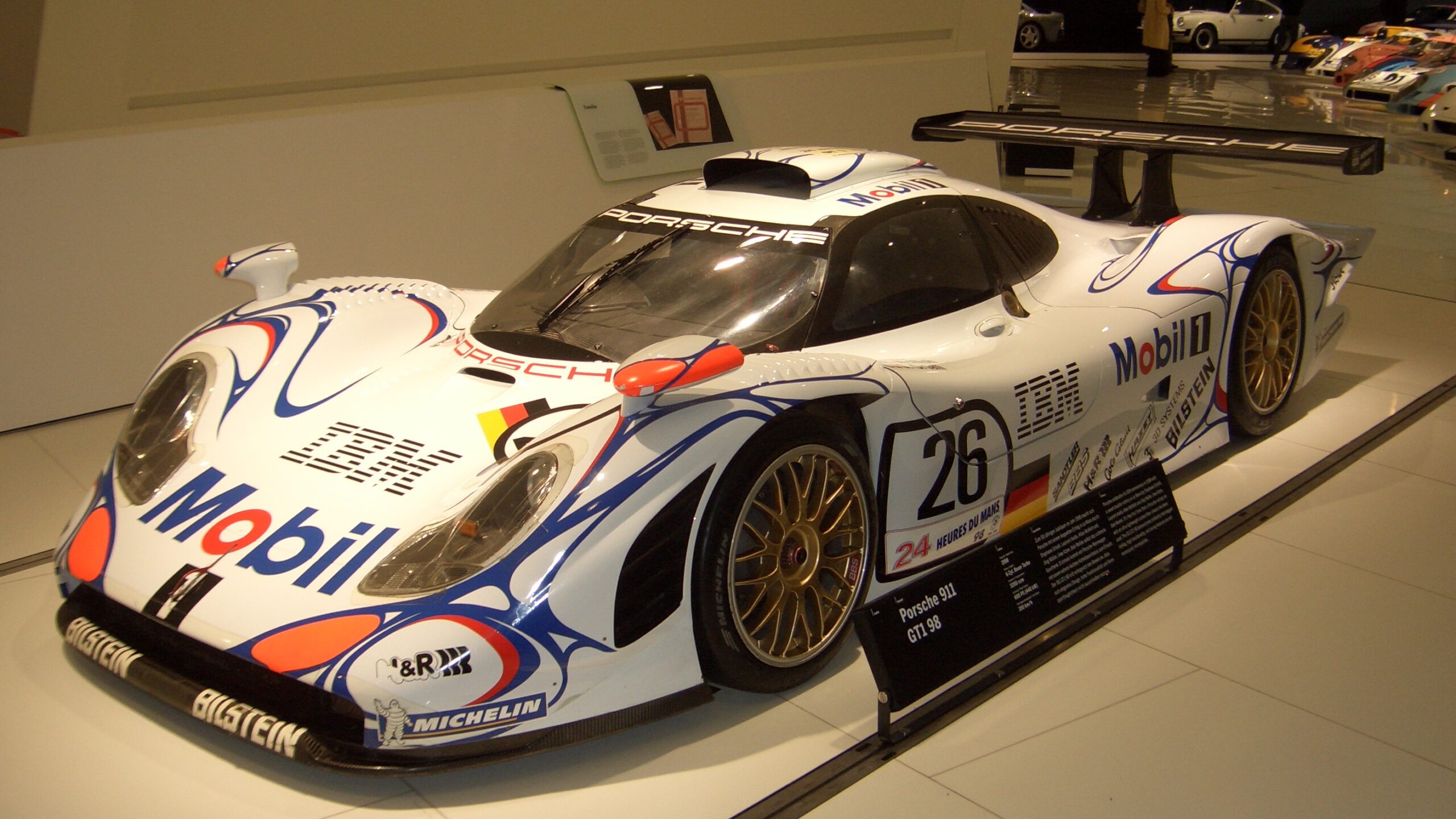
Homologation demanded a road variant, so Porsche created the 911 GT1 Straßenversion, a road-going derivative that retained the core layout of the racer. It gained headlights and tail-lights that nodded to the contemporary 996-generation 911, along with a more finished interior, yet the underlying structure and proportions remained pure race car. The cockpit sat low between swollen fenders, the rear wing towered above the deck, and the nose stretched long and flat to feed air to the radiators and front aero devices.
The 1998 evolution of the GT1 brought a reworked body and chassis package that sharpened its competitive edge. Porsche refined the aerodynamics, revised the suspension and further optimized weight distribution. The race version, wearing the 911 GT1-98 designation, would go on to secure an overall victory at the 24 Hours of Le Mans, validating the development path that blurred the boundary between GT car and prototype.
While the race team chased outright speed, engineers working on the road cars had to satisfy crash regulations, emissions rules and basic usability. The Straßenversion received slightly detuned power, more compliant suspension and a cabin trimmed with leather and carpeting, yet many of the race car’s compromises remained. Getting in and out required athleticism, the seating position was pure competition, and visibility was shaped by the demands of airflow rather than daily comfort.
Homologation pressure and the GT1 formula
The 911 GT1 did not emerge in isolation. It was part of a short-lived era when GT1 regulations encouraged manufacturers to build track-focused machines that only paid lip service to production roots. Mercedes-Benz responded with the CLK GTR, Toyota with the GT-One, and each manufacturer interpreted the rules to create cars that were effectively thinly disguised prototypes.
Porsche’s approach took the familiar 911 silhouette and stretched it into something more extreme. Moving the engine ahead of the rear axle transformed the car into a mid-engined layout that improved balance and grip. Extensive carbon composite construction reduced weight and allowed engineers to tune stiffness precisely. The result was a car that carried a Porsche crest and 911 badging, yet shared little with the steel-bodied road cars built in Stuttgart.
The need to produce a limited number of street-legal examples shaped several design choices. The addition of 996-style headlamps, for example, helped visually link the GT1 to the showroom 911 while also satisfying lighting regulations. Inside, the sparse cabin incorporated recognizable Porsche switchgear and instrumentation. These touches allowed the company to argue that the car was a derivative of its production range, not a clean-sheet prototype.
At the same time, the underlying engineering remained committed to endurance racing. The turbocharged flat-six was developed to run for hours at full load, the gearbox was designed for rapid, repeated shifts under high stress, and the aero package prioritized stability at very high speed. The road car inherited these traits, making it a ferocious machine on track days and a challenging companion on public roads.
Race-bred hardware on public roads
The road-legal 911 GT1 sat in an unusual position. It was not a softened supercar with racing aspirations, but rather a race car that had been tamed only slightly. Suspension geometry, brake hardware and aerodynamic balance were all configured with track performance in mind. Even in detuned form, the turbocharged engine delivered power levels that placed it among the fastest road cars of its era.
Owners who drove the GT1 on public roads faced a car that demanded concentration. Steering was direct and heavy at low speed, the ride was firm, and the turbocharged power delivery rewarded precise throttle inputs. Limited ground clearance made speed bumps and steep driveways a constant concern. For drivers who accepted those compromises, the payoff was a car that felt almost identical to the machines that lined up at Le Mans.
The interior reflected this dual identity. Bucket seats and a prominent roll structure signaled the car’s competition roots. At the same time, Porsche added enough trim and sound insulation to make longer journeys possible, at least for those willing to live with elevated noise levels and limited luggage space. The cabin layout, with its familiar Porsche steering wheel and instrument cluster, gave a thin veneer of normality to what was otherwise a highly specialized machine.
Why it matters
The 1998 911 GT1 occupies a special place in Porsche history because it represents the last time the company built a Le Mans-winning GT car that was so directly tied to a road-going counterpart. Later regulations shifted the balance toward pure prototypes, which reduced the incentive to create such extreme homologation specials. As a result, the GT1 stands as a high-water mark for the idea that a private owner could, at least in theory, drive a car closely related to an overall Le Mans winner.
That connection between track and road also influenced how enthusiasts view Porsche’s later halo models. When the company launched the Carrera GT in the early 2000s, it again drew on race-derived technology, particularly in the use of a high-revving V10 and carbon chassis. On unrestricted highways, the Carrera GT demonstrated how closely a road car could mimic the sensations of a prototype, yet it was still conceived first as a production supercar rather than a homologation obligation.
Compared with that later car, the 911 GT1 feels like a more direct product of the rulebook. Its existence depended on satisfying a specific line in the regulations that required road cars. That constraint pushed Porsche to accept compromises that a clean-sheet supercar did not face, such as integrating production-style lighting and interior elements into a body shaped primarily by downforce and cooling requirements.
The GT1 also helped cement Porsche’s reputation for endurance racing dominance. The 1998 Le Mans victory with the GT1-98 came during a period when the company was navigating the transition from air-cooled to water-cooled engines in its road cars. Success at the Circuit de la Sarthe reassured enthusiasts that the brand’s competitive instincts remained sharp, even as its production lineup evolved.
Impact on the hypercar playbook
Although the GT1 era was short, its influence can be traced in the way manufacturers later approached ultra-high-performance road cars. The idea that a limited-production machine could carry over major components from a racing program gained traction. Projects such as the later Mercedes-Benz CLK GTR road car and other track-derived specials followed a similar template, combining homologation logic with extreme performance.
Porsche itself leaned on lessons from the GT1 when developing subsequent flagships. The emphasis on lightweight construction, advanced aerodynamics and motorsport-grade braking systems carried through to models that did not have direct racing counterparts. Even when regulations no longer required a road version, engineers continued to think in terms of how circuit-proven technology could be adapted for customers.
For collectors and historians, the 911 GT1 also serves as a reference point in discussions about what qualifies as a road car. Its limited production, specialized maintenance needs and uncompromising setup raise questions about usability versus legality. The car could wear a license plate, but its natural environment was a race circuit. That tension has since become a defining characteristic of many modern hypercars, which offer extraordinary performance that can only be fully accessed on closed courses.
Rarity and cultural cachet
The small number of 911 GT1 road cars built has contributed to their near-mythic status. Each example represents a snapshot of a regulatory moment that no longer exists, when building a handful of street-legal versions unlocked eligibility for the world’s most prestigious endurance races. That scarcity, combined with the car’s competition record, has driven intense interest among enthusiasts and collectors.
Beyond the numbers, the GT1 has become a symbol of a certain kind of engineering freedom. Within the constraints of the GT1 rulebook, Porsche created a machine that stretched the definition of a production car to its limits. Designers could experiment with radical proportions and aero devices, knowing that only a tiny group of road customers would need to live with the results. That mindset encouraged bold solutions that might have been impossible on a mainstream model.
The car’s unusual blend of 911 styling cues and prototype hardware has also given it a distinctive visual identity. The familiar roundish headlamps and sloping roofline sit on top of a body that is longer, wider, and more aggressive than any standard 911. This combination has made the GT1 instantly recognizable, even to casual fans who might not know its full history.
What to watch next
The legacy of the 1998 911 GT1 continues to shape how enthusiasts and manufacturers think about the connection between road cars and racing programs. As regulations in top-level endurance racing have shifted toward more controlled prototypes, the opportunity to create direct homologation specials has diminished. Yet the appetite for road cars with a genuine competition pedigree remains strong.
Manufacturers now explore that demand through track-focused variants of existing supercars, customer racing programs and limited-run specials that borrow heavily from motorsport technology. The template established by cars like the GT1 still informs these projects. Engineers look for ways to bring racing-derived aerodynamics, suspension setups and powertrains into vehicles that can pass road-legal certification, even if no rulebook requires it.
For Porsche, the memory of the GT1 era continues to influence brand storytelling. References to Le Mans victories, race-bred technology and the idea of a 911 that can compete at the highest level of endurance racing remain central to how the company presents its performance models. While the exact regulatory environment that produced the GT1 may not return, the underlying concept of a road car that feels inseparable from its racing counterpart continues to resonate.
More from Fast Lane Only
- Unboxing the WWII Jeep in a Crate
- 15 rare Chevys collectors are quietly buying
- 10 underrated V8s still worth hunting down
- Police notice this before you even roll window down
*Research for this article included AI assistance, with all final content reviewed by human editors.