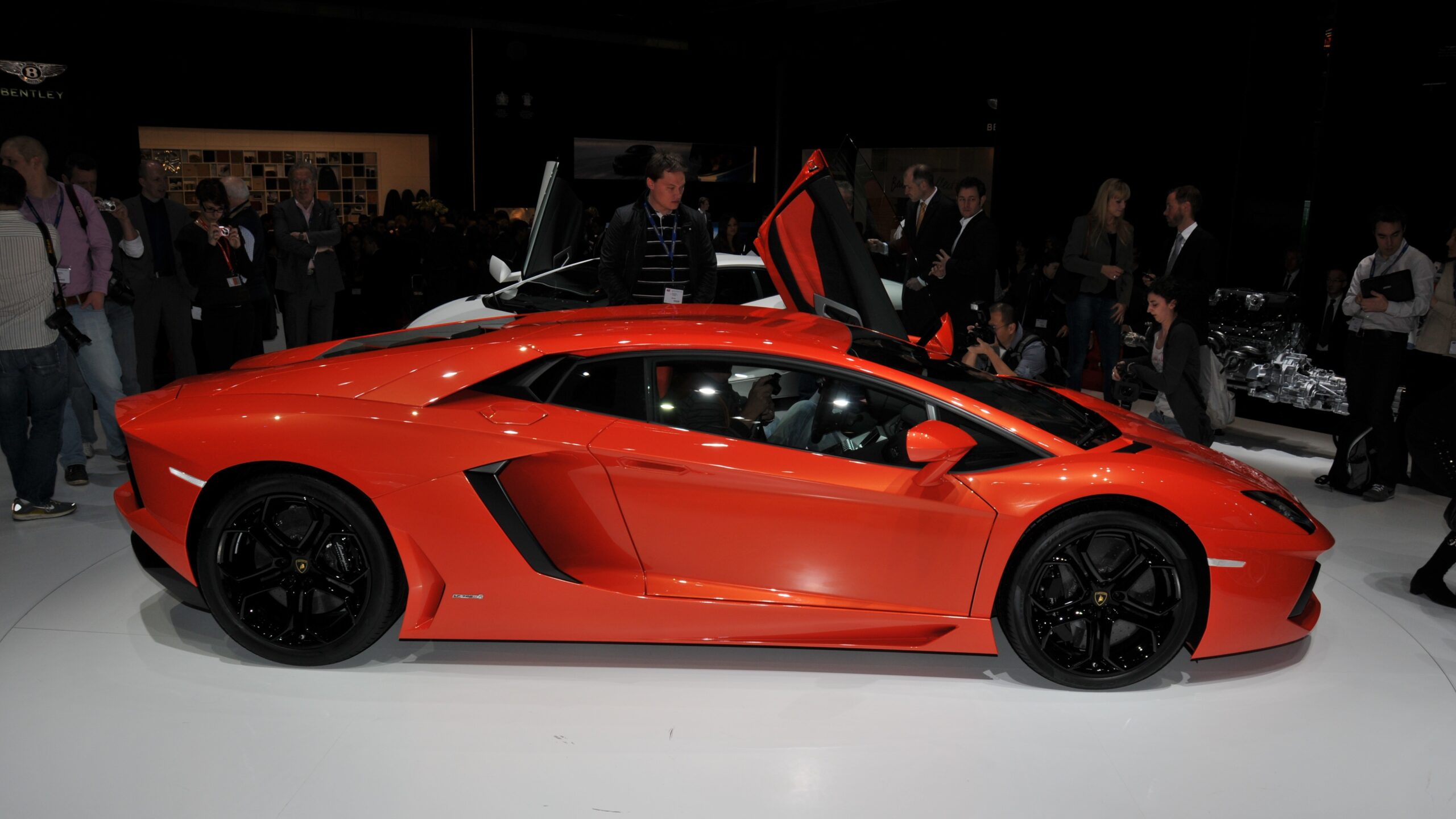
The arrival of the Lamborghini Aventador in 2011 did more than replace the Murciélago. It reset expectations for what a naturally aspirated V12 supercar could be in an era already turning toward downsizing and turbocharging. From its carbon tub to its shrieking 6.5‑liter engine, the Aventador marked a clean break with the past and laid the template for every flagship Lamborghini that followed.
Over more than a decade of production, that template proved remarkably adaptable. The Aventador spawned track specials, open‑top showpieces, and one‑off coachbuilt cars, while its core V12 architecture carried Lamborghini from the analog age into a hybrid future. The result is a car that now reads as a turning point between old‑school excess and modern performance engineering.
A radical new flagship arrives
When Lamborghini unveiled the Aventador LP 700‑4, it introduced an all‑new 6.5‑liter V12, a carbon fiber monocoque, and a design that looked like it had driven straight out of a concept sketch. The car’s powertrain was not a reworked carryover but a fresh engine that signaled Lamborghini’s commitment to keeping a naturally aspirated twelve‑cylinder at the top of its range. Combined with permanent all‑wheel drive and a single‑clutch automated manual, the Aventador launched as one of the most dramatic road cars of its time.
From the outset, Lamborghini treated the Aventador as more than a routine product launch. The first example to reach the United States, finished in Arancio Argos orange, was used behind closed doors to host private previews for key clients before the wider rollout. That strategy underscored how central the new V12 flagship was to the brand’s identity and future business.
Design that made everything else look dated
The Aventador’s styling crystallized the sharp, faceted language that would define Lamborghini through the 2010s. Its low, wide stance, scissor doors, and hexagon‑obsessed detailing created a car that looked aggressive even when parked. The bodywork was not just theatrical. Large side intakes fed air to the mid‑mounted V12, while active rear aerodynamics helped keep the car stable at the extreme speeds it could reach.
Inside, the cabin mixed aerospace cues with digital instrumentation, including a configurable TFT display that replaced traditional analog dials. The fighter jet-style flip cover over the starter button became an instant talking point. For a company known for extroverted design, the Aventador still managed to feel like a step into a more futuristic era, and it set the visual tone for later models that would share its platform.
A naturally aspirated V12 that defined an era
At the heart of the Aventador sat a 6.5‑liter V12 that delivered both towering performance and a soundtrack that quickly entered supercar folklore. The engine produced 700 metric horsepower in its original LP 700‑4 form, with later variants climbing well beyond that figure. Crucially, it did so without turbochargers, relying on high revs and careful breathing to deliver its power.
Among enthusiasts and critics, the Aventador’s twelve‑cylinder engine became a reference point for how a modern high-performance engine should sound. Lists of the best sounding V12 routinely place the Lamborghini unit near the top, citing its crisp throttle response and the way it builds from a metallic growl to a piercing wail as the revs rise. That character helped distinguish the Aventador from rivals that used turbocharged V8s or more muted powertrains.
Carbon fiber structure and performance leap
The Aventador did not only rely on its engine for speed. Lamborghini adopted a carbon fiber reinforced polymer monocoque for the central structure, with aluminum front and rear subframes. This approach increased torsional rigidity while keeping weight in check, and it represented a major investment in composite manufacturing for the company.
The result was a car that could exploit its 700 horsepower with relative composure. Official performance figures placed the Aventador among the quickest production cars of its day, with acceleration and top speed that matched or exceeded contemporary benchmarks. The all‑wheel drive system provided traction off the line, while large carbon ceramic brakes helped rein in the speed repeatedly on road or track.
From LP 700‑4 to SVJ: a growing family
Over its long life, the Aventador evolved through a series of increasingly focused variants. The LP 700‑4 gave way to the Aventador S, which brought revised aerodynamics, four wheel steering and a retuned chassis. The Superveloce and later SVJ pushed the platform toward track performance, with more power, reduced weight, and aggressive aero packages that generated significant downforce.
Alongside the coupes, Lamborghini produced roadster versions with removable roof panels that preserved most of the car’s performance while adding open-air drama. Special editions and limited runs, including models inspired by motorsport and collaborations, kept demand high and allowed the company to experiment with styling and materials while staying within the Aventador architecture.
Production records and commercial success
The Aventador was not a niche halo car built in tiny numbers. Over time, it became one of Lamborghini’s most successful flagships. At one point in its lifecycle, the company announced that the Aventador had reached a new production record, surpassing the total output of its Murciélago predecessor. That milestone highlighted how demand for extreme V12 supercars had grown, especially in markets such as the United States, the Middle East, and parts of Asia.
Strong sales of the Aventador helped fund Lamborghini’s broader expansion, including the development of the Huracán and the Urus SUV. The car’s success also validated the decision to invest heavily in carbon fiber production and a bespoke V12 engine at a time when many manufacturers were moving toward shared platforms and smaller powertrains.
The final Aventador and the end of a chapter
After more than a decade in production, Lamborghini built the last Aventador, a car that symbolized the end of a specific era for the company. The final example marked the conclusion of series production for the pure, non‑hybrid V12 that had defined the brand’s flagships for generations. In its own communications, the company described the completion of the last Aventador as the end of an era, linking the model directly to the heritage of earlier twelve‑cylinder Lamborghinis.
That final car did not just close the book on one model line. It marked a transition point toward electrified powertrains and stricter emissions rules that made a naturally aspirated, stand‑alone V12 increasingly difficult to justify. For collectors, the last Aventadors represent the culmination of a lineage that runs back through the Murciélago and Diablo to the Miura and the original 350 GT.
From Aventador to hybrid V12
The Aventador’s departure cleared the way for a new flagship built around a hybridized twelve‑cylinder engine. Lamborghini presented the Revuelto with a V12 paired to electric motors, a configuration that preserves the cylinder count while adding electric assistance and plug in capability. In promotional material and events, the company has framed this new car as the next step in the story that began with its early V12s and was redefined by the Aventador.
One exhibition dedicated to the legend of the and the Revuelto placed the Aventador alongside both its predecessors and its hybrid successor. That context reinforces how the 2011 model served as the bridge between old and new, combining a traditional engine layout with modern materials and electronics in a way that made the subsequent move to electrification feel like evolution rather than rupture.
Why the Aventador mattered beyond the spec sheet
The Aventador arrived at a time when environmental regulations and fuel economy pressures were reshaping the supercar market. Many rivals chose smaller displacement engines with turbocharging to balance performance and efficiency. Lamborghini instead doubled down on a large, naturally aspirated V12 and made the case that there was still room for such an engine, provided it sat within a lighter, more advanced chassis.
This decision had cultural as well as technical consequences. The Aventador became a fixture in popular media, from video games to music videos, where its dramatic silhouette and unmistakable engine note made it instantly recognizable. For a generation of younger enthusiasts, it was the archetypal poster car, much as the Countach had been decades earlier. In that sense, the Aventador helped keep the idea of a wild, uncompromising supercar alive in an era increasingly defined by crossovers and electrification.
How it reshaped Lamborghini’s identity
Before the Aventador, Lamborghini’s image rested largely on a small number of low volume flagships and a reputation for theatrical styling. The new car expanded that image into something more technologically ambitious. The carbon monocoque, advanced electronics and iterative aerodynamics showed that the company could match or exceed its rivals on engineering, not just drama.
The Aventador also influenced how Lamborghini approached customer engagement. The private previews held with the first US car exemplified a more curated, relationship driven sales strategy. Limited editions and track-oriented variants allowed the brand to segment its audience more precisely, catering to collectors, track day drivers and those who valued exclusivity above all.
Lessons for the next generation of supercars
The Aventador’s long production run and steady demand offer several lessons for the future of high-performance cars. First, there remains a strong market for vehicles that prioritize emotional appeal, especially sound and design, even as regulations tighten. Second, a flexible platform that can support numerous variants and special editions can extend a model’s life while keeping it fresh.
For manufacturers now developing hybrid and fully electric supercars, the Aventador era shows the importance of continuity. By retaining a naturally aspirated V12 and pairing it with modern chassis and electronics, Lamborghini created a car that felt both familiar and new. The move from Aventador to Revuelto suggests that carrying forward key elements of character, such as cylinder count or design language, can help customers accept significant technological change.
What enthusiasts and collectors are watching now
With production ended, attention has shifted to how the Aventador will age in the market. Collectors are already drawing distinctions between early LP 700‑4 cars, more developed S and SVJ models, and limited editions that capped the run. Provenance, including stories such as cars used for early private previews, is likely to play a growing role in valuation.
Enthusiasts are also paying close attention to how the hybrid V12 successor compares in terms of sound and feel. The Aventador’s place on lists of the most memorable variants and its reputation for drama set a high bar. If the new generation can match that emotional impact while adding electric performance, it will validate Lamborghini’s strategy of evolution rather than abrupt reinvention.
Legacy of a modern icon
Looking back, the 2011 Aventador did more than introduce a new model. It redefined what a flagship Lamborghini could be in the 21st century, combining a traditional V12 layout with cutting-edge materials and a design that still looks futuristic years later. Its success gave the company the financial and technical foundation to pursue hybridization on its own terms, without abandoning the character that made its cars distinctive.
More from Fast Lane Only
- Unboxing the WWII Jeep in a Crate
- 15 rare Chevys collectors are quietly buying
- 10 underrated V8s still worth hunting down
- Police notice this before you even roll window down
*Research for this article included AI assistance, with all final content reviewed by human editors.