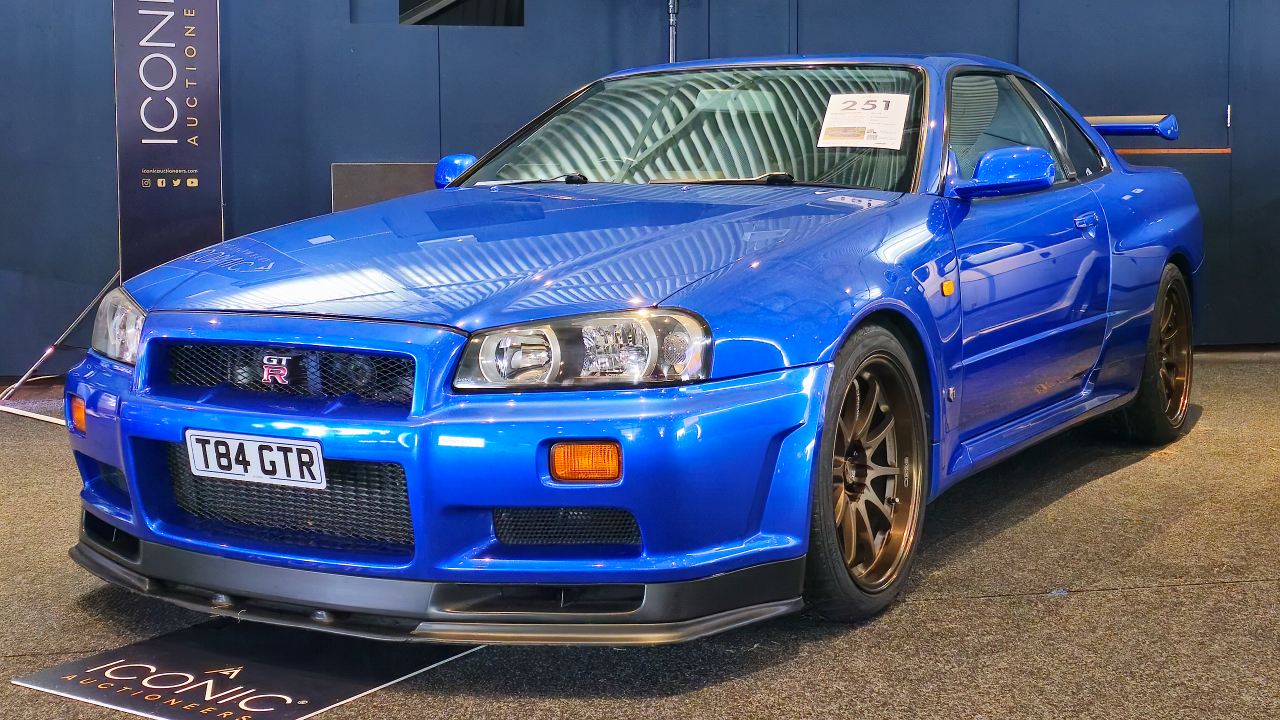
The 1999 Nissan Skyline GT-R V-Spec arrived as a sharpened evolution of Japan’s most famous all-wheel-drive performance coupe, engineered for quicker lap times and harder launches. With its twin-turbo straight-six, advanced all-wheel-drive hardware, and subtle track-focused upgrades, the V-Spec turned the Skyline’s video game legend into high real-world speed.
That mix of motorsport tech, pop-culture fame, and limited production has since made the 1999 V-Spec one of the most coveted R34-generation GT-Rs, with collectors chasing clean examples and paying supercar money for the right car. The story of how this once-forbidden Japanese coupe became a blue-chip icon starts with what Nissan quietly built into the V-Spec from day one.
From street coupe to high-tech hero
By the late 1990s, the Skyline GT-R name already carried weight in touring car paddocks and on Japanese expressways. The R34 generation, which arrived for 1999, refined that heritage with a shorter wheelbase than the R33, crisper bodywork, and a more focused chassis. Under the hood sat the familiar RB26DETT, a 2.6-liter twin-turbo inline-six officially rated at 276 horsepower in line with Japan’s gentleman’s agreement but widely regarded as capable of far more in stock form.
Nissan paired the RB26 with a six-speed Getrag manual gearbox, an electronically controlled all-wheel-drive system, and the ATTESA E-TS Pro active torque-split hardware that could shuffle power between front and rear axles in response to grip. The car also used the Super-HICAS rear-steering system to fine-tune cornering response. Together, these systems created a coupe that felt closer to a touring car for the road than a traditional grand tourer, especially in V-Spec trim.
Period tests and later retrospectives have noted that the R34 GT-R’s official power figure understated its real output, with dyno runs often showing figures well above the advertised number. The engine’s iron block, strong internals, and twin-ceramic-turbo layout gave tuners a forgiving base that could tolerate significant power increases without internal changes. That tuning headroom became a defining part of the R34’s reputation and helped cement the 1999 V-Spec as a favorite starting point for serious builds.
What set the V-Spec apart
The V-Spec badge signaled more than a trim package. Nissan treated it as a track-focused evolution of the standard GT-R, with hardware changes aimed at shaving lap times rather than adding comfort. Contemporary coverage of the 1999 model highlights the use of stiffer suspension tuning and a more aggressive ATTESA E-TS Pro calibration that favored sharper responses at the limit.
V-Spec cars received a front carbon-fiber diffuser that worked with an undertray to manage airflow beneath the car, increasing stability at high speed. Many examples also featured larger brake rotors and revised pads to cope with harder track use. Although the weight difference between a base GT-R and a V-Spec was not dramatic, the aero tweaks and chassis calibration combined to make the V-Spec feel more composed under heavy braking and through fast corners.
Inside, the V-Spec kept the same basic layout as other R34 GT-Rs, with deeply bolstered front seats, a compact steering wheel, and the signature multifunction display on top of the dashboard. That screen allowed drivers to monitor boost pressure, oil and water temperatures, and other key metrics, reinforcing the car’s motorsport flavor. The cabin remained understated, more functional than luxurious, which suited the V-Spec’s mission as a serious driver’s car.
N1 and other hardcore variants
For enthusiasts who wanted a more extreme version, Nissan created the V-Spec N1, a homologation special aimed squarely at racing teams and dedicated track drivers. Reports on the V-Spec N1 describe a stripped-back specification that deleted comfort features such as air conditioning and audio equipment in the pursuit of lower weight.
The N1 engine used reinforced components and a different turbocharger setup designed to cope with the sustained abuse of endurance racing. These cars typically came with thinner glass, minimal sound deadening, and plain white paint, all in the name of function over form. Production numbers were tiny compared with the regular V-Spec, which has made surviving N1 examples some of the most valuable R34s in the collector market.
Beyond the N1, Nissan also offered later refinements such as the V-Spec II and the Nür editions, but the 1999 V-Spec holds a special place as the first expression of the R34’s more focused personality. It bridged the gap between road car and race car in a way that resonated with both weekend track drivers and professional teams building cars for series such as Super Taikyu and JGTC.
Performance that backed up the attitude
The numbers behind the 1999 V-Spec’s reputation tell part of the story. Contemporary testing recorded 0 to 60 mph runs in the low 5-second range for stock cars, with quarter-mile times around 13 seconds. Those figures put the GT-R in the same performance bracket as European exotics of the era, despite its relatively understated styling and four-seat layout.
On a circuit, the combination of all-wheel drive, rear steering, and a well-balanced chassis allowed skilled drivers to carry high cornering speeds and exploit the car’s traction on corner exit. The V-Spec’s more aggressive differential tuning and stiffer suspension reduced body roll and improved feedback, helping drivers trust the car at the limit. That confidence translated into strong lap times on tracks ranging from Tsukuba to the Nürburgring.
In stock form the RB26DETT’s mid-range torque gave the car strong in-gear acceleration, while the close-ratio six-speed kept the engine in its power band. Tuners quickly discovered that simple modifications such as intake, exhaust, and ECU adjustments could unlock substantial gains. More ambitious builds, including some documented 1,000-horsepower V-Spec projects, showed how far the platform could be pushed when paired with upgraded turbos and fuel systems.
From forbidden fruit to collector favorite
For years the R34 GT-R remained out of reach for many American enthusiasts because of import regulations. That scarcity, combined with the car’s presence in games and movies, created a sense of mystique around the 1999 V-Spec. As examples have gradually become eligible for legal import, the market has responded with rising prices and intense competition for clean cars.
Recent listings, such as a stunning 1999 Skyline offered through a specialist platform, show how collectors now treat these cars on par with European supercars from the same era. High-quality V-Specs with documented histories, limited modifications, and desirable colors often command six-figure sums, and auction results suggest that buyers are willing to pay a premium for originality.
Market analysts have noted that the R34 GT-R’s values are driven by more than nostalgia. The car sits at the intersection of analog driving feel and modern electronics, with a manual gearbox, hydraulic steering, and relatively compact dimensions paired with sophisticated all-wheel-drive control. That blend appeals to collectors who want a car that feels engaging on the road but still represents a significant technological step in performance-car history.
Design that aged into an icon
The R34’s styling has proven remarkably resilient. Its blocky proportions, squared-off headlights, and muscular fenders looked purposeful in 1999 and now read as a kind of retro-futurist statement. The V-Spec’s subtle exterior differences, including its front splitter and rear diffuser, add visual intent without turning the car into a caricature.
Modern commentators often group the R34 GT-R among the most desirable Japanese performance cars, and some analyses of future classics highlight the model’s combination of design and engineering as a key reason. The factory color palette, which included shades like Bayside Blue and Midnight Purple, further boosted the car’s visual impact and helped individual examples stand out.
Inside, the dashboard and center console now look unmistakably late-1990s, but the layout remains functional and driver-focused. The multi-function display that once felt like a novelty has become a nostalgic highlight, a reminder of a time when real-time engine data felt like something borrowed from a race car rather than a smartphone app.
Pop culture, Paul Walker, and the Fast & Furious effect
Beyond raw performance, the 1999 Skyline GT-R V-Spec owes much of its global fame to film and gaming culture. Appearances in racing games introduced a generation of players to the R34’s capabilities long before they could see one on the road. That exposure set the stage for the car’s breakout role in the Fast & Furious franchise.
Content creators and enthusiasts have continued that thread, with builds such as Adam LZ’s R34 project, which drew direct inspiration from the movie cars. Coverage of his Skyline build describes how specific visual cues and tuning choices pay tribute to the silver-and-blue movie hero while still functioning as a serious track machine. That kind of homage keeps the R34’s image alive for younger audiences.
The market has responded to this cultural weight. Auction reports have documented record prices for cars tied to the franchise, including R34 GT-Rs associated with actor Paul Walker. Those sales have reinforced the perception of the R34, and particularly special variants like the V-Spec, as blue-chip collectibles rather than simply fast used cars.
Why the 1999 V-Spec still feels modern
Drive impressions from modern testers often highlight how contemporary the R34 GT-R still feels. The steering offers clear feedback, the chassis communicates grip levels transparently, and the all-wheel-drive system works quietly in the background to maximize traction. Compared with many current performance cars that rely on complex drive modes and extensive driver aids, the V-Spec’s interface feels relatively straightforward.
The car’s balance between usability and speed also stands out. Four seats, a usable trunk, and decent visibility make it practical for real-world driving, while the drivetrain and suspension can handle repeated hard use on track. That dual character explains why some owners still track their cars regularly despite rising values, treating them as machines to be exercised rather than static investments.
At the same time, the R34’s analog nature appeals to drivers who feel overwhelmed by the layers of software in newer performance cars. The V-Spec’s electronics focus on controlling power delivery and stability rather than reshaping the entire driving experience. For many enthusiasts, that approach hits a sweet spot between pure mechanical feel and intelligent assistance.
How tuners pushed the platform
The V-Spec’s hardware gave tuners a strong foundation for serious power. The RB26DETT’s iron block and stout bottom end tolerated significant boost increases, while the all-wheel-drive system helped put that power to the ground. High-profile builds have shown what is possible when those elements are combined with modern turbo technology and engine management.
One example involves a 1,000-horsepower 1999 V-Spec that retains street registration while running performance figures in line with contemporary hypercars. That car uses upgraded turbos, reinforced internals, and a carefully tuned fuel system to deliver four-figure output, yet it still relies on the original platform’s basic layout and drivetrain concept.
Such builds highlight why the V-Spec remains a favorite among tuners even as values climb. The car can be pushed far beyond its original performance envelope without losing the core characteristics that made it special. Owners can choose between preserving a stock example for collectability or creating a personalized machine that showcases the platform’s potential.
More from Fast Lane Only
- Unboxing the WWII Jeep in a Crate
- 15 rare Chevys collectors are quietly buying
- 10 underrated V8s still worth hunting down
- Police notice this before you even roll window down
*Research for this article included AI assistance, with all final content reviewed by human editors.