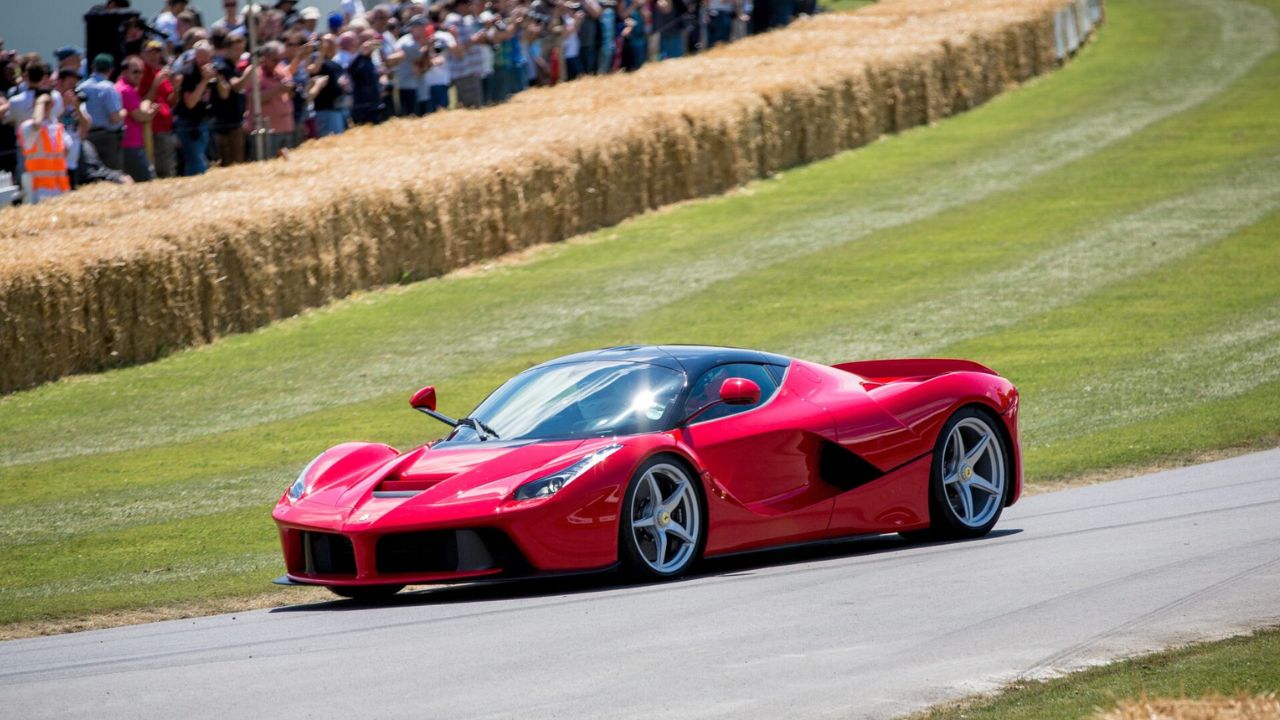
The 2014 LaFerrari arrived as a clear statement of intent from Maranello, pairing a naturally aspirated V12 with electric power to create the most advanced road-going Ferrari of its era. Instead of using batteries as a green badge, Ferrari treated hybrid hardware as a performance multiplier, targeting gains in lap time, throttle response, and efficiency all at once. The result is a limited-production flagship that shows how racing-derived hybrid systems can redefine what a road-legal supercar can do.
Ferrari’s new flagship takes shape
LaFerrari sits at the top of Ferrari’s range, following the lineage of the 288 GTO, F40, F50, and Enzo. For this generation, Ferrari built a two-seat berlinetta with a mid-mounted V12 and an integrated hybrid system, wrapped in a carbon fiber body shaped in its own Formula 1 wind tunnel. Only 499 examples were planned for production, a number chosen to keep the car rare while still allowing Ferrari to amortize the cost of its new hybrid technology.
At the heart of the car is a 6.3 liter V12 that revs to 9,250 rpm and produces 800 cv, paired with an electric motor that contributes a further 163 cv. Combined, the system delivers 963 cv, or roughly 950 horsepower, to the rear wheels through a seven speed dual-clutch gearbox. Ferrari targeted a dry weight of around 1,255 kilograms, which gives the car a power-to-weight ratio that belongs firmly in racing territory.
Ferrari’s engineers did not simply bolt an electric motor onto the driveline. The hybrid system, known as HY-KERS, was designed as a structural and dynamic component of the car. The batteries sit low within the carbon fiber tub to keep the center of gravity down, and the electric motor is integrated with the transmission to deliver instant torque and assist the V12 across the rev range.
Hybrid power as a performance tool
While many hybrids focus on fuel savings, LaFerrari uses its electric side to sharpen performance. The HY-KERS system recovers energy under braking and during off-throttle moments, then redeploys that energy to boost acceleration and fill in torque gaps. The electric motor helps the V12 deliver a broad, continuous surge of power, improving both straight-line pace and drivability.
Ferrari stated that the combined output of 963 cv allows LaFerrari to reach 100 km/h from a standstill in under 3 seconds, 200 km/h in under 7 seconds, and 300 km/h in around 15 seconds. Top speed exceeds 350 km/h. Together, these figures place the car in the same conversation as contemporary hypercars that also combine internal combustion engines with electric assistance.
The hybrid layout also improves efficiency, although Ferrari framed this as a secondary benefit. The HY-KERS system allows the V12 to run closer to its most efficient operating points more often, while the electric motor covers transient demands. Regenerative braking captures energy that would otherwise be lost as heat, which means the car can deliver more performance for a given amount of fuel.
This approach reflects lessons learned from Ferrari’s Formula 1 KERS systems. In both cases, the goal is to capture and reuse energy to improve lap times, not simply to reduce consumption. LaFerrari translates that racing philosophy into a road car, giving drivers a sense of what hybrid power can do when it is tuned for outright speed.
Chassis, aerodynamics, and materials
To support the hybrid powertrain, Ferrari built LaFerrari around a carbon fiber monocoque that combines several types of composite material. The structure uses four different kinds of carbon fiber, each placed where its specific properties are most useful. This approach delivers high torsional rigidity with low mass, which is vital when adding batteries and electric hardware.
The chassis was developed using techniques borrowed from Ferrari’s Formula 1 program. The carbon fiber layup and curing process, the positioning of structural elements, and the integration of safety features all reflect racing practice. The result is a tub that is both light and extremely stiff, improving handling precision and crash performance.
Aerodynamics play a central role in the car’s character. LaFerrari uses active aerodynamic elements, including a rear spoiler and diffusers that adjust their angle, to balance downforce and drag. At lower speeds and in corners, the system increases downforce to improve grip. At higher speeds, it trims drag to help the car reach its top speed. These adjustments happen automatically based on speed, throttle position, and other parameters.
The bodywork itself is shaped to manage airflow over and through the car. Large front intakes feed radiators and brake cooling ducts, while sculpted side channels guide air toward the engine bay and rear diffusers. The combination of a flat underbody and a powerful rear diffuser helps generate significant downforce without resorting to oversized wings.
Driver environment and ergonomics
Inside, LaFerrari continues the race-inspired theme. The driving position is fixed in concept: the seat is integrated into the carbon tub, and the driver adjusts the steering wheel and pedal box instead of sliding the seat on rails. This layout keeps mass lower and closer to the center of the car, and it also allows Ferrari to tailor the cockpit around the driver’s body.
The steering wheel incorporates numerous controls, including driving mode selectors and shift lights. Behind it sit large paddle shifters for the dual-clutch gearbox. The instrument cluster is fully digital, with configurable displays that can prioritize engine data, performance timers, or navigation information depending on the chosen mode.
Materials in the cabin mix exposed carbon fiber with leather and Alcantara. Although LaFerrari is a halo car, the interior does not chase traditional luxury in the way a grand tourer might. Instead, the emphasis is on function, weight savings, and a sense of connection to Ferrari’s racing cars.
Electronics and dynamic systems
Managing 963 cv through the rear wheels requires sophisticated electronics. LaFerrari uses Ferrari’s traction and stability control systems, integrated with the hybrid powertrain and active aerodynamics. The car’s electronic brain coordinates engine output, electric assist, differential locking, and aero settings to maintain traction and stability while still allowing the driver to exploit the car’s performance.
The electronic differential helps apportion torque between the rear wheels, improving corner exit grip and reducing understeer. Brake-by-wire integration with the hybrid system allows the car to blend regenerative and friction braking smoothly, so drivers experience a consistent pedal feel even as the system recovers energy.
Different driving modes adjust the thresholds and behavior of these systems. In more conservative settings, the car intervenes earlier to prevent wheelspin or instability. Switch to more aggressive modes and it allows greater slip angles and a more direct connection to the powertrain, while still keeping a safety net in place for most situations.
Production, rarity, and positioning
Ferrari capped LaFerrari production at 499 units, all of which were allocated to selected clients. The company targeted its most loyal customers first, particularly those who already owned previous flagship models. This strategy reinforced LaFerrari’s role as a collector’s piece as well as a technology showcase.
The car’s limited run, combined with its status as Ferrari’s first production hybrid, positions it as a landmark model. It represents both the peak of Ferrari’s naturally aspirated V12 development and the starting point for a new era of electrified performance. For many buyers, that dual significance is as compelling as the performance figures.
Pricing reflected its flagship status. While exact transaction figures varied depending on market and specification, LaFerrari sat well above the rest of Ferrari’s range and in line with other contemporary hypercars that used hybrid systems. The car’s rarity and technical significance quickly pushed values on the secondary market beyond original list prices.
Technical overview from key data
Technical summaries highlight LaFerrari’s core specifications: a 6,262 cc V12 producing 800 cv at 9,000 rpm, an electric motor with 163 cv, and a combined 963 cv output. Torque peaks at 700 Nm from the combustion engine, with additional torque from the electric motor available across a wide band. The dual-clutch transmission delivers rapid shifts that keep the engine in its power band.
Performance data indicate 0 to 100 km/h in less than 3 seconds, 0 to 200 km/h in under 7 seconds, and 0 to 300 km/h in around 15 seconds, with a top speed above 350 km/h. Braking performance is equally impressive, with carbon-ceramic discs and advanced cooling systems working alongside regenerative braking to bring the car down from high speeds repeatedly without fade.
These figures are gathered and presented in technical profiles such as the detailed overview on 2014 LaFerrari, which consolidates engine, chassis, and performance data in a single reference. Such data-driven views help place LaFerrari within the broader context of high-performance cars of its time.
Why LaFerrari matters for hybrid engineering
LaFerrari shows that hybrid systems can serve as performance tools rather than mere compliance features. By integrating HY-KERS deeply into the car’s architecture, Ferrari used electric power to enhance every aspect of the driving experience: acceleration, throttle response, and even braking feel. The car demonstrates that batteries and electric motors can coexist with a high-revving V12 without diluting its character.
From an engineering perspective, LaFerrari is a proof of concept for high-performance hybrids. It validates the idea that energy recovery and redeployment can make cars both faster and more efficient. It also shows how careful packaging of batteries and electric components can preserve, and even improve, weight distribution and handling.
For the broader industry, LaFerrari’s approach signals a shift in how performance brands think about electrification. Instead of treating hybridization as a threat to traditional engines, Ferrari embraced it as an opportunity to push its flagship to new levels. That mindset is likely to influence future supercars and sports cars that must balance emissions regulations with customer expectations for speed and emotion.
What comes next for Ferrari and hybrid performance
LaFerrari sets a template for future Ferrari models that will need to navigate stricter emissions standards while maintaining the brand’s performance identity. The lessons from HY-KERS, carbon fiber chassis construction, and active aerodynamics are likely to filter down into more accessible models over time.
The car also raises questions about how long naturally aspirated V12 engines will remain viable in road cars. LaFerrari pairs such an engine with hybrid assistance to extend its lifespan in a changing regulatory environment. Future flagships may follow a similar path or shift toward smaller turbocharged engines with more powerful electric systems.
Beyond Ferrari, LaFerrari’s success encourages other manufacturers to pursue hybrid and electric performance solutions that prioritize driver engagement. As battery technology improves and charging infrastructure expands, the balance between combustion and electric power in high-end sports cars will continue to evolve. LaFerrari stands as an early benchmark in that transition, a car that uses advanced hybrid engineering not as a compromise, but as the key to peak performance.
More from Fast Lane Only
- Unboxing the WWII Jeep in a Crate
- 15 rare Chevys collectors are quietly buying
- 10 underrated V8s still worth hunting down
- Police notice this before you even roll window down
*Research for this article included AI assistance, with all final content reviewed by human editors.