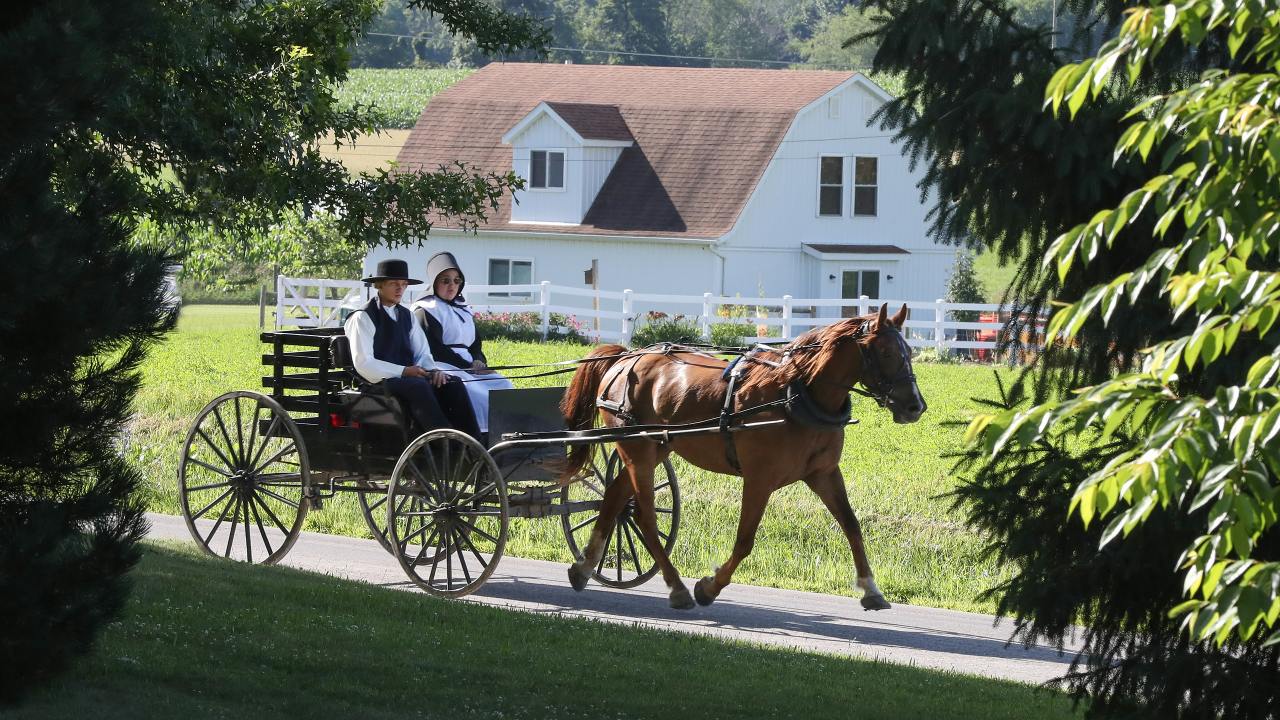
In the rolling farm country of the Midwest, a quiet transportation revolution is unfolding on gravel shoulders and two-lane blacktop. Where horse-drawn buggies once set the pace of daily life, electric bicycles now glide past with baskets full of tools, groceries, and children’s backpacks. The Amish are not abandoning their culture so much as recalibrating it, trading reins for handlebars in a way that even “Weird Al” Yankovic, with his “Amish Paradise” parody, might not have imagined.
What looks like a quirky juxtaposition from the outside is, for Amish communities, a serious and carefully negotiated shift. E-bikes promise speed, independence, and economic opportunity, but they also test long-standing rules about simplicity, humility, and separation from the modern world. The result is a case study in how a tradition-bound society selectively absorbs new technology without surrendering its core identity.
From buggies to batteries in Holmes County
Nowhere is the change more visible than in Holmes County, Ohio, one of the largest Amish settlements in the world. On roads that once belonged almost entirely to horse-drawn rigs, electric bikes have become a common sight, often overtaking the very buggies that long symbolized Amish life. Local observers describe e-bikes as “ubiquitous” in this region, with riders in plain dress cruising past fields and farmsteads at speeds that would have been unthinkable when travel meant a horse and a steel-rimmed wheel.
The shift did not happen overnight. Earlier adoption of push scooters and traditional bicycles laid the groundwork, familiarizing church leaders and families with pedal-powered mobility before motors entered the picture. As e-bike technology improved and prices fell, shops dedicated to serving Amish customers emerged in the heart of Holmes County, including businesses that specialize in models tailored to plain communities. One local retailer, operating under the name E-Bikes of Holmes County, now markets electric bicycles as a practical tool that fits Amish values when configured with the right features and power sources.
Why e-bikes fit Amish logic about technology
For outsiders, the sight of a community that rejects private cars yet embraces lithium-ion batteries can seem contradictory. Within Amish logic, however, the distinction is less about the gadget itself and more about what it does to social life. Church leaders often stress that technology should not intrude into the home or undermine the cohesion of the group. E-bikes, in their view, can be framed as a tool for work and church rather than a status symbol, especially when they are limited in speed and stripped of flashy styling.
That reasoning helps explain why roughly two-thirds of Amish churches now permit e-bikes, while about one-third still oppose them. The congregations that allow electric bicycles often do so under conditions, such as requiring pedal-assist rather than throttle-only systems, or insisting that batteries be charged from off-grid or solar sources. In some communities, e-bikes are explicitly justified as a way to maintain face-to-face ties, allowing members to travel farther to visit relatives, attend worship, or support church events without relying on hired drivers or public buses.
Speed, distance, and a “totally different lifestyle”
The most immediate impact of e-bikes is practical: they compress distance. In sprawling rural settlements, a horse and buggy can turn a simple errand into a half-day commitment, especially on hilly terrain. Electric assistance changes that calculus. Riders in Holmes County and in northern Indiana report that they can now cover 15 or 20 miles in the time it once took to travel a fraction of that distance by buggy, and they can do it without arriving drenched in sweat or exhausted from pedaling a heavy steel frame.
That new mobility is reshaping daily routines. One researcher, Joseph Donnermeyer, has described the effect as a “Totally Different Lifestyle,” noting that e-bikes are now accepted in many Amish communities as a normal part of life. In northern Indiana, photos of rows of parked e-bikes outside Amish-owned businesses illustrate how quickly the machines have moved from novelty to necessity. Local commentary highlights “Speed & mobility” as the key attractions, with riders using e-bikes to commute to factory jobs, reach farm fields scattered across the countryside, and shuttle children to schools or youth gatherings that would otherwise require arranging a car ride with an English neighbor.
Business, tourism, and the e-bike economy
The rise of e-bikes is not only changing how Amish people move, it is also reshaping local economies. In Holmes County, dedicated e-bike shops have become fixtures of the commercial landscape, selling, repairing, and customizing bikes for Amish customers. These businesses stock step-through frames that accommodate long dresses, heavy-duty racks for hauling milk cans or tools, and accessories like large baskets and child seats that match the practical needs of farm families. Some retailers emphasize that their models are tuned for reliability on gravel roads and steep hills, rather than for sport or recreation.
Tourism is also adjusting to the new reality. Regions that once marketed the horse and buggy as the defining image of Amish life now find that visitors are just as likely to encounter a line of electric bikes outside a bulk food store or roadside bakery. Travel guides that once highlighted carriage rides increasingly mention e-bike rentals and guided rides through Amish country, even as they note that the machines are controversial in some church districts. The visual contrast of a black buggy and a sleek electric bicycle sharing the same lane has become part of the region’s brand, a reminder that tradition and innovation are now intertwined in the rural Midwest.
Debates, limits, and what comes next
Despite their growing presence, e-bikes remain contested within Amish society. The one-third of churches that still reject them often voice concerns that higher speeds could encourage unnecessary travel, weaken local ties, or foster a sense of individual freedom that conflicts with communal discipline. Some leaders worry that young people on fast bikes might be more tempted to explore distant towns, entertainment venues, or online-connected spaces that sit far outside the traditional Amish orbit. Others question whether the cost of high-quality e-bikes, and the batteries and maintenance they require, might introduce new forms of inequality between families who can afford them and those who cannot.
Even in communities that accept e-bikes, boundaries are constantly renegotiated. Rules about maximum motor power, acceptable charging methods, and where bikes may be parked near church buildings are all subject to ongoing discussion. At the same time, the underlying logic that has guided Amish engagement with technology for generations still applies: tools are evaluated by their impact on faith, family, and community, not by their novelty. In that sense, the sight of a plain-clothed farmer gliding past a cornfield on a battery-assisted bike is less a break with the past than another chapter in a long-running effort to live apart from the modern world while still moving through it.
More from Fast Lane Only