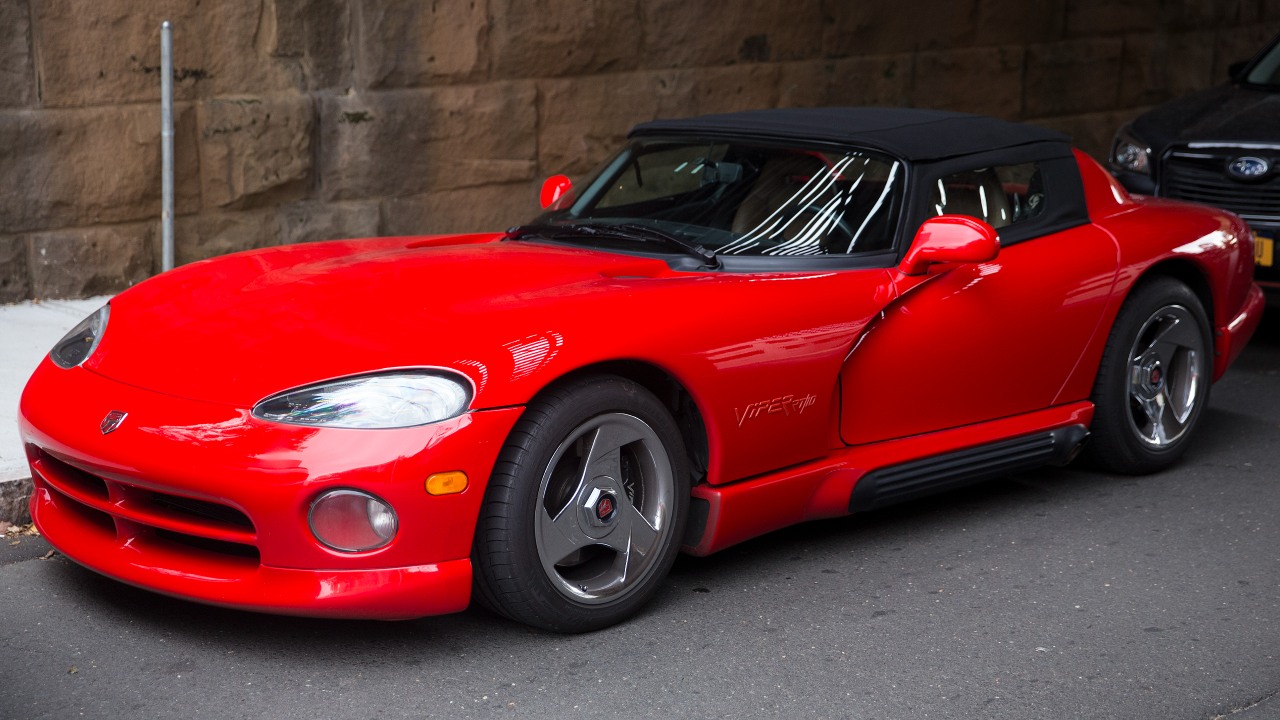
The Dodge Viper RT/10 arrived as a shock to a cautious industry, a brutal roadster that rejected the rising tide of comfort and electronic safety in favor of raw speed and spectacle. Its appearance at the start of the 1990s sent a jolt through performance car culture, reshaping how American manufacturers, enthusiasts, and even rivals thought about homegrown supercars. Across that decade, the RT/10 did not simply sell in modest numbers, it altered expectations of what an American performance flagship could be.
By pairing a massive V10 with a stripped back, almost primitive chassis, the Viper RT/10 made excess its central design principle and turned that extremity into a marketing weapon. The result was a car that influenced corporate strategy at Chrysler, inspired a generation of enthusiasts, and left a legacy that still colors how modern high performance models are judged.
From audacious concept to hand built reality
The origins of the Dodge Viper RT/10 lie in a deliberate decision inside Chrysler to build a dramatic, front engine sports car that could stand apart from European rivals. According to reporting on the First Generation, the idea was championed by Chrysler executive Bob Lutz, who wanted a modern interpretation of a big engine, minimal compromise American performance car. That vision took shape in the late 1980s, when Dodge unveiled a concept that previewed the long hood, side exhaust and open cockpit that would define the production RT/10. The car that finally reached buyers in the early 1990s stayed remarkably close to that concept, signaling that Chrysler was willing to prioritize drama over convention.
When the Dodge Viper RT/10 went on sale, it did so in tightly controlled numbers that underscored its halo status. One account of the launch notes that Only 285 examples were produced in the first model year, reinforcing the sense that this was a hand built special rather than a mass market sports car. Later reporting on the model’s production run describes how Only 6709 RT/10s were ultimately assembled before the roadster was replaced by the SRT/10, a figure that highlights how the car’s influence far exceeded its volume. That scarcity, combined with the car’s uncompromising specification, helped the RT/10 feel more like a statement of intent than a simple product line.
Engineering a blunt instrument in a cautious era
The Viper RT/10’s technical package was as confrontational as its styling. Instead of a high revving, small displacement engine, Dodge and Chrysler engineers adapted a large truck based V10 into a performance unit, creating the 8.0 liter motor that defined the early RT/10. Coverage of the powertrain notes that The Viper engine story began with this 8.0 liter V10, which was reworked with a low profile cross ram intake and dual throttle bodies for the sports car application. A museum description of a 1994 example explains that the Viper version of the engine used that intake layout to keep the hood line low while still feeding the large displacement V10, a detail that underlined how form and function were intertwined in the RT/10’s design.
Performance figures from period sources confirm that the early RT/10 delivered serious numbers for its time. Valuation data for 1993 Vipers cites output of 400 horsepower and 450 lb-ft of torque, with an impressive redline of 6,000 rpm, and a top speed originally quoted at 164 mph. A separate overview of the RT/10’s pros and cons notes that the 8.0 liter V10 was rated at 400 hp, reinforcing how the car relied on torque rich, low rev power rather than sophisticated electronics. Later in the decade, incremental improvements pushed output higher, with one history of the model recording that by 1997 the RT/10 received a power increase to 450 hp along with other refinements, showing that Dodge continued to sharpen the package while preserving its essential character.
Deliberate minimalism and the cult of difficulty
If the engine defined the Viper RT/10’s personality, the rest of the car made clear that comfort and convenience were secondary concerns. Contemporary and retrospective accounts emphasize that early RT/10s arrived with no fixed roof, side curtains instead of proper windows, and a sparse interior that prioritized weight savings. A video profile of a 1993 car captures this ethos with the line “no windows no roof no apologies,” noting that in the early 1990s, while much of the industry chased comfort, safety and refinement, Dodge went in the opposite direction. That choice turned the RT/10 into a kind of rolling manifesto against the creeping civility of performance cars, and it quickly became part of the car’s legend.
The absence of electronic driver aids further reinforced the Viper’s reputation as a car that demanded respect. Analysis of the V10 model’s dynamics describes how The Dodge Viper V10 went down in history as one of the wildest and most unpredictable sports cars to come out of the United States, difficult to control but easy to love. That difficulty became a selling point, especially among enthusiasts who saw the RT/10 as an antidote to increasingly filtered driving experiences. Later test drives of mid decade cars, including a 1996 Dodge Viper RT described as the definition of an untamed beast, underline how the lack of traction control and the abundance of torque kept the car’s reputation intact even as incremental updates arrived.
Reshaping Chrysler’s image and the 1990s performance landscape
The Viper RT/10’s impact extended far beyond its own sales figures, reshaping how Chrysler and its Dodge division were perceived in the 1990s. A detailed history of Viper development notes that the first generation car was a fiscal success on its own terms, inexpensive to develop and consistently oversubscribed relative to production capacity. More importantly, it helped revive Chrysler’s image at a time when the company needed a bold statement, influencing brand perception in ways that were difficult to quantify but widely acknowledged. The RT/10 became a rolling advertisement for American engineering confidence, signaling that Chrysler could build something as dramatic and desirable as any import.
That halo effect rippled across the broader performance market. An overview of The Dodge Viper describes the car as an American sports car icon, designed from the outset to challenge European exotics and Japanese imports. Another analysis frames the RT/10 as an Underrated American supercar or bonkers muscle car, depending on perspective, but in either case a deliberate attempt by Chrysler and Dodge to resurrect interest in a homegrown halo model. Social media histories of the 1992 Dodge Viper RT/10 repeatedly describe it as a wild, unapologetic American supercar reborn, a phrase that captures how the car came to symbolize a broader resurgence of American performance in the decade.
Enduring myth, limited numbers and a louder future
Although the original RT/10’s production run was relatively short, its cultural footprint has proved durable. Enthusiast reflections describe how The Dodge Viper RT was the car on bedroom walls in the 1990s, displacing Lamborghinis and Ferraris for some young fans who were captivated by its exaggerated proportions and bright colors. Video features on individual cars, such as a profile of a 93 Dodge Viper RT10 hosted by Dustin on East Coast Garage, reinforce how owners still see these early roadsters as bucket list machines rather than mere collectibles. Even in the context of later Vipers, including a 2005 Dodge Viper with a 500 horsepower 8.3 liter V10 that is praised for its value, the original RT/10 retains a special status as the purest expression of the concept.
More from Fast Lane Only