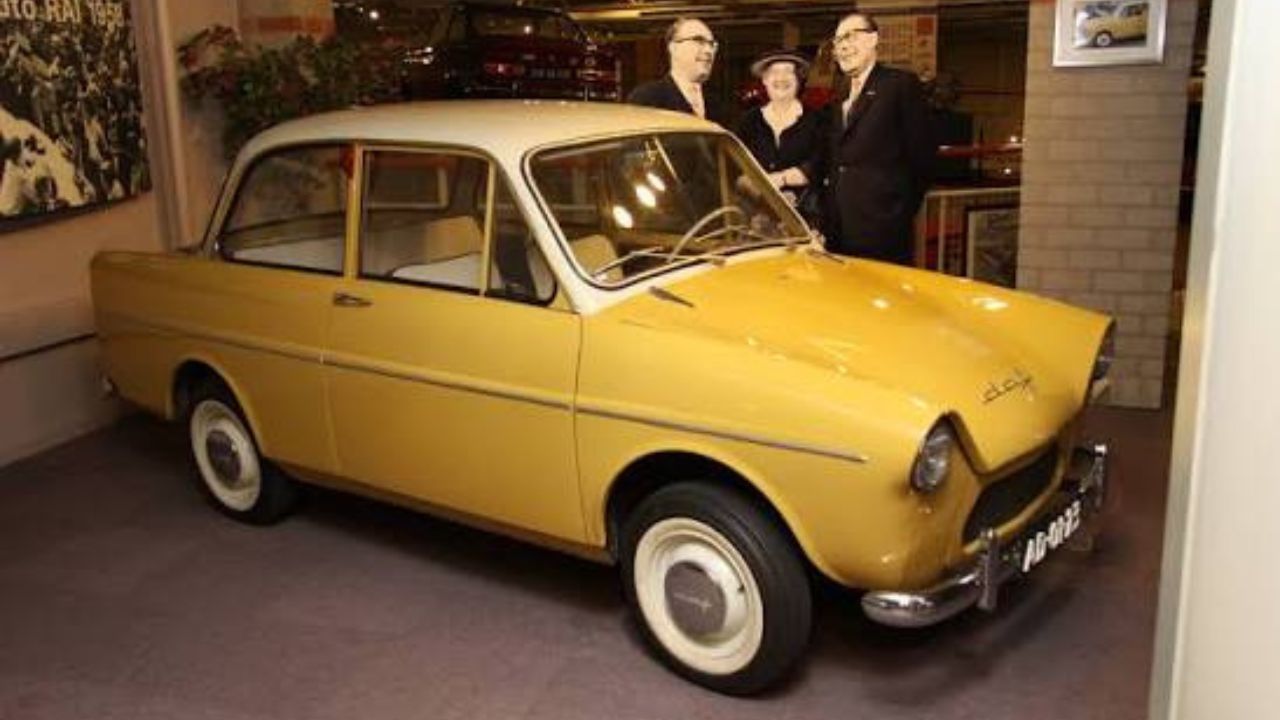
The 1958 DAF 600 may not be as famous as many classic European cars, but it introduced one of the automotive industry’s most forward-thinking ideas. At a time when nearly every small car relied on a manual gearbox, the Dutch-built DAF 600 featured a continuously variable transmission (CVT). Although the concept was decades ahead of its time, the technology struggled to gain widespread acceptance, making the DAF 600 one of history’s most overlooked engineering pioneers.
DAF Wanted to Simplify Everyday Driving
During the 1950s, most affordable European cars came with manual transmissions that required frequent shifting, especially in busy city traffic. DAF believed there was a better solution—one that would make driving easier without sacrificing efficiency.
The company developed an innovative transmission called the Variomatic. Instead of fixed gears, it used a system of variable-diameter pulleys connected by reinforced rubber drive belts. As engine speed and road conditions changed, the pulleys automatically adjusted their effective diameters, creating an infinite range of gear ratios within the transmission’s operating range.
The result was remarkably smooth acceleration with no traditional gear changes. Drivers simply selected forward or reverse and allowed the transmission to manage engine speed automatically.
For many motorists unfamiliar with automatic transmissions, the system offered a surprisingly modern driving experience.
The Technology Was Unlike Anything Else on the Road
The Variomatic transmission challenged nearly every convention of automotive engineering. Without first, second, or third gears, the engine could remain near its most efficient operating speed while the transmission continuously adjusted to changing conditions.
This approach eliminated the noticeable shift points common to both manual and conventional automatic transmissions. The DAF 600 accelerated smoothly, making city driving particularly comfortable and reducing the learning curve for inexperienced drivers.
The compact transmission also suited the small rear-mounted engine, allowing engineers to maximize interior space without adding unnecessary mechanical complexity elsewhere in the vehicle.
Although unusual, the system demonstrated that traditional stepped gearboxes were not the only solution for passenger cars.
Public Skepticism Slowed Wider Acceptance
Despite its technical innovation, the DAF 600 faced several challenges that limited its commercial impact. Many drivers were unfamiliar with the idea of a transmission that operated without distinct gear changes, and some questioned whether belts could be as durable as conventional gears.
The modest power output of the DAF 600 also shaped public perception. Because the car was designed primarily as economical transportation rather than a performance vehicle, some buyers mistakenly associated the transmission with limited capability rather than engineering innovation.
Service knowledge also remained limited outside DAF dealerships. Mechanics accustomed to traditional gearboxes sometimes found the Variomatic unfamiliar, making some owners hesitant to embrace the new technology.
These factors slowed adoption even though the basic concept proved remarkably effective for everyday driving.
A Pioneer That Influenced Modern Automotive Engineering
Although the DAF 600 itself remained a niche vehicle, its transmission concept survived long after production ended. Engineers continued refining CVT technology, replacing early rubber belts with stronger steel belts, improving electronic controls, and dramatically increasing reliability.
By the late twentieth and early twenty-first centuries, CVTs had become common in compact cars, hybrids, and economy vehicles around the world. Modern versions offered better fuel efficiency, smoother operation, and greater durability while following the same basic principle introduced by DAF decades earlier.
Today, automotive historians recognize the 1958 DAF 600 as an important milestone in transmission development. It demonstrated that continuously variable gear ratios could provide practical advantages long before computing power and advanced materials allowed the technology to reach its full potential.
Looking back, the DAF 600’s forgotten CVT experiment was less a failed idea than an innovation that arrived ahead of its time. While the automotive world initially hesitated to embrace such an unconventional transmission, the principles pioneered by DAF eventually became a familiar part of millions of modern vehicles, proving that some of the industry’s most influential breakthroughs begin quietly.
More from Fast Lane Only
- Unboxing the WWII Jeep in a Crate
- 15 rare Chevys collectors are quietly buying
- 10 underrated V8s still worth hunting down
- Police notice this before you even roll window down
*Research for this article included AI assistance, with all final content reviewed by human editors