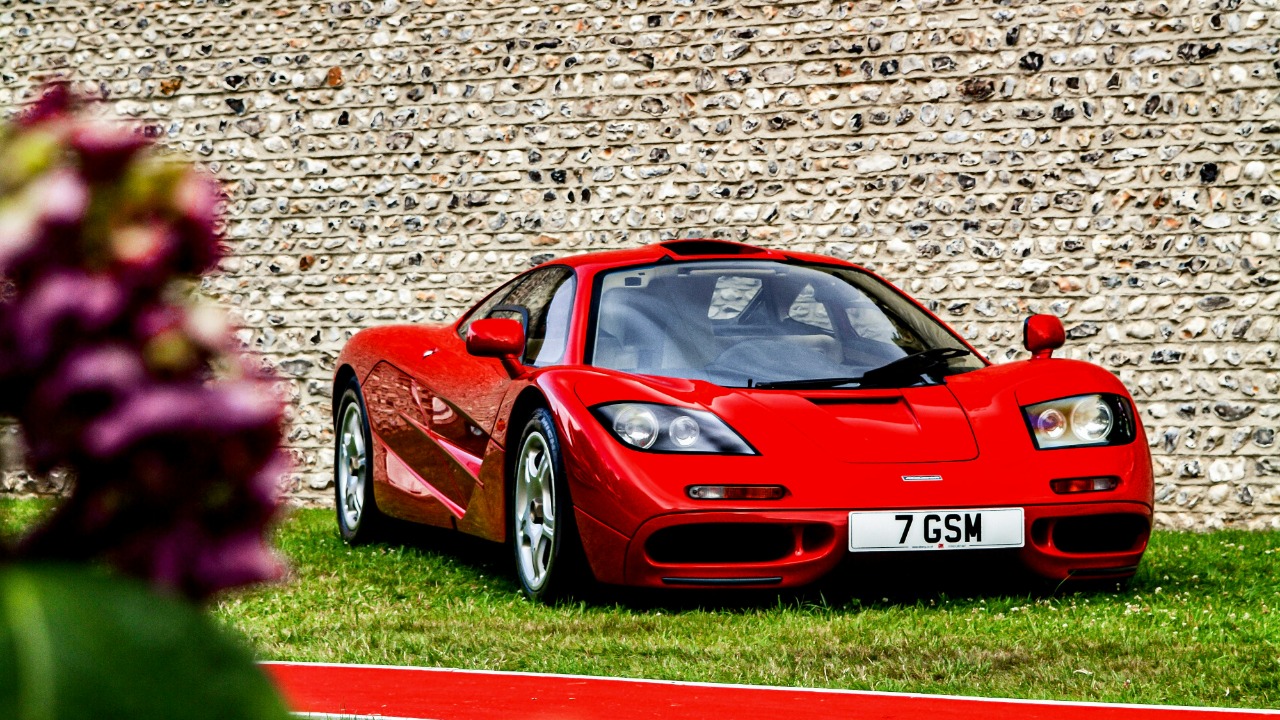
The McLaren F1 arrived in the 1990s as a road car that behaved like a prototype racer, a machine so far ahead of its time that rivals spent decades trying to catch it. Even now, more than thirty years on, its blend of speed, purity and scarcity keeps it out in front, like a shadow that the rest of the supercar world still cannot quite grasp.
Rather than fading into nostalgia, the F1 has only grown more influential as modern performance cars have become heavier, more complex and more digital. I see it less as a museum piece and more as a benchmark, a reminder of what happens when a small team pursues a single idea with almost obsessive focus.
Engineered to Perfection in an Analog Age
The McLaren F1 was conceived as a road car first, not a detuned racer, which is why its engineering still feels so singular. The design team chased minimal weight, compact packaging and driver focus, then wrapped those priorities in a body that was both low drag and visually restrained. That philosophy produced a car that was beautifully engineered and exceptionally quick, a combination that helped it break multiple world records in the 1990s and cement its reputation as one of the most exclusive cars in the world, a status reflected in how it is still described as engineered to perfection.
Underneath that understated shape sat a technical package that pushed road-car design into territory usually reserved for top-level motorsport. The F1 used a carbon fibre monocoque, exotic materials around the engine bay and a naturally aspirated V12 tuned for instant response rather than headline boost figures. In period, that approach made the McLaren F1 from McLaren Automotive a symbol of engineering excellence that pushed the boundaries of what was possible in a road-going supercar and helped turn it into one of the most iconic and revered performance cars in history.
From Experimental Vision to Production Reality

What makes the F1 story compelling is how methodical its creators were in turning a radical idea into something usable on public roads. The team refined the concept through a series of development prototypes, adjusting everything from aerodynamics to cooling before committing to full production. Once all creases were ironed out, the prospective internals were fitted to McLaren’s first carbon monocoque, and the early development cars have since been affectionately dubbed the XP cars, a detail that captures how the project evolved from pure experiment into a fully resolved legend once the engineering team was satisfied.
That careful gestation mattered because the F1 was never intended to be a mass-market halo model. It was built in tiny numbers, with each car effectively hand-finished, and the production run was deliberately capped to preserve its purity and value. In the end, In the final tally, 106 F1s were produced and of that total only 64 were pure road cars as originally envisaged by Gordon Murray, with the rest made up of variants such as the F1 GTR and F1 LM that extended the concept into racing and track-focused territory.
Scarcity, Value and the Sultan’s Secretive Fleet
The F1’s mystique is inseparable from its scarcity, and the production numbers are stark even by supercar standards. The model line was limited to just 106 examples across all variants, and only 64 were built as standard road cars, a combination that has helped turn the F1 into one of the most sought after supercars of the modern era and pushed auction prices into territory usually reserved for rare race cars and art.
That rarity also explains why the F1 has become a fixture in some of the world’s most secretive private collections. In general, the McLaren F1 from McLaren cars was a mid-engined sports car produced between 1992 and 1998, and today examples are valued in a range from 8 million dollars to 13.5 million dollars, figures that help explain why collectors such as the Sultan of Brunei have been linked to multiple chassis tucked away from public view.
From Road to GTR and the Birth of the Longtail
Although the F1 was designed as a road car, its underlying engineering made the jump to competition almost inevitable. The racing version, known as the F1 GTR, started life as a road-going supercar modified for the track, but as rival manufacturers began building purpose-designed racing cars and then offering them in tiny numbers for the road, things had changed and McLaren had to stretch the F1 concept further to stay competitive.
That pressure produced the Longtail evolution, which extended the bodywork for more downforce and stability at racing speeds and in the process created a silhouette that still influences McLaren’s modern LT models. While the Longtail variants were built in very small numbers, they reinforced the idea that the original F1 chassis and aero package had enough headroom to compete against bespoke race cars, a testament to how far ahead of the curve the original road car really was.
A Legacy Preserved, Not Replaced
Three decades on, the F1’s story is still being written, not through new production but through meticulous preservation and restoration. In total, 106 McLaren F1s from McLaren Automotive were built between 1993 and 98, among them 64 standard road cars, and specialist programs now exist to restore these cars to as-new condition so that everyone is eligible to keep running exactly as intended rather than being frozen as static investments.
That ongoing support underlines how the F1 occupies a different space from modern hypercars that chase ever larger power figures and complex hybrid systems. The original car was framed as beautifully engineered and exceptionally quick rather than simply powerful, and its combination of low weight, naturally aspirated response and central driving position has never been replicated at scale. I see that as the core of its enduring appeal: the McLaren F1 did not just set records in its era, it defined a template for driver-focused performance that later cars still reference but rarely match, which is why the world is still, in effect, chasing its shadow.