At highway speeds and on race tracks, air behaves less like empty space and more like a thick, invisible fluid that can be shaped, stolen, and weaponized. The difference between running alone in undisturbed flow and tucking into a rival’s wake can decide whether a car surges forward or stalls out in dirty turbulence. Understanding the science behind drafting, side-drafting, and clean air reveals why modern racing is as much about managing the atmosphere as it is about horsepower.
I see the same physics at work whether a stock car is slicing around Daytona, a Formula 1 machine is chasing through Monza, or a road driver is stuck behind a truck on the interstate. The core principles of drag, pressure, and airflow are universal, and they explain why drivers sometimes crave a slipstream and other times fight desperately to escape it.
How drafting really works in the air behind a car
Drafting, often called slipstreaming, starts with a simple aerodynamic reality: when a lead vehicle punches through the air, it leaves behind a region of lower pressure and disturbed flow. A trailing car that tucks into this wake experiences less aerodynamic drag, so it needs less power to maintain the same speed or can use the same power to go faster. In technical terms, the lead car has already done part of the work of pushing air aside, and the follower rides in that “hole” in the air, a principle that underpins classic explanations of Drafting.
That reduced drag is not just a theoretical gain. Educational material from Sonoma Raceway describes how the front car disturbs the air and creates a wake behind it, and how a trailing car that moves into that wake can save energy and increase speed because it is not plowing into undisturbed air at full force. The same logic appears in engineering discussions of Drafting in racing, which emphasize that aerodynamic drag rises sharply with speed, so any reduction in that resistance translates into meaningful performance. In practice, that is why a car tucked tightly behind another can slingshot past on a straight, using the draft to build speed before pulling out into clean air to complete the pass.
Clean air, dirty air, and why grip disappears in traffic
For all the benefits of a slipstream on the straights, the air coming off a car is rarely friendly in the corners. As a vehicle moves, its wings, bodywork, and rotating wheels churn the flow into a chaotic, swirling mess that aerodynamicists and drivers call dirty air. Technical explainers on Dirty air stress that the term has nothing to do with pollution and everything to do with turbulence: the smooth, laminar flow that wings need to generate consistent downforce is broken up, which can create sudden losses of grip and unpredictable handling.
Clean air is the opposite state, the undisturbed flow a car enjoys when it is running alone or far enough from rivals that their wakes do not interfere. In Formula 1, glossaries define Clean Air as air with minimal turbulence around the car, which allows the wings and underbody to work as designed. A separate explainer on What Is Clean Air In F1 notes that a car running alone can achieve optimal aerodynamic performance and cooling, because the airflow over the wings, radiators, and other surfaces is stable. When a following car dives into the wake of a rival, it trades some of that stability for reduced drag, which is why drivers often report that they can catch a car on the straight but then struggle to follow closely through a sequence of bends.
Why modern race cars struggle in another car’s wake

The dirty air problem is especially acute in high-downforce series, where cars rely on carefully managed airflow to generate grip. Technical breakdowns of What Is Dirty Air In F1 explain that the air coming off the rear of a car is highly turbulent, which disrupts the flow over the front wing and underbody of the car behind. That disruption reduces downforce, particularly at the front, so the following driver feels understeer and sliding just when they need precision to attack. Fans on technical forums echo this, noting that if a car is grip limited, it wants clean air, because the disturbed flow from a rival can rob the tires of the load they need to bite into the track.
Teams and rule makers have tried to address this by reshaping how cars generate downforce. A guide to 2022 Formula 1 aerodynamics explains that earlier generations of cars lost a significant portion of their downforce when running close behind another, which made overtaking difficult. The 2022 ruleset pushed more of the load generation to the underfloor and simplified the upper bodywork, with the goal of producing a wake that is less punishing for a car following within a few meters in what engineers still call Clean air. Even with those changes, the basic trade-off remains: on the straight, the wake is a gift that cuts drag; in the corners, it is a hazard that can strip away grip and cooling.
The physics and tactics of side-drafting
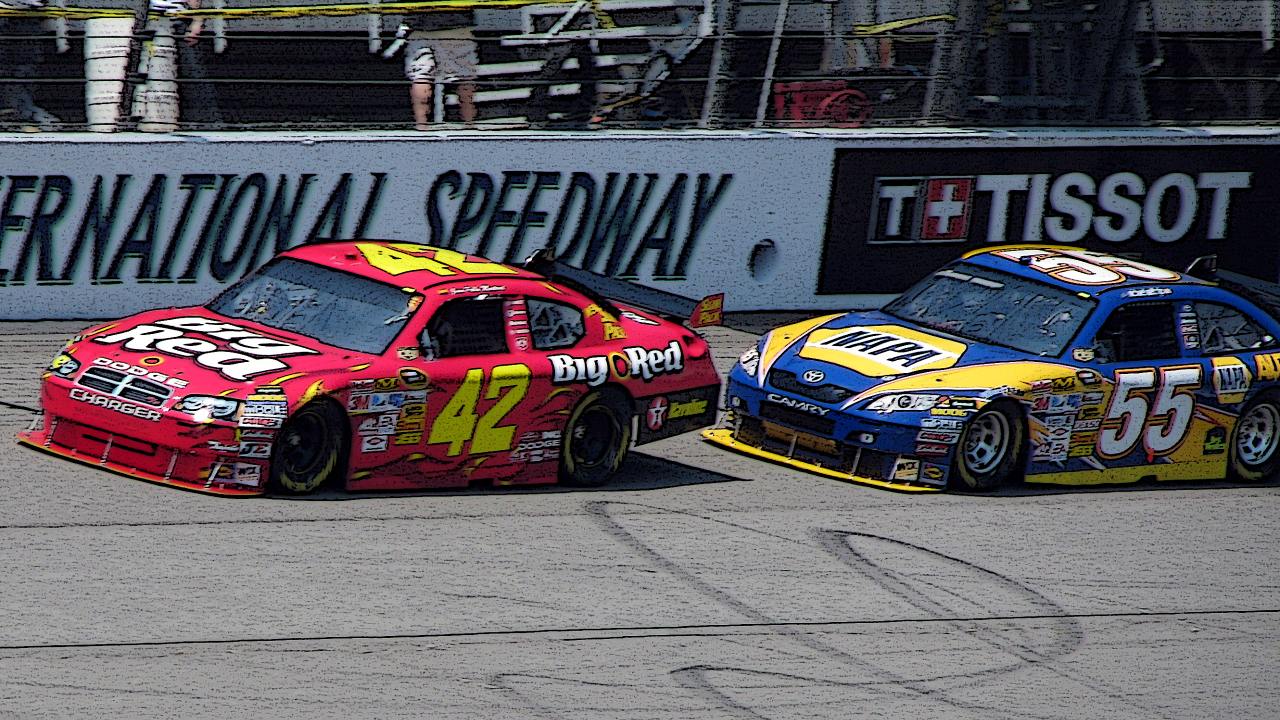
Side-drafting takes the logic of a slipstream and rotates it ninety degrees. Instead of tucking directly behind a rival, a driver pulls alongside, placing their car very close to the other’s flank. By doing that, they interfere with the airflow along the side of the opponent’s bodywork, increasing drag on the rival while slightly reducing their own. Explanations of Side drafting describe it as a technique used primarily in high-speed oval racing, where drivers position their car closely alongside another to manipulate the pressure field and slow the opponent just enough to complete a pass.
The science is subtle but powerful. When two cars run side by side with only a small gap, the air squeezed between them accelerates, which lowers pressure in that channel. The car closer to the trailing position can use this low-pressure region to reduce its own drag while effectively “pulling” on the side of the car ahead, increasing the leader’s resistance. That is why side-drafting is so visible in stock car racing, where drivers in Chevrolet Camaro ZL1 or Ford Mustang bodies will edge up to a rival’s quarter panel on a straight, hang there to bleed speed from the other car, then pop out into cleaner flow to finish the move. It is the same aerodynamic technique of exploiting pressure differences, just applied laterally instead of directly behind.
When drivers want clean air instead of a tow
Despite the obvious speed gain from drafting, there are many situations where a driver will sacrifice a tow to run in undisturbed flow. On technical circuits with long, loaded corners, the priority is often grip and consistency rather than top speed. Contributors in F1-focused discussions point out that if a car is power limited, it benefits from a slipstream on the straights, but if it is grip limited, it prefers clean air so the wings and underbody can generate maximum downforce. That logic explains why, in qualifying, drivers sometimes back off to find space rather than chase a rival’s wake, even at tracks like Monza where a tow on the straight is tempting.
Clean air also matters for cooling and engine performance. Technical explainers on ICE operation note that oxygen reaching the internal combustion engine, and air passing through radiators and over hot elements, all depend on stable, relatively undisturbed flow. When a car sits in another’s wake for too long, the turbulent, lower-pressure air can reduce cooling efficiency, forcing teams to open up bodywork or instruct drivers to move out of the slipstream periodically. Even road cars feel a version of this: a dirty engine air filter that restricts the supply of clean air can cut performance and efficiency, as service guides on how a dirty air filter affects a vehicle’s performance make clear. In both cases, the engine’s need for a steady, clean supply of air can override the short-term gains of sitting in a turbulent wake.
How teams and drivers balance the trade-offs
In practice, racing strategy is a constant negotiation between the benefits of reduced drag and the costs of lost downforce and cooling. On superspeedways, teams often build multi-car lines to maximize the drafting effect, but even there, engineers have to consider how many cars can realistically share the same wake. Aerodynamic analyses of multi-car packs note that while two cars in a line can both benefit, adding a third or fourth changes how the wake forms and can reduce the net gain, a point explored in discussions of why Some drafting formations work better than others.
On road and street circuits, the balance shifts toward managing tire life and aerodynamic stability. Drivers might use a slipstream on the main straight to close up, then deliberately drop back slightly in the twisty sections to keep their front tires in cleaner air and avoid overheating. Fans dissecting the difference between clean air and slipstream on technical forums often highlight this rhythm: use the tow where the car is power limited, then prioritize clean air where it is grip limited. That same trade-off shapes how teams set up their cars, from wing angles to cooling inlets, and it explains why a machine that looks dominant in free air can suddenly struggle when trapped in a rival’s wake.
More from Fast Lane Only: