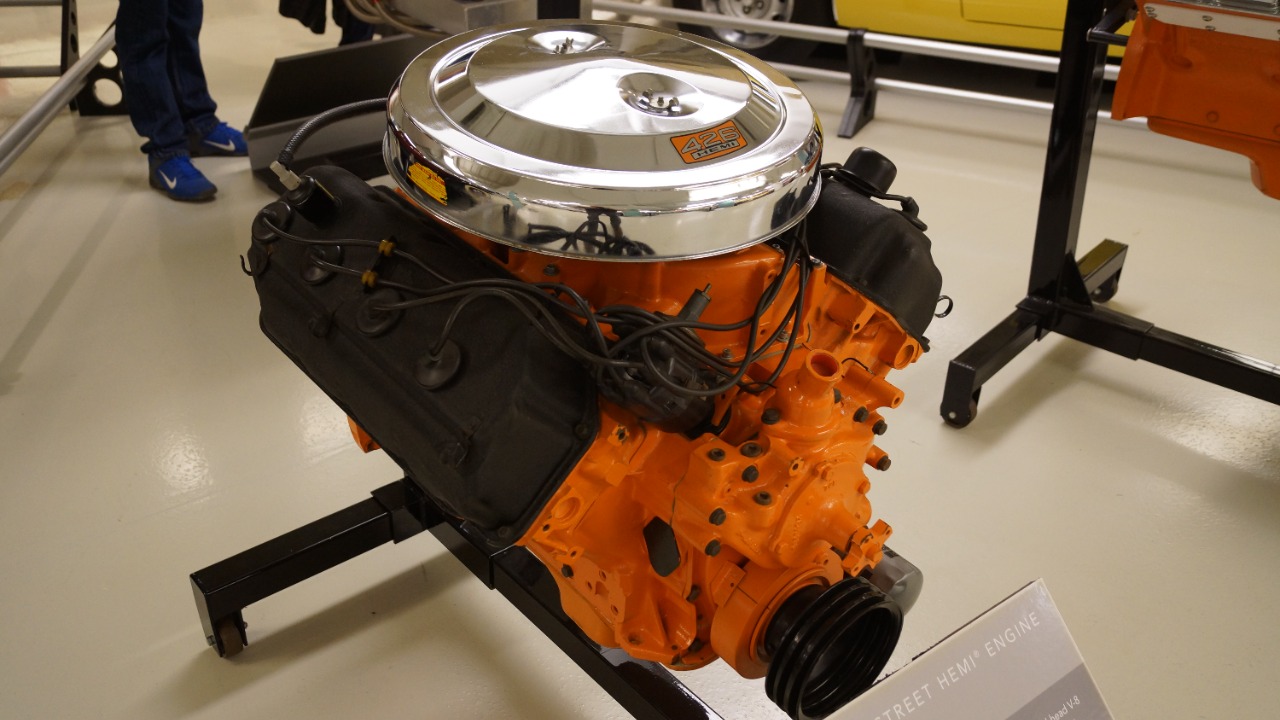
The 426 Hemi is remembered today as one of the most feared engines in muscle car history, but its path to production was far from guaranteed. Before it ever dominated drag strips and NASCAR headlines, it faced internal resistance, engineering skepticism, and serious pressure to be scrapped entirely within Chrysler’s own development system.
Chrysler’s race-focused engineering pushed the Hemi into risky territory
When Chrysler began developing the Chrysler 426 Hemi engine, the goal was simple: build a racing engine capable of dominating top-level motorsport. The hemispherical combustion chamber design promised superior airflow, higher efficiency at high RPM, and extreme power potential compared to traditional wedge-head V8s.
However, that same performance advantage created complications. The engine was expensive to produce, difficult to tune for street use, and required highly precise manufacturing tolerances. Inside Chrysler, some engineers questioned whether the cost and complexity could ever be justified for mass production, especially for a market that still valued affordability in performance cars.
NASCAR pressure forced Chrysler to rethink the Hemi’s future
The survival of the Chrysler 426 Hemi engine became closely tied to NASCAR competition rules. At the time, manufacturers were building engines specifically to meet racing homologation requirements, and Chrysler needed a competitive advantage against Ford and GM in high-speed oval racing.
Despite early success, regulatory changes and shifting NASCAR interpretations created uncertainty around the engine’s future. The cost of maintaining competitiveness in sanctioned racing programs under Chrysler put additional pressure on the program, leading executives to seriously consider whether the Hemi project should continue or be discontinued in favor of simpler, cheaper engine designs.
Engineering challenges nearly killed the program before street production
Beyond racing politics, the Chrysler 426 Hemi engine also struggled with real-world manufacturing challenges. Its hemispherical combustion chamber design required unique cylinder heads, specialized valvetrain geometry, and more expensive machining processes than standard V8 engines.
These complexities made it difficult to scale production efficiently under Chrysler’s cost structure. At one point, internal discussions reportedly leaned toward abandoning the project entirely or limiting it strictly to racing applications, where its benefits could justify its high production cost.
The Hemi survived because performance could not be ignored
Despite the doubts, the Chrysler 426 Hemi engine proved too powerful to abandon. Its real-world performance in racing environments demonstrated a clear advantage over competing engine designs, particularly in high-RPM durability and airflow efficiency.
As word spread of its capabilities, demand for street applications began to grow, especially in performance-focused models under Chrysler brands like Dodge and Plymouth. This external pressure helped secure its transition from a nearly canceled racing experiment into a limited-production street legend.
From near cancellation to muscle car immortality
What began as a risky engineering experiment became one of the most iconic engines in automotive history. The Chrysler 426 Hemi engine ultimately defined an era of raw, unapologetic performance and helped cement Chrysler’s reputation in the muscle car wars.
Today, its survival story adds to its mythology. The fact that the Hemi nearly never reached production makes its legacy even more significant, transforming it from just another big-block V8 into a symbol of what happens when engineering ambition narrowly escapes cancellation.
More from Fast Lane Only