Mechanics in the UK have a nickname for the sludge that shows up inside a neglected diesel engine. They call it “Black Death,” a thick, tar-like buildup that coats valve trains and chokes off oil passages until critical parts stop moving.
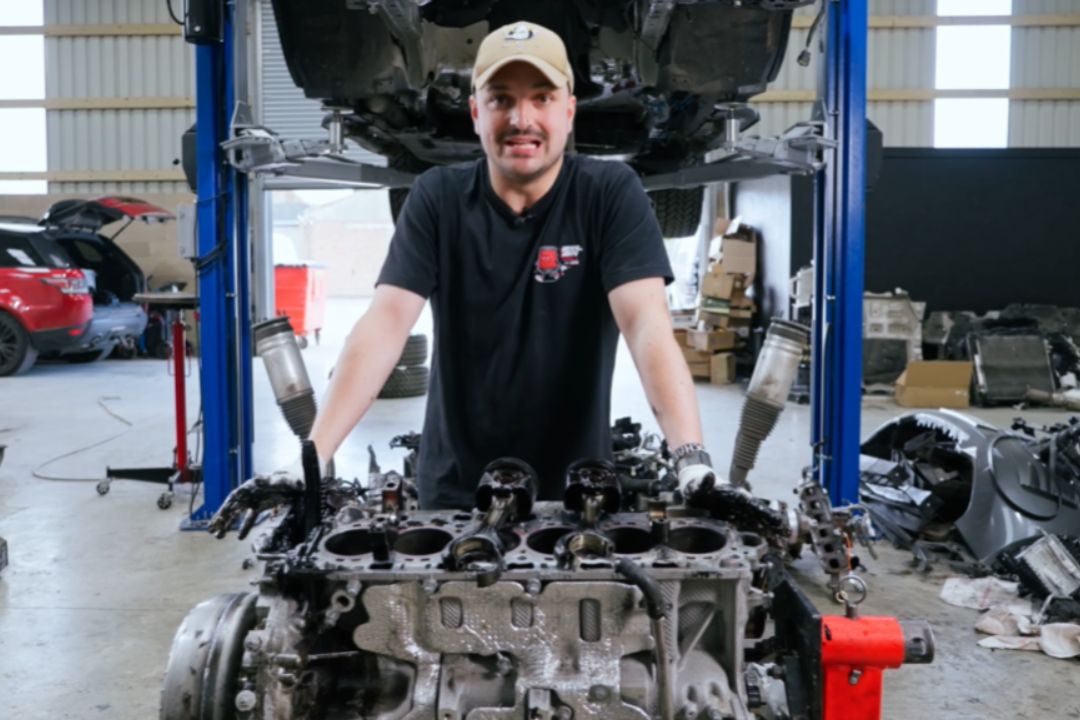
That name fits what specialists found when they opened up a Jaguar Land Rover AJ300D, a 3.0-liter turbocharged straight-six diesel that had built a reputation for being nearly indestructible. A five-year-old Land Rover Defender arrived at Diesel Heads, a UK workshop that rebuilds JLR engines, with the AJ300D locked up completely solid. The crankshaft would not turn even with a prybar against the flywheel.
What technicians found inside explains how an engine worth roughly $10,000 to replace or rebuild ended up destroying itself from within.
A Reputation Built on a Weak Predecessor
The AJ300D replaced JLR’s older 3.0-liter V6 diesel, an engine known for snapped crankshafts and balance problems. The new straight-six design solved that weakness on paper and is part of JLR’s modular Ingenium family, which also includes smaller three- and four-cylinder diesels. Output ranges from about 200 to 350 horsepower, and the engine has powered the Defender, Discovery 5, Range Rover, Range Rover Sport, Range Rover Velar, and Jaguar F-Pace.
Independent specialists said the AJ300D had earned a genuine reputation for durability, especially compared to JLR’s smaller 2.0-liter diesel, which has struggled with cylinder liner failures. According to Diesel Heads, this was the first AJ300D their shop had ever needed to rebuild.
What the Teardown Revealed
The top end was coated in heavy, tar-like sludge, and the intake ports were badly clogged with soot and hardened oil residue. Once the cylinder head came off, the liners showed no scoring, ovality, or the liner drop that has plagued smaller Ingenium engines. Structurally, the block itself was sound.
The real damage was in the bottom end. Metallic shrapnel was mixed into the sludge at the bottom of the oil pan, and one connecting rod journal showed extreme thermal bluing from friction heat. The rod bearing on that journal had spun completely out of position and welded itself directly to the crankshaft, and the heat and debris that followed damaged an adjacent main bearing as well. Technicians only freed the crankshaft after removing the affected rods and pistons to clear the welded material.
How an Oil Change Interval Destroys a Bearing
The failure traced back to something as ordinary as short trips around town. Modern diesels need periodic regeneration cycles to burn off soot trapped in the particulate filter, and vehicles that never drive long enough to complete those cycles allow unburned fuel to seep past the piston rings and dilute the oil. At the same time, exhaust gas recirculation keeps pulling soot back into the engine, and that soot mixes with the thinning oil to form the sludge found throughout the top end.
Once oil quality breaks down far enough, the protective film around the rod bearings fails. Diesel Heads technicians said a bearing can spin and weld itself to the crankshaft within seconds once lubrication is gone. They pointed to extended oil change intervals as the root cause, recommending 6,000 to 8,000 miles for engines driven mostly on short trips, well under the 20,000-plus miles some manufacturer schedules allow.
A Strong Engine, Undone by Maintenance
The AJ300D’s core design held up throughout the teardown. The block, liners, and timing components showed none of the structural weaknesses that have hurt JLR’s smaller diesels. What failed was not the engineering, but the maintenance schedule applied to it.
More from Fast Lane Only: