Buying a damaged car sight unseen is always a gamble. Most of the time, buyers get exactly what the listing describes and nothing more. Every so often, though, someone picks up a rough project and ends up with something far rarer than the average buyer would expect.
That is exactly what happened with a 2006 Aston Martin DB9 that recently changed hands in a private sale. The car had visible damage down one side and had clearly been sitting for a while, the kind of listing that usually attracts buyers looking for a straightforward fixer-upper rather than anything special. On the surface, it looked like a common story: a cheap DB9 that needed some bodywork before it could go back on the road.
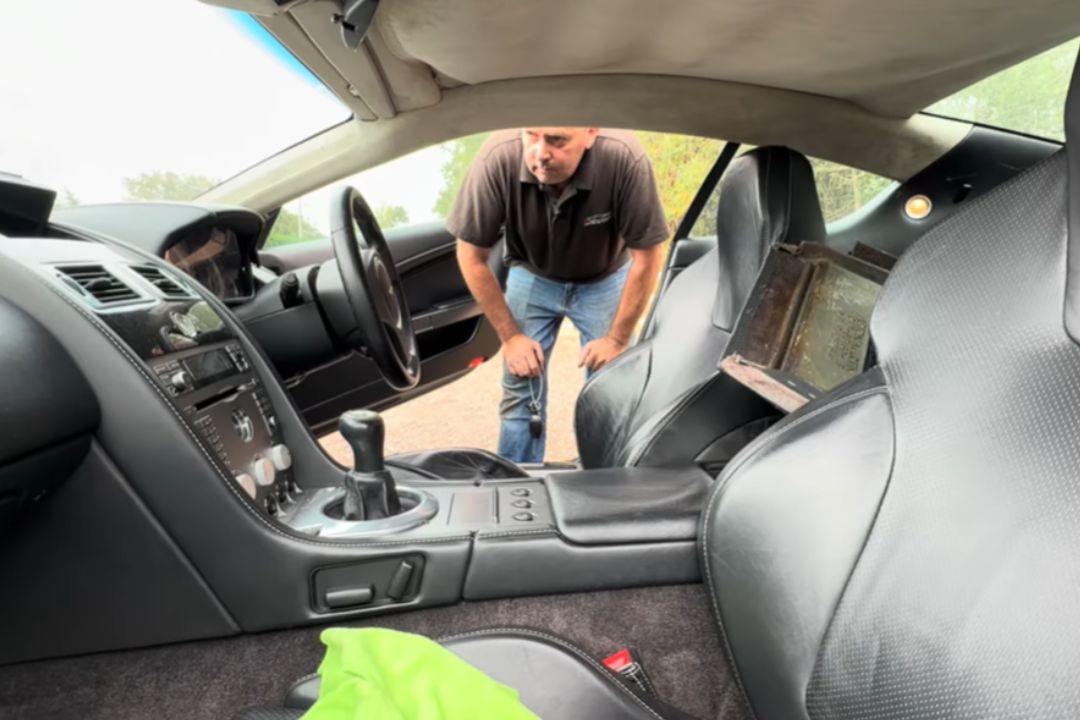
What set this car apart was the gearbox. This was not a standard automatic DB9, the version Aston Martin sold in the vast majority of cases. It was one of the rare six-speed manual cars, a variant that almost never comes up for sale in any condition. A routine cheap-project purchase turned out to be a car that enthusiasts rarely get the chance to buy at all.
A V12 Built for a Different Era
The Aston Martin DB9 launched with a naturally aspirated 5.9-liter V12, a formula that fit right in with the grand touring cars of its time. Aston Martin sold the DB9 mostly with a smooth automatic transmission, and the manual gearbox option was far less common on this car.
That imbalance is exactly why a manual DB9 stands out today. For enthusiasts who care about how a car drives rather than just how it looks, that gearbox turns an already desirable GT into something closer to a collector’s piece.
Finding the Car
This particular DB9 came from a seller who had picked it up through a salvage auction. Despite going through that channel, the car did not carry an official salvage title or insurance write-off marker. A vehicle history check on the car turned up a couple of prior damage assessments instead, including one that estimated repair costs in the range of 20,000 to 22,500 British pounds. That figure points to real structural work being needed, even though the car had not been formally recorded as a write-off.
Once the buyers looked the DB9 over in person, the damage turned out to be concentrated on one side of the car, mainly around the rear quarter panel. The wheels showed heavy curb damage, and some areas of the body had discolored paint protection film that had clearly been on the car a long time. None of it looked catastrophic, but it was enough to explain why the car had ended up selling for a fraction of what a clean example would bring.
Getting It Running Again
With the battery flat, the first job was simply figuring out if the V12 still ran. After putting the battery on charge, the engine fired up and settled into a smooth idle, a good sign that the powertrain itself had avoided any major damage in whatever incident led to the car’s low price. A diagnostic scan turned up a long list of fault codes. The presenters suspected many were linked to a weak battery, though not every code cleared on the first attempt.
The locking wheel nuts still needed some work to remove. Years of corrosion meant they had to be chiseled and knocked loose with a socket, but once that method was worked out, all four came off without much trouble.
Why the Gearbox Changes Everything
None of this would matter nearly as much if the car had come with the standard automatic. A DB9 with cosmetic damage and some paint wear is still a nice find, but it is not an unusual one. Add a manual gearbox into the mix, and the calculation changes completely. The manual gearbox is what turns this into a car worth the extra repair effort, since automatic was the far more common choice for this generation of DB9.
That rarity is also why the repair plan makes sense from a financial standpoint in a way it might not for a more common car. Bodywork, a wheel refurbish, and sorting out the electrical faults are all straightforward jobs for a shop that specializes in this kind of project. None of it threatens the manual transmission itself, which is the part of this car that is genuinely hard to replace.
A Rare Survivor Worth the Effort
Cars like this do not stay hidden for long once people realize what they actually are. A V12 Aston Martin with three pedals is the kind of detail that turns a routine salvage pickup into a project worth finishing properly. The body damage will get repaired, the wheels will come back refurbished, and the electrical gremlins will likely clear up once the car has a healthy battery and some regular use again.
What will not change is the rarity of that gearbox. Once this DB9 is back on the road, it will belong to a small group of manual cars that most Aston Martin owners never get the chance to drive, and that is what makes the whole story worth following.
More from Fast Lane Only: