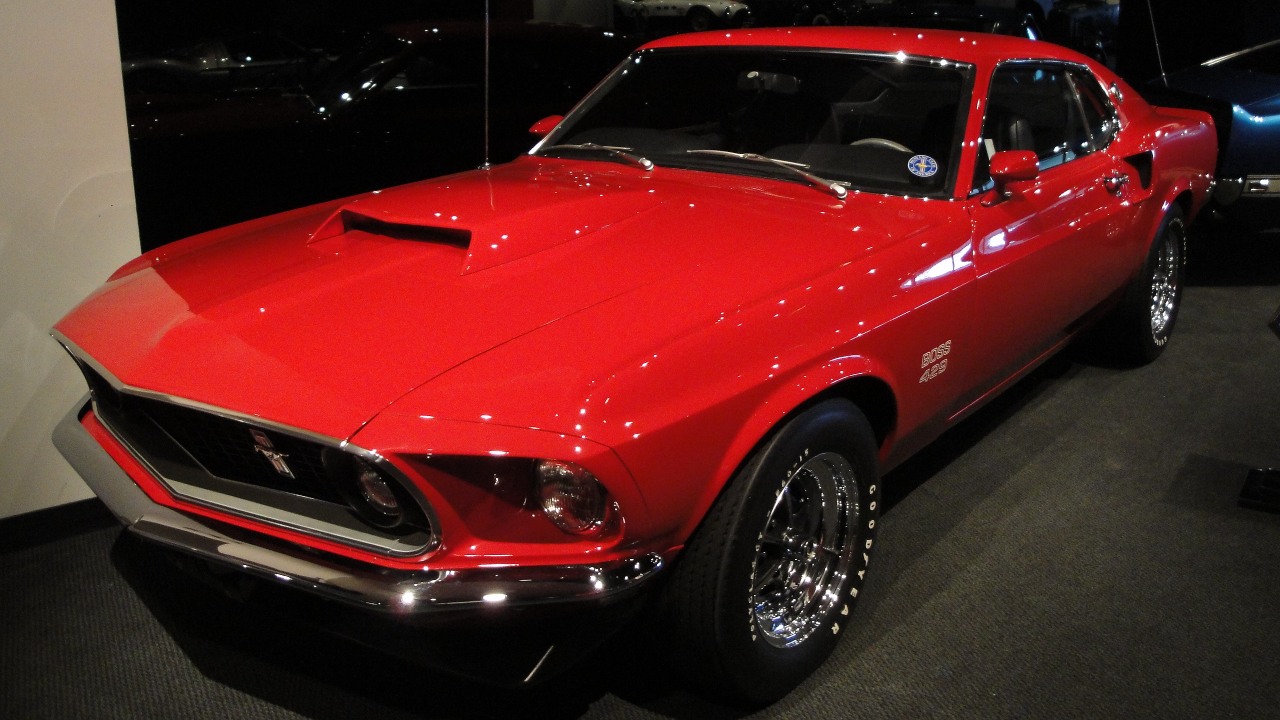
The Boss 429 arrived at a moment when the Ford Mustang risked being dismissed as a stylish commuter rather than a serious threat on track. By forcing an outsized racing engine into a compact pony car shell, Ford turned its showroom star into a blunt instrument aimed squarely at stock car supremacy. The year that car appeared, the Mustang’s reputation shifted from fashionable to fearsome, and the Boss 429 has defined the model’s hardcore image ever since.
The NASCAR problem that forced Ford’s hand
Ford did not create the Boss 429 out of a casual desire for more power, it did so because racing rules demanded it. When Chrysler launched the massively successful 426 HEMI V8 for NASCAR in 1964, the advantage was so decisive that Ford Motor Company suddenly faced a credibility crisis in America’s premier stock car series. The sanctioning body’s homologation rules required that engines used in competition be offered in production cars, so Ford needed a new big block that could match the 426 and a street-legal host to carry it into showrooms.
The Mustang, still relatively young but already a sales phenomenon, became that host. Instead of building a bespoke racer, Ford chose to turn its popular pony car into a homologation weapon, a decision that would permanently change how enthusiasts viewed the model. The resulting Boss program produced a family of competition-bred Mustangs, but none was more extreme than the variant created to answer Chrysler’s HEMI in NASCAR.
Engineering a Mustang around an engine
The Boss 429 program began with an engine that barely fit the car chosen to carry it. Ford’s new big block, sized at 429 cubic inches, was designed first for high rpm durability and breathing on superspeedways, not for easy installation in a compact unibody coupe. To make it work, engineers effectively had to rebuild the Mustang’s front structure, reworking shock towers and inner fenders so the massive cylinder heads and intake could clear the bodywork. The car was, in effect, reverse engineered around the powerplant rather than the other way around.
That engine, often referred to in period as a 429 M, was far more sophisticated than its simple displacement figure suggested. With large ports, free flowing heads and a bottom end built for sustained punishment, it was conceived as a racing tool first and a street engine second. The Mustang that carried it, commonly known as the Mustang Boss 429, therefore arrived with a chassis and engine combination that felt closer to a detuned stock car than a typical muscle coupe, even if its official output figures were conservative.
Homologation special, showroom sleeper
On paper, the Boss 429 did not look like a revolution. Factory ratings listed the 429 at figures that, at a glance, did not tower over other big block offerings of the era. Yet the car’s real purpose was not quarter mile bragging rights, it was NASCAR homologation. The Ford Mustang Boss 429 was a purpose built machine created so Ford could run the engine in stock car competition, and its street tune left considerable performance potential untapped for those willing to modify it.
That dual identity, part race hardware and part understated road car, helped reshape the Mustang’s image. The model had already gained performance credibility, but the Boss 429 signaled that Ford was willing to compromise comfort, packaging and cost in order to chase victories. Enthusiasts who understood the car’s origins saw it less as a boulevard cruiser and more as a thinly disguised competition chassis, a perception that still colors how the Mustang is judged against its rivals.
Scarcity, myth and the numbers that matter
The Boss 429’s impact on the Mustang’s reputation is amplified by how few were built. The Mustang BOSS 429, produced in 1969 and 1970, was assembled in very limited numbers to satisfy NASCAR’s minimum requirements rather than mass market demand. Only 859 were made in 69, and reports on a matching numbers example note that just 859 units in 1969 contributed to a total production run of only 1,358 cars across both years. That scarcity has turned the model into a touchstone for collectors and a benchmark for what a factory built performance Mustang can be.
Those production figures also explain why the Boss 429 looms so large in enthusiast memory despite its brief life. With so few cars on the road, each surviving example carries an outsized share of the story, from the early 1969 builds to the later 1970 versions that continued the same basic formula. Modern accounts routinely describe the Ford Mustang Boss 429 as one of the most revered and rare muscle cars ever built, and that reputation feeds back into the broader mythology of the Mustang as a platform capable of genuine racing pedigree rather than mere appearance packages.
From period weapon to modern icon
Over time, the Boss 429 has evolved from a specialized homologation tool into a cultural symbol of peak muscle car excess. Contemporary retrospectives on the 1969 Mustang Boss 429 emphasize how, in the golden era of muscle performance, this variant stood apart as an almost uncompromising expression of Ford’s racing ambitions. The car’s aggressive stance, functional scoops and subtle badging signaled intent without resorting to flamboyance, reinforcing the idea that the most serious Mustangs were built for speed first and spectacle second.
The model’s afterlife in restoration and collection circles has only deepened that aura. High profile projects, including carefully documented work on 1970 Boss 429 Mustang examples, highlight how much effort is required to return these cars to original specification, from recreating the unique front structure made to fit the engine to sourcing correct drivetrain components. Each restored Boss becomes a rolling reminder of the year the Mustang stopped being just a popular pony car and proved it could carry a 429 M born for NASCAR, a transformation that still shapes how every subsequent high performance Mustang is judged.
More from Fast Lane Only