Every terrible idea starts with someone saying “how hard could it be,” and this one started with a guy watching a video of a semi truck bolted to a boat and deciding the internet’s asking price was the only thing wrong with the concept. Everything else about it seemed fine. Five hours, a barn-find pontoon, and a truck with a blown engine later, that theory got tested against actual water, and actual water had opinions.
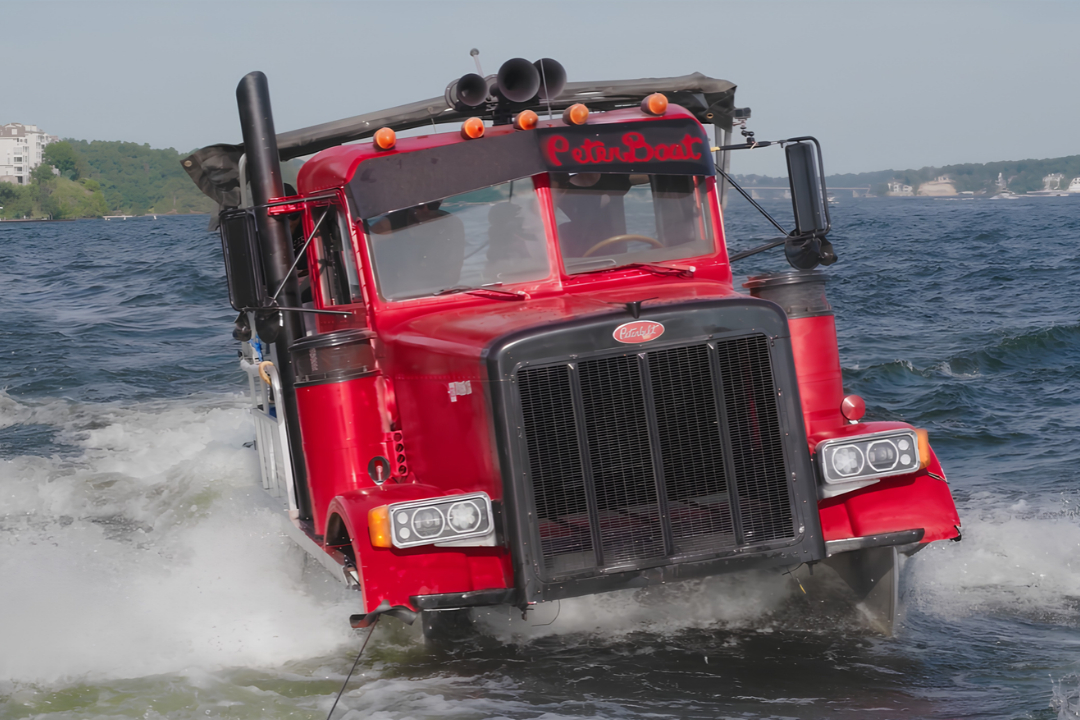
The idea itself wasn’t new. A version of it already existed online, a Peterbilt cab bolted to a pontoon hull, priced somewhere in the tens of thousands of dollars. That price tag was the whole reason to build one instead of buying one. A 1998 Sun Cruiser pontoon, purchased for $3,000 after sitting untouched in a barn for four years, provided the hull. A Peterbilt 379 with a blown engine and a severed hydraulic line provided the cab and hood, donating its front end to a project it would never actually be able to drive again.
Five hours later, the two were one boat. Whether that boat actually belonged on open water turned out to be a completely separate question, and not one anybody had time to answer before the trailer needed to hit the road for Lake of the Ozarks.
A five-hour deadline dictated every decision
The build moved fast because it had to. The team stripped the pontoon’s front section down to bare deck, measured out 112 inches of usable space, and found the Peterbilt’s cab and hood assembly came in at almost exactly that length, with just enough overhang to work. A forklift did the heavy lifting, threading its forks through the cab’s windows to hoist it into position, brake linkage and all still attached until someone remembered to disconnect it mid-lift.
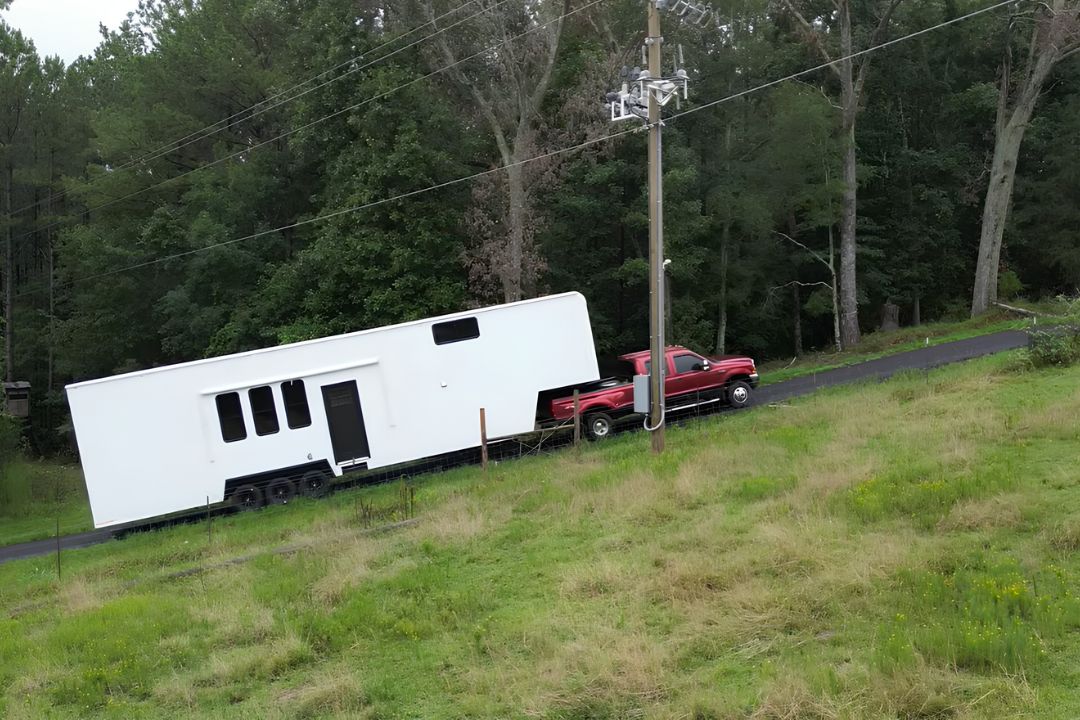
The cab’s weight caused an immediate structural problem. What had been a level trailer sagged badly in the middle once the front-heavy assembly settled onto it, enough that the crew stopped to weld a length of 4×4 steel tube along the center frame before the loaded trailer could safely make the drive. It was the kind of fix that wasn’t part of the original plan, discovered and solved in the same afternoon it became a problem.
By three in the afternoon, five hours after the first pontoon panel came off, the boat was finished. Red paint, black grille accents, a set of train horns wired in for good measure. Nobody involved could say for certain it would actually run right, let alone handle open water, but there wasn’t time left to test it before the drive to the lake.
It floated, right up until the water got rough
The first launch went better than anyone expected. The old two-stroke outboard, of uncertain vintage but clearly well past its prime, ran smoothly at the boat ramp and pushed the boat off the trailer under its own power. Inside the calm water of the ramp, the heavy front end rode low but stable, dipping toward the waterline without taking on water.
Open water told a different story. Once the boat left the shelter of the cove for the lake’s main channel, chop that would have been unremarkable for a normal pontoon became a serious problem for one carrying a several-hundred-pound steel cab on its nose. Waves washed directly over the front grille, and with the outboard’s airbox removed earlier to help the engine run smoother, water found its way into the exposed carburetor and stalled the motor entirely, stranding the boat mid-channel.
Getting back required help. A support boat towed the disabled Peterbilt-boat hybrid roughly three miles through rough water toward a lakeside bar, a slow and uncomfortable trip that made clear the build had reached the edge of what its underlying pontoon hull could handle.
The fix wasn’t mechanical, it was geographic
Rather than reinforce the boat further, the team changed the plan entirely for day two. Instead of returning to the open main channel, they launched from a ramp inside a sheltered cove, avoiding the chop that had caused the previous day’s problems altogether. The difference was immediate. In calm water, the same boat that had nearly been swamped a day earlier cruised comfortably, drawing curious looks from other boaters and even a slow pass from a local marine patrol crew that seemed more entertained than concerned.
It was, by the team’s own admission, obviously the wrong kind of build for open, choppy water and exactly the right kind of build for puttering slowly through a calm cove. The boat had never needed a mechanical fix so much as it needed a different body of water to exist on.
A build defined by what it survived, not what it accomplished
The Peterbilt boat never became fast, efficient, or particularly practical, and nobody involved seemed to expect otherwise going in. What it did do was float, survive a rough tow through open water without sinking, and eventually find a setting calm enough to let its novelty be the whole point rather than a liability. A late-night Facebook Marketplace find and a truck with nowhere else useful to send its front end turned into something that, on its best day, made an entire cove full of boaters stop and stare.
That’s a reasonable outcome for something built in five hours out of two vehicles that had no business being combined in the first place. It was never going to handle real chop, and once the team stopped trying to make it, the boat finally got to do the one thing it was actually built for: floating slowly, looking absurd, and drawing a crowd.
More from Fast Lane Only
- Unboxing the WWII Jeep in a Crate
- 15 rare Chevys collectors are quietly buying
- 10 underrated V8s still worth hunting down
- Police notice this before you even roll window down
*Research for this article included AI assistance, with all final content reviewed by human editors.