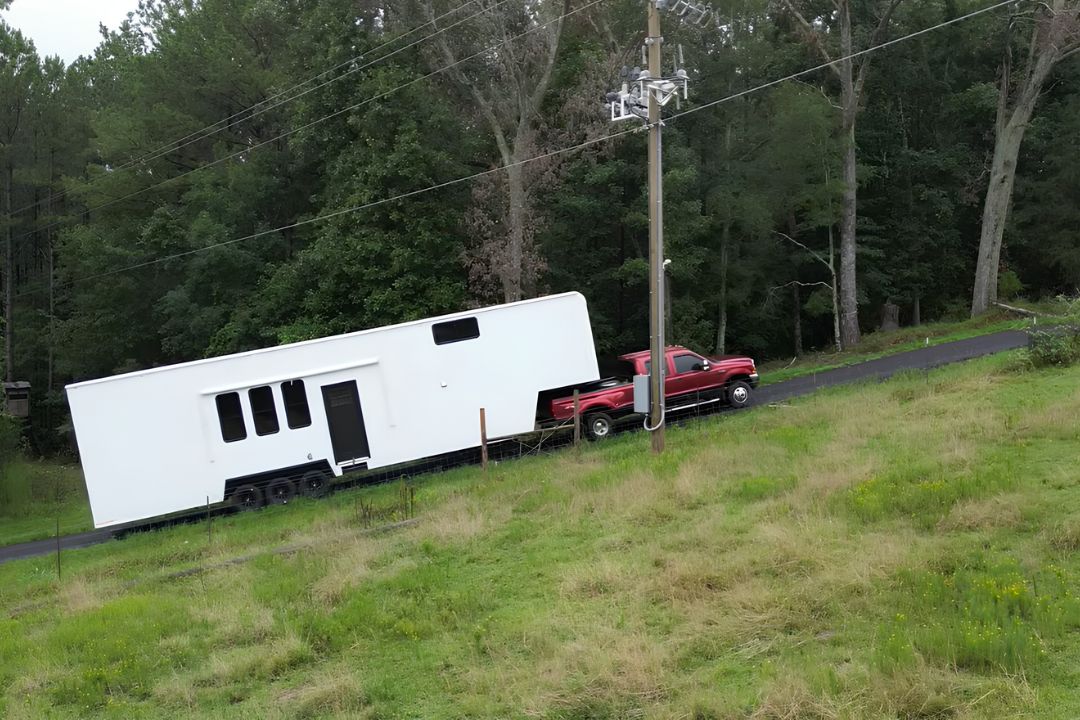
An 8,900-pound box trailer that once hauled race cars is not most people’s idea of a blank canvas. It arrived covered in dents and rust, filled with garbage and grass, with an actual bird’s nest inside and a hole large enough to make weatherproofing a joke rather than a feature. Chay and his brother Kobe looked at that same trailer, found on Facebook Marketplace, and decided it was exactly the starting point for what they’d end up calling the Mega Camper, a build that would eventually consume their entire May, June, and most of July.
The trailer itself was enormous even before any modifications, 43 feet long, 8.5 feet wide, and 10 feet tall, so large it barely fit in their parking lot on delivery. But size alone wasn’t the appeal. The brothers had a specific vision that required tearing the thing down to its bones and rebuilding it taller, stronger, and considerably more livable than anything resembling its original purpose as a rolling storage unit.
Cutting the roof off like a can opener
Demolition started with stripping the thin aluminum wall panels, which came off easily enough to reveal just how much interior volume the trailer actually had. That volume still wasn’t enough. With an 8-foot factory ceiling already taller than most campers, the brothers decided to raise the roof another 3 feet to make room for a two-story layout, cutting the entire sun-damaged original roof off the trailer and lifting it away with an excavator.
What followed was hours of welding in 85-degree heat, attaching 4-foot lengths of steel tubing to the existing wall channels to extend the frame upward, a process intense enough that Chay half-joked about accidentally starting a small fire mid-project. Once the new height was framed in steel, the team switched to wood for the actual roof structure, reasoning that lumber would be both stronger and easier to work with than trying to fabricate everything from metal. Re-skinning the whole exterior meant riveting on thousands of individual fasteners across new aluminum sheeting at $100 per sheet, a process so labor-intensive it took a full day per side of the trailer and left even Kobe visibly unenthused by the end of it.
A floor that used to smell like a racetrack
Structural problems hid inside the trailer too. Cracked, loose flooring throughout the cabin needed new screws and spray foam sealing around the perimeter, but the bigger issue was the smell. Because the trailer had spent years hauling race cars, oil had seeped directly into the floorboards over time, leaving a lingering odor that required an expensive specialized primer just to seal it off before any new flooring could go down. In the front loft area, the damage was too severe to patch at all, and that section of subfloor was torn out and rebuilt completely from scratch.
With the floor addressed, the brothers framed out an entire interior layout inside what had been an empty metal shell: a bathroom, a garage space in the back, a second bedroom above the garage, a third bedroom above the bathroom, and a staircase leading up to a master bedroom in the front loft, formerly just the raised bunk area from the original trailer. A proper front door replaced what had been an entrance exclusively through the garage door, and three windows went in to bring actual daylight into what had previously felt more like a tunnel than a living space.
More wire and pipe than a real house
Once the framing was locked in, the build shifted into infrastructure that had nothing to do with woodworking. Electrical work alone required drilling roughly 40 holes for wiring and running over 1,000 feet of cable to a central breaker panel located in the garage, a job the brothers’ father handled with enough confidence to make an intimidating tangle of wires look organized within about an hour.
Plumbing was arguably more involved. The build includes three separate sinks, in the kitchen, bathroom, and garage, plus a shower, a flushing toilet, and a washer and dryer, all draining through pipe runs Chay installed largely by himself, crawling underneath the trailer to connect everything to a 100-gallon black water tank capable of weighing over 800 pounds when full. To save money and construction time, the team skipped installing a dedicated freshwater holding tank entirely, opting instead to run gray water straight to a drain valve rather than build out a full three-tank system. A 36,000-BTU mini-split HVAC system, split across three separate zones covering the master bedroom, second bedroom, and main living area, handled climate control once the interior sealed up enough to hold air conditioning at all.
A four-week deadline that wasn’t a bit
About halfway through the build, Chay revealed the actual motivation behind the project: the entire camper was being built as a surprise, of sorts, for Kobe, who had reportedly wanted a giant camper to tow behind his own truck for years. Once finished, ownership of the Mega Camper would transfer entirely to him.
That sentimental framing came with real-world pressure attached. The family had already paid $2,000 to reserve beachfront camping spots six months in advance, locking in a hard departure date roughly four weeks out from that point in the build, with the exterior of the trailer still looking essentially untouched and unpainted. Getting everything finished in time meant dividing labor by specialty rather than working collectively room by room: Kobe took on an enormous cabinetry workload, building fronts, boxes, and eventually 54 individual cabinet doors from raw lumber, while Chay bounced between plumbing, electrical, and general finish carpentry, and their father filled in wherever needed, painting trim, priming walls, and installing doors throughout the camper.
Rather than spend $7,000 on stone countertops, the price the family had paid for similar counters in an earlier bus conversion project, the brothers ordered raw acrylic sheet material for roughly $2,000 and fabricated their own countertops by hand, cutting, gluing, and sanding the material into finished slabs across the kitchen, bathroom, and garage. Tile went into the bathroom, a custom coffered wood ceiling and built-in fireplace went into the living room, and carpet went into both loft bedrooms, transforming spaces that had looked like raw plywood boxes only weeks earlier into something that genuinely resembled finished rooms.
From parking lot eyesore to beach-bound rig
With the interior nearly finished, the trailer finally moved out of the workshop lot and into an open field for exterior painting, the first time anyone had actually seen the completed structure in motion. A full coat of white primer and paint, followed by black trim detailing to set off the massive white body, finished the exterior transformation from a battered, rusted box trailer into something that genuinely looked purpose-built rather than repurposed.
The finished Mega Camper made it out for its maiden trip on schedule, hitched behind Kobe’s truck and driven alongside the family’s separately converted bus to the beachfront campsite booked months in advance. What started as a neglected, foul-smelling storage trailer picked up off Facebook Marketplace ended the summer as a two-story camper complete with three bedrooms, three sinks, a working shower and toilet, a full kitchen, and a garage, built almost entirely by two brothers and their father working through a genuinely brutal deadline they’d set for themselves six months before the first cut was ever made.
More from Fast Lane Only
- Unboxing the WWII Jeep in a Crate
- 15 rare Chevys collectors are quietly buying
- 10 underrated V8s still worth hunting down
- Police notice this before you even roll window down
*Research for this article included AI assistance, with all final content reviewed by human editors.