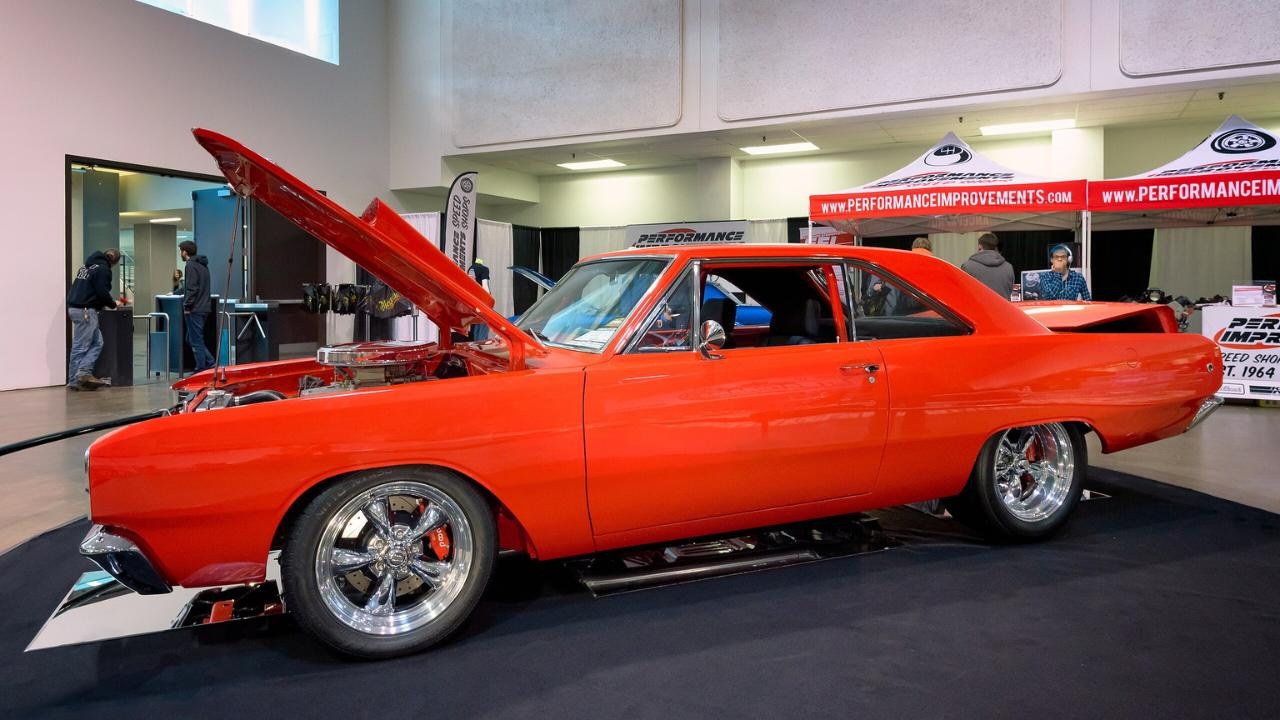
The 1968 Dodge Hemi Dart is one of those factory-built oddities that makes muscle car history feel almost improbable. Stripped to bare essentials, fitted with race hardware, and sold as a nominally street-legal car, it existed for a single purpose: to dominate the drag strip. Today, surviving examples sit at the intersection of race car, artifact, and blue-chip collectible.
What distinguishes this Dart is not just its legendary 426 Hemi, but how ruthlessly Dodge reengineered an ordinary compact into a quarter-mile weapon. Built in tiny numbers and delivered to a handful of favored racers, it stands as one of the most extreme interpretations of “factory performance” the Detroit Big Three ever attempted.
What happened
By 1968, Dodge already had a reputation for big power, but the compact Dart had been marketed as sensible transportation as much as a performance car. That changed when the company created a limited run of lightweight Darts fitted with the 426 cubic inch Hemi V8, intended primarily for Super Stock drag racing. According to period accounts, these cars were assembled as incomplete vehicles at Dodge, then shipped to outside contractors for the specialized engine and body work that turned them into purpose-built drag machines.
The Hemi itself was no ordinary street engine. The 426 cubic inch V8 had already proven itself in NASCAR and top-level drag racing, and in the Dart it was rated at 425 horsepower on paper. In practice, the actual output of the race-prepped engines was significantly higher, with internal components, camshaft profiles, and induction systems tailored for quarter-mile bursts rather than daily commuting. Combined with the Dart’s compact footprint and relatively short wheelbase, that power produced a car that could run deep into the 10-second range in factory-backed trim.
To make that performance possible, Dodge treated weight as the enemy. The Hemi Dart program replaced steel body panels where possible with lighter components, used thinner side glass, and deleted sound deadening and many comfort features. Even the seats and interior trim were chosen with weight savings in mind. One detailed breakdown of the model describes how the cars left the factory with simple bench seats, minimal carpeting, and a bare-bones dashboard, all in service of reducing mass for the drag strip.
Despite that focus, the cars were technically street legal. Dodge registered them as production vehicles, not pure race cars, which allowed them to qualify for certain drag racing classes that required factory-built bodies and drivetrains. A retrospective look at this strategy characterizes the Hemi Dart as a rare example of a street-legal drag car that most buyers at the time never even knew existed, sold through a quiet channel to racers and insiders rather than advertised to the general public.
Production numbers were tiny. Contemporary records and later research point to a run that numbered in the tens rather than hundreds, which explains why even seasoned Mopar enthusiasts can go years without seeing one in person. Many of the original cars were raced hard, modified heavily, and sometimes crashed, which further thinned the surviving population. The few that remain with original drivetrains and bodywork are now treated as historically significant competition cars as much as collectible muscle machines.
Why it matters
The Hemi Dart matters because it captures a moment when Detroit automakers were willing to bend the definition of a production car in the name of racing. This was not simply a high-performance option package. It was a competition program disguised as a showroom offering, designed to win trophies on Sunday and, at least in theory, wear license plates on Monday.
That approach helped cement Dodge’s identity within the broader Mopar universe. The Dart platform itself was usually seen as the accessible side of muscle, a compact that offered V8 power without the size or price of a Charger or Coronet. Market analysts examining the 1967 to 1976 Dart range have described it as a path to accessible Mopar muscle, a car that allowed buyers to tap into Chrysler performance without the premium attached to the halo models. The Hemi variant took that same shell and pushed it to the extreme, turning an everyman compact into a specialist drag tool.
From a historical standpoint, the car illustrates how intertwined factory engineering and grassroots racing had become by the late 1960s. Super Stock and related classes rewarded cars that could plausibly be ordered from a dealer, which encouraged manufacturers to create these limited, sometimes barely practical specials. The Hemi Dart, along with its Plymouth Barracuda counterpart, became a benchmark in that arms race, proving that a properly sorted factory car could threaten or beat heavily modified private builds.
Its influence also shows up in how modern manufacturers think about street-legal performance. The idea of a production car that is barely civilized enough for the road, but optimized for the drag strip, echoes in more recent machines that chase single-digit quarter-mile times straight from the factory. The Hemi Dart did that in an era without electronic traction control, advanced tire compounds, or modern safety systems, which gives its performance a raw, mechanical character that continues to fascinate collectors.
Collectability has followed that reputation. Surviving Hemi Darts often trade in a different orbit from ordinary Darts or even other period muscle cars, with values shaped as much by race history and documentation as by condition. Cars with known provenance in Super Stock competition, original engine blocks, and period-correct modifications tend to command the highest interest. For many Mopar fans, owning one is less about weekend cruising and more about preserving a piece of factory-backed drag racing history.
The car also helps explain why the broader Dart line has gained renewed respect among enthusiasts. While the Hemi version sits at the top of the pyramid, the existence of that extreme model casts a longer performance shadow over the entire run. When buyers look at a tidy 340-powered Dart or a well-kept Swinger, they see not only an affordable classic, but a chassis that once hosted one of the most ferocious V8s Detroit ever built.
What to watch next
Interest in the 1968 Hemi Dart is unlikely to fade, but how that interest expresses itself is changing. As the remaining original cars age and become more valuable, they are less likely to appear in all-out competition. Owners increasingly treat them as historic artifacts, bringing them to high-profile shows, auctions, and carefully curated nostalgia events rather than weekly test-and-tune nights at local strips.
That shift opens space for high-quality recreations and tribute builds. Builders who want the experience of a Hemi-powered Dart without risking a seven-figure original are turning to reproduction body panels, crate engines, and modern safety gear. These cars often mirror the original formula, with lightweight interiors, altered wheel openings, and drag-focused suspensions, but they can be driven and raced more freely because they do not carry the same historical weight.
On the market side, the broader Dart family is drawing fresh attention from collectors who see it as a more attainable entry into Mopar performance culture. Enthusiasts tracking auction results and private sales are watching how values for 1967 to 1976 Darts move relative to the more famous B-body and E-body cars. If prices for Chargers and Challengers continue to climb, clean small-block Darts, especially those with period-correct upgrades, may see additional demand from buyers priced out of the traditional halo models.
There is also growing interest in documenting the exact history of each surviving Hemi Dart. Registries, period photographs, and race records are being used to trace which cars ran in which classes, who drove them, and how they were modified over time. That research can have real financial impact, since a verified connection to a well-known racer or a prominent drag strip often increases a car’s desirability. At the same time, it helps preserve the stories behind cars that spent their early lives with front wheels in the air and scoreboards flashing.
More from Fast Lane Only