The next generation of rocket engines does not always spit out the familiar bright orange plume that defined the Saturn V or the space shuttle. On test stands across the United States, engineers are firing powerplants whose exhaust can glow icy blue, turn nearly transparent, or appear almost smokeless to the naked eye. The strange appearance is not a camera trick but a sign that rocket design is shifting to new propellants and far more aggressive combustion cycles.
Those unusual flames tell a story about how companies are chasing higher efficiency, lower cost, and reusable hardware, and why the exhaust of tomorrow’s heavy-lift rockets will not resemble the torch-like tails of the past.
What happened
Two engines sit at the center of this visual and technical break from tradition: SpaceX’s Raptor and Blue Origin’s BE-4. Both are designed for large, reusable launch vehicles and both rely on methane as their fuel instead of the kerosene or hydrogen that powered most earlier rockets. That single change, combined with how the engines burn their propellants, produces a flame that looks markedly different from the billowing orange exhaust of a Falcon 9 or Soyuz.
Raptor is a full-flow staged combustion engine that burns liquid methane with liquid oxygen at extremely high pressure. In this design, both the fuel and oxidizer are fully burned in separate preburners before entering the main chamber, which runs at pressures significantly higher than those in traditional open-cycle engines. The result is a compact, intensely hot core flow that can appear pale, bluish, or nearly invisible in some test footage, framed by thin shock diamonds instead of a wide, roaring plume.
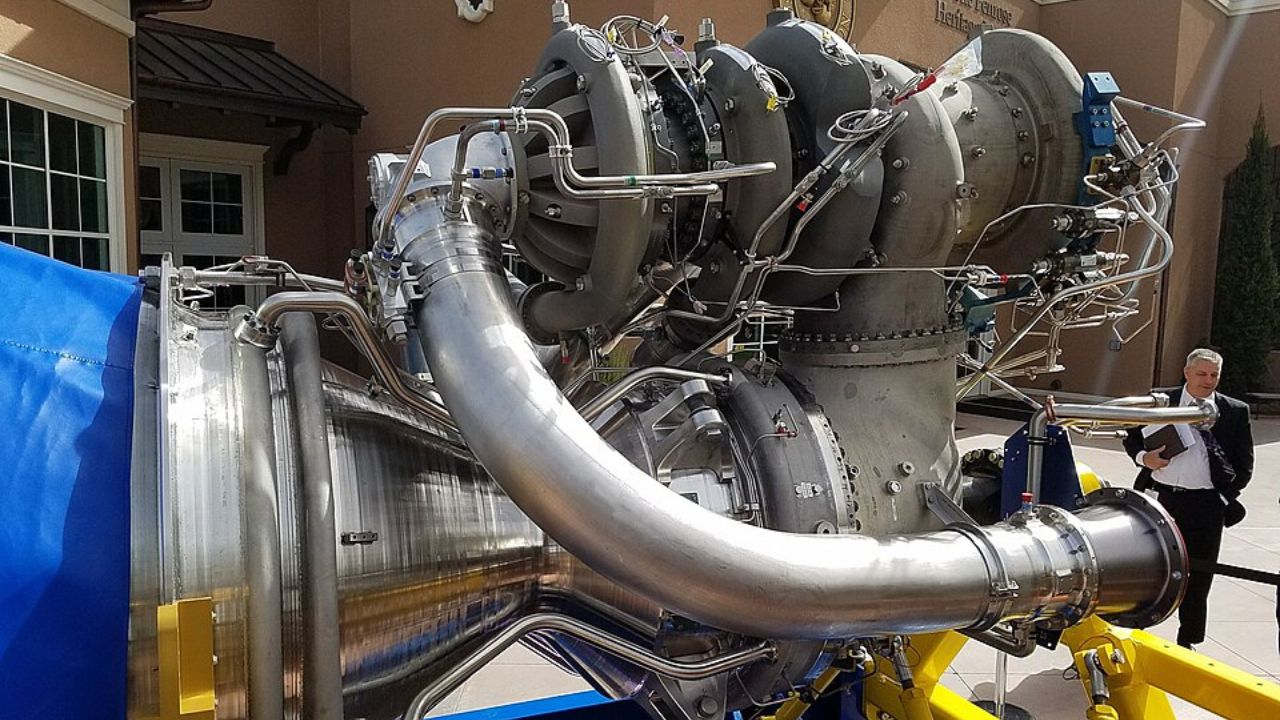
Blue Origin’s BE-4, developed for the New Glenn rocket and United Launch Alliance’s Vulcan, also uses liquid methane and liquid oxygen but follows an oxygen-rich staged combustion cycle. In this configuration, a portion of the oxygen and fuel first burns in a preburner that drives the turbopumps, then feeds the main chamber. On the test stand, the exhaust often shows a tight, bright column with a cooler, more transparent outer region, a look that contrasts sharply with the sooty trails of older kerosene engines.
Both engines break with the long heritage of RP-1 kerosene used in vehicles such as the Atlas V and Falcon 9. Kerosene tends to leave unburned carbon in the flow, which glows as incandescent orange particles. Methane burns cleaner, with fewer carbon byproducts, so the visible flame is dominated by excited molecules of water and carbon dioxide rather than glowing soot. That chemistry alone shifts the color and texture of the exhaust, even before factoring in the extreme pressures of modern staged combustion.
Analysts who compare Raptor and BE-4 point out that both engines target high thrust and efficiency while also supporting reuse, which demands very tight control over combustion. The unusual flames seen in test videos reflect that control. Instead of a messy, overfueled plume, the exhaust is finely tuned for performance, with propellant ratios adjusted to squeeze as much energy as possible from each kilogram of methane and oxygen.
Camera exposure, atmospheric conditions, and test-stand plumbing can all influence how the exhaust appears on video. Even so, the consistent differences between methane engines and kerosene engines, and between staged combustion and simpler cycles, show that the underlying physics is driving the visual shift. The flame is not just a spectacle for viewers; it is a diagnostic signature that engineers watch closely to validate their models.
Why it matters
The strange-looking exhaust from these engines signals deeper changes in how launch companies think about cost, safety, and long-term operations in space. Methane sits at the heart of this shift. Compared with RP-1 kerosene, liquid methane is cleaner burning and leaves less residue inside the engine. That reduces coking on turbine blades and injector faces, which in turn cuts the maintenance burden for reusable boosters.
Raptor’s full-flow staged combustion cycle pushes this trend further. By routing all the propellant through preburners, the engine can run at very high chamber pressures while keeping turbomachinery within acceptable temperature limits. High pressure translates directly into higher specific impulse, a key measure of efficiency. That efficiency lets a vehicle carry more payload for the same amount of propellant or fly with more margin for reuse. The price is complexity, both in design and in manufacturing, which is why very few engines in history have attempted a full-flow cycle.
BE-4 takes a different path to similar goals. Its oxygen-rich staged combustion design also aims for high chamber pressure and good specific impulse, but with a different balance of risk and engineering trade-offs. Running oxygen rich in the preburner can be hard on materials, yet it simplifies some parts of the system and can improve overall performance. The visible exhaust reflects that balance, with a tightly collimated plume that indicates efficient mixing and high exit velocity.
For launch providers, these design choices have direct commercial implications. A cleaner, more efficient engine can be fired multiple times with less refurbishment, which supports higher launch cadence and lower per-flight cost. That is vital for companies that plan to fly large constellations of satellites or support regular cargo and crew missions. The distinctive flames are an outward sign that the engines are operating in a regime optimized for that kind of high-frequency use.
The shift to methane also aligns with long-term ambitions for missions beyond Earth orbit. Methane can be synthesized from carbon dioxide and water using processes such as the Sabatier reaction, which becomes attractive for in situ resource utilization on Mars or on icy moons with accessible volatiles. An engine family that already runs on methane and oxygen fits naturally into that strategy. The exhaust that looks so unusual on a test stand today could one day be the signature of rockets refueled from Martian air and ice.
There are environmental angles as well. Launches remain a small contributor to global emissions, but cleaner combustion and fewer soot particles in the stratosphere are still valuable goals. Methane engines reduce black carbon output compared with kerosene engines, and their higher efficiency means less total propellant burned for a given mission profile. The visual absence of thick orange smoke hints at that reduction, even if the full climate impact needs careful long-term study.
For engineers and regulators, the flame shape and color serve as real-time feedback. Deviations from the expected pattern can indicate mixture ratio shifts, combustion instabilities, or hardware wear. High-speed cameras and spectrometers can analyze the exhaust to detect early signs of trouble. What looks like a stylish, almost science-fiction plume in public footage is, for the teams running the tests, a critical diagnostic tool that influences design tweaks and go or no-go decisions.
What to watch next
The most immediate question is how these engines will perform in repeated operational service. Test-stand footage captures ideal conditions, but launch environments introduce vibration, weather, and rapid turnaround schedules. How well Raptor and BE-4 can maintain their clean, tight exhaust patterns after dozens of flights will be a strong indicator of whether the underlying design choices have paid off.
Observers will also be watching how future variants evolve. Higher-thrust versions, vacuum-optimized nozzles, and potential derivative engines for upper stages could all alter the appearance of the exhaust. Larger expansion ratios tend to produce broader plumes in vacuum, sometimes with visible shock cells that differ from sea-level tests. Those visual cues will help track how the technology migrates from first stages to deep-space applications.
Competition between different propellant strategies is another storyline. While methane has gained momentum, hydrogen remains attractive for upper stages because of its very high specific impulse, and some providers still favor kerosene for its handling convenience and heritage. If new hydrogen engines enter service with advanced combustion cycles, their exhaust will look different again, often as a nearly invisible plume with faint blue or violet hues. The launch market may end up with a patchwork of exhaust signatures that reflect distinct business and mission priorities.
More From fast Lane Only: