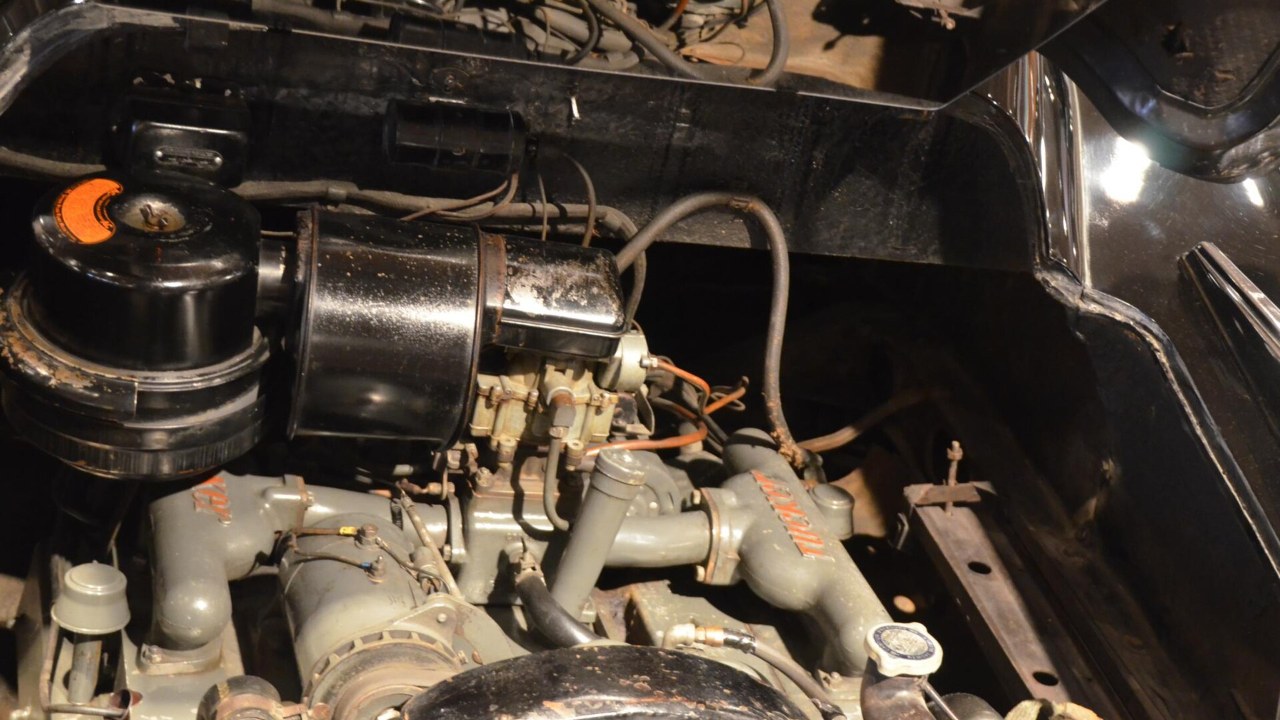
Tucker built only 51 Tucker 48 sedans. The flat-six mounted in the back of each one began life as an air-cooled unit from a Syracuse, New York, company that supplied helicopter engines. However, Preston Tucker did not start out planning to use that Tucker 48 engine. He turned to it after his own ambitious engine design failed, and then he bought the company that made it.
The switch tells you a lot about how the Tucker 48 came together. The car’s promises were bold and the deadlines were tight. As a result, the engine that finally went into production was an aviation design, reworked for a family sedan in a hurry.
Here is what Tucker tried first and why the helicopter engine replaced it. After that comes how the team converted it, and where the cars that carry it are today.
The 589: the first Tucker 48 engine
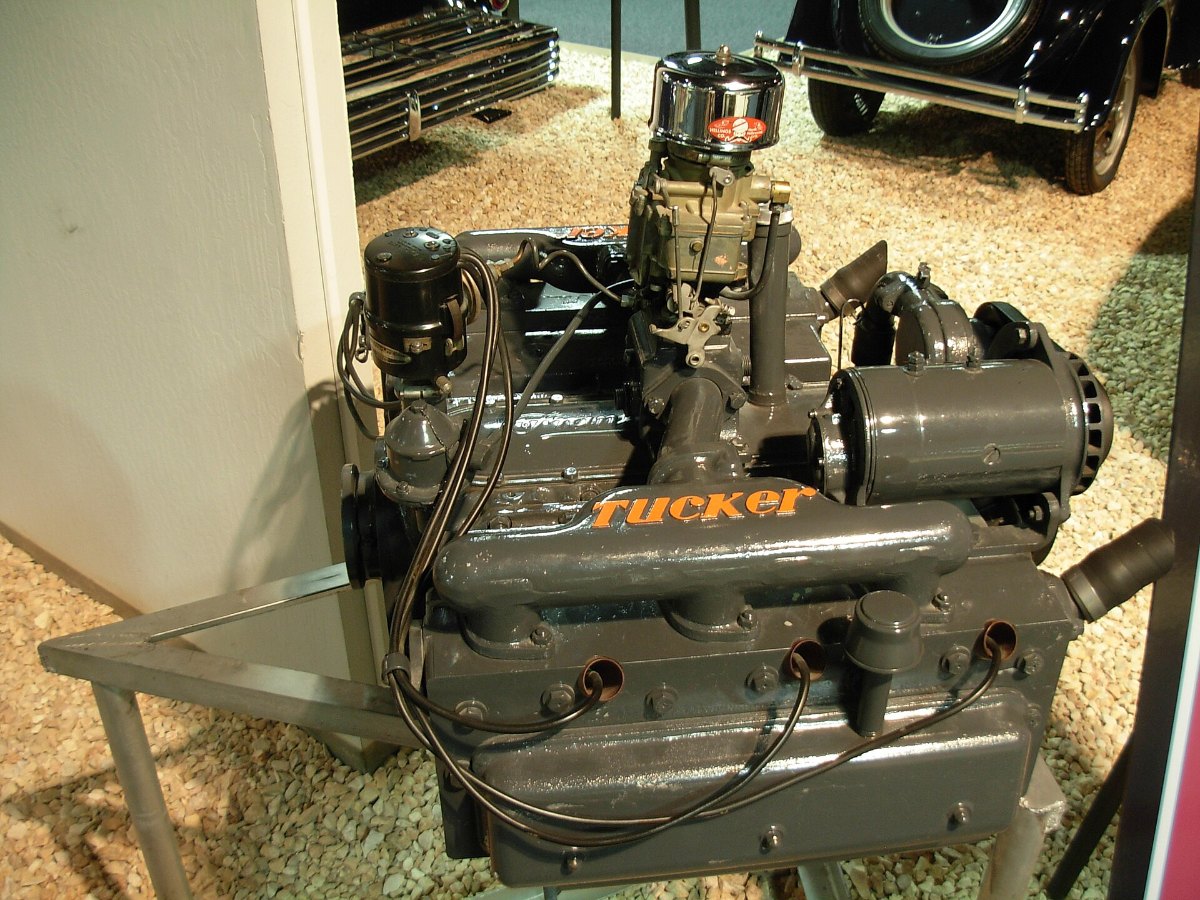
At first, Tucker planned something far more radical. RM Sotheby’s catalog description for chassis 1040 says the prototype carried a version of a horizontally opposed six-cylinder engine. It also had hemispherical combustion chambers. Instead of a camshaft, pushrods and rockers, oil pressure opened its overhead valves. It displaced 589 cubic inches.
Hagerty’s history of the car gives each cylinder a bore and stroke of 5 inches by 5 inches. It also says the hydraulically operated valves were not ready for real use. A separate Hagerty report on a surviving 589 engine says Tucker produced only three. Published output figures for the 589 disagree between Hagerty articles. So the plain fact is the one that matters here: Tucker could not make it work in time for production.
Why a helicopter engine maker got the call
With the 589 shelved, Tucker needed a compact, powerful engine that already existed. The answer, then, came from Aircooled Motors of Syracuse. The Aircraft Engine Historical Society’s Franklin history says Aircooled Motors developed the Franklin line of aircraft engines from 1938 through the Second World War. It adds that the Franklin O-335, in its helicopter-engine versions, was the basis of the 1948 Tucker engine.
RM Sotheby’s describes Aircooled Motors as a company making air-cooled helicopter engines for the Bell Aircraft Corporation. A flat-six already in production solved Tucker’s most urgent problem. First, it was a working design rather than a prototype. Second, its horizontally opposed layout suited the rear-engine package the designers had drawn the car around. Hagerty reports that the Tucker team bought and tore down four Franklin engines to study them. Only then did they reengineer them for the sedan.
Turning an air-cooled engine into a water-cooled one
The biggest change was cooling. An aircraft or helicopter engine sheds heat through fins in a constant stream of air. By contrast, a car’s engine bay at traffic-light speed cannot supply that airflow. RM Sotheby’s says Tucker reworked the 334-cubic-inch Franklin-derived engine for water cooling before it went into the car. In the Tucker 48, RM Sotheby’s adds, the engine teamed with a four-speed transaxle based on the Cord 810 and 812. Meanwhile, the Aircraft Engine Historical Society describes the result as a fully sealed liquid-cooling system that Franklin and Tucker developed together.
Sources quote the displacement as 334 or 335 cubic inches, depending on rounding. In fact, Hagerty’s article on the surviving 589 engine calls the production unit a 335-cubic-inch flat-six. Hagerty rates the finished engine at 166 horsepower and 372 lb-ft of torque. Other published figures differ, though, so those are Hagerty’s numbers rather than a factory rating confirmed here.
Buying the supplier outright
Tucker did not simply order engines. Instead, he bought the company. Hagerty states that the Tucker Corporation purchased Aircooled Motors outright, and the Aircraft Engine Historical Society dates the purchase to March 1948. RM Sotheby’s also records that Tucker bought the Syracuse firm. Owning the supplier gave Tucker control over the one major part his car could not do without. That mattered because his company was racing to build cars.
The transmission side was less tidy. Hagerty says the team scavenged 22 Cord gearboxes from junkyards and built 18 transmissions from the parts. That shows how improvised parts of the program became as money ran short.
Where the 51 cars are now
The Tucker Corporation did not survive long enough to build in volume. RM Sotheby’s notes that 25 cars went under the hammer at the factory bankruptcy auction in October 1950. Today, Hagerty reports, 47 of the 51 cars remain. RM Sotheby’s catalog adds that car 1040 carries a replacement engine, number 33579, which came from the Harrah Collection. Its original engine was number 33543. Finally, RM Sotheby’s sold chassis 1040, the 40th of the 51 cars built, for $1,600,000 at its Arizona sale in 2019.
More from Fast Lane Only
- Unboxing the WWII Jeep in a Crate
- 15 rare Chevys collectors are quietly buying
- 10 underrated V8s still worth hunting down
- Police notice this before you even roll window down
This article was created with the help of AI and was reviewed and edited by Fast Lane Only editors before publication.