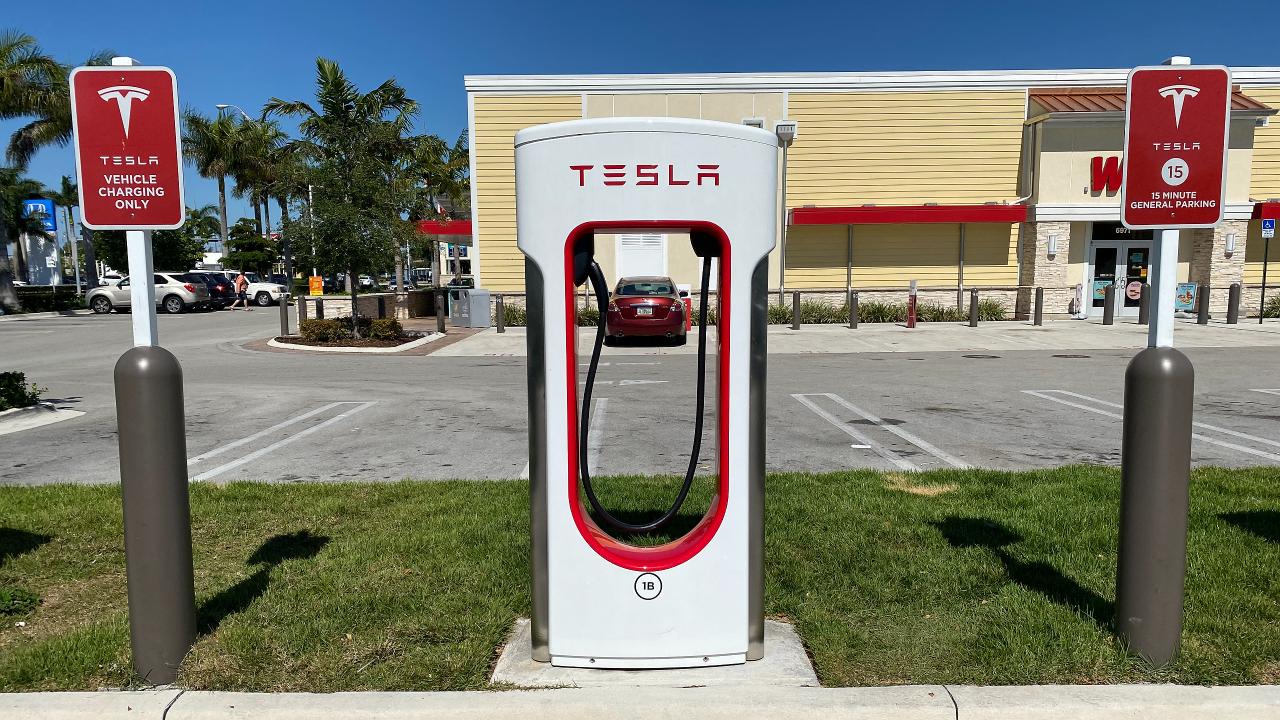
Wawa has quietly shifted from being a favored stop for Tesla drivers to becoming a charging operator in its own right, rolling out self-branded Tesla Superchargers that it owns and controls. The move turns the convenience chain from a passive host into an active player in electric vehicle infrastructure, with direct authority over pricing, branding, and customer experience at select sites. It also signals how closely tied retail fuel and charging have become as electric vehicles move from novelty to daily reality.
From host to infrastructure owner
For years, Wawa functioned as one of the largest locations for Tesla drivers to plug in, offering parking spaces and amenities while Tesla handled the hardware and operations. That relationship has now evolved, with Wawa taking ownership of specific Supercharger installations instead of simply leasing space on its lots. At a location in Alachua, Wawa is no longer just providing real estate, it owns the charging infrastructure outright, including the equipment and the associated rights to set pricing and manage how the chargers are presented to customers, a shift confirmed by reporting on the Alachua site and its new status as Wawa’s first fully owned Supercharger installation.
This change matters because it alters who makes the key decisions about how drivers interact with the chargers and what they pay. Rather than deferring to Tesla on tariffs and branding, Wawa can now align charging rates with its broader retail strategy, using energy pricing as another lever to attract and retain customers. According to information shared by Max de Zegher, Tesla’s Director of Charging North America, Wawa has already been the largest host of Tesla Superchargers, so its decision to move into ownership suggests a deliberate step up the value chain rather than a small experiment at the margins.
What “self-branded” Superchargers actually mean
The new installations are still Tesla Superchargers in technical terms, but they are visually and commercially framed as part of Wawa’s own network. At the Alachua site, the chargers are described as Wawa owned, with Wawa’s branding integrated into the experience so that drivers see the station as a Wawa service rather than a separate Tesla enclave on the edge of the parking lot. Reporting on the Alachua rollout notes that Wawa now controls the branding and pricing at this location, which effectively turns the Superchargers into a white-labeled product that fits inside Wawa’s broader retail identity.
That self-branding extends to how the chargers are presented in digital tools and on-site signage, reinforcing the idea that Wawa is not just a landlord but a charging operator. Coverage of Wawa’s first self-branded Tesla Superchargers explains that the company is setting its own per kilowatt-hour rate at the Alachua location, with the price listed at 0.37 dollars per kilowatt-hour. By tying a specific, Wawa-determined price to a Wawa-branded charger, the company is effectively telling drivers that the charging experience is part of the same curated offering as its coffee, food, and fuel, rather than a separate service layered on top of the store.
Pricing power and the new EV customer journey
Owning the hardware gives Wawa a new kind of pricing power that it did not have as a host. Instead of accepting Tesla’s rate structure, Wawa can calibrate its 0.37 dollars per kilowatt-hour price at Alachua to balance revenue, grid costs, and in-store sales. If the company sees that drivers who charge for 20 to 30 minutes are also buying meals or groceries, it can treat charging margins as part of a larger basket, potentially using competitive rates to draw in more traffic. The reporting that identifies Wawa’s control over pricing at its first owned Supercharger site underscores how central this flexibility is to the new model.
This control also reshapes the EV customer journey at Wawa locations. A driver arriving in a Tesla Model 3 or Model Y now encounters a Wawa-branded charger, a Wawa-set price, and a Wawa store that can tailor promotions to the dwell time created by a charging session. The fact that Wawa is the largest Tesla Supercharger host, as highlighted by Max de Zegher, means it already understands how EV drivers behave on its lots. Ownership lets the company turn that behavioral insight into a more integrated experience, from targeted food offers timed to charging durations to loyalty programs that could eventually link energy purchases with in-store rewards, although any specific loyalty integrations beyond pricing remain unverified based on available sources.
Why Tesla is comfortable sharing the spotlight
For Tesla, allowing a partner like Wawa to own and brand Superchargers reflects a pragmatic approach to scaling infrastructure. The company still supplies the technology and maintains the broader charging ecosystem, but it can offload capital expenditure and site-level management to a retailer that already has prime roadside real estate. According to reporting that cites Max de Zegher’s comments, Tesla views Wawa as its largest Supercharger host in North America, which makes the chain a natural candidate to pilot a model where the retailer steps up from host to owner while Tesla remains the technology backbone.
This arrangement also helps Tesla extend its charging footprint without bearing the full financial and operational burden of every new site. By enabling Wawa to set its own pricing and apply its own branding at locations like Alachua, Tesla can keep utilization high and maintain compatibility for its vehicles, while Wawa assumes responsibility for the local business case. Coverage of Wawa’s first owned Supercharger notes that the chargers are still Tesla units, which means Tesla drivers continue to see them as part of the familiar network, even as Wawa gains more visibility and control. The result is a hybrid model in which Tesla’s hardware and software are paired with Wawa’s retail expertise and capital, a combination that could be replicated with other large hosts if it proves successful.
What Wawa’s move signals for the wider charging landscape
Wawa’s decision to own and self-brand Tesla Superchargers is a small but telling sign of how the charging market is maturing. Instead of treating EV infrastructure as a side project handled by automakers or utilities, major retailers are beginning to see it as core infrastructure that can shape traffic patterns and customer loyalty. The Alachua site, identified in reporting as Wawa’s first fully owned Supercharger location, functions as a proof of concept that a convenience chain can take on the role of charging operator while still relying on Tesla’s technology stack.
If the model works, it could encourage other large hosts to seek similar arrangements, blending automaker-grade hardware with retailer-controlled branding and pricing. Wawa’s status as the largest Tesla Supercharger host, confirmed by Max de Zegher, gives it a unique vantage point to test this approach at scale, but the underlying logic is not unique to one chain. As more drivers in vehicles like the Tesla Model 3, Model Y, and other compatible models rely on fast charging for long-distance travel, the businesses that control those charging experiences will gain new influence over where people stop, how long they stay, and how much they spend. Wawa’s quiet shift from host to owner suggests that the competition for that influence has already begun, even if most of the hardware still carries the familiar Tesla shape.
More from Fast Lane Only