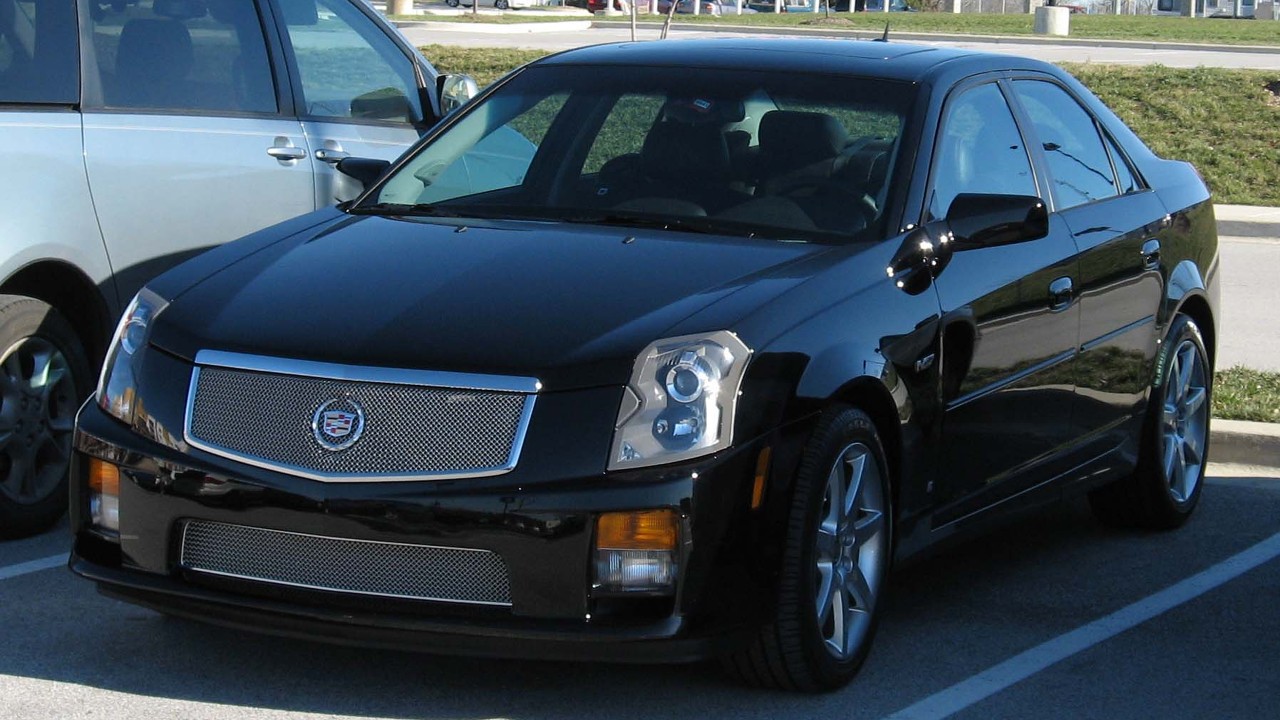
The first-generation Cadillac CTS-V arrived as a shock to the luxury market, pairing a compact American sedan with a Corvette-sourced LS6 V8 and a manual gearbox. That combination created a short-run performance sedan that now sits in an interesting place for collectors, with values rising but still accessible compared with European rivals. I want to trace exactly when Cadillac built the LS6-powered CTS-V sedan and how the current market is valuing clean examples today.
How the CTS-V LS6 sedan fit into Cadillac’s performance reboot
Cadillac spent the early 2000s trying to redefine itself from soft luxury to sharp performance, and the CTS-V was the clearest proof of that shift. The broader “Art and Science” design era, which a detailed brand history ties to a new focus on angular styling and motorsport involvement, set the stage for a sedan that could credibly chase German benchmarks while still feeling distinctly American. That same reporting notes how Cadillac returned to serious road racing with the four-liter twin-turbo Cadillac Northstar LMP, signaling that the company was no longer content to sit on the sidelines of high performance.
Within that context, the CTS-V became the spearhead of a new V-Series performance line, described in one historical overview as a family of high-output Cadillacs built to compete with established European sport sedans. That piece on the evolution of the CTS-V explains how the model was engineered to deliver track-capable handling and straight-line speed, not just cosmetic upgrades. The LS6-powered first-generation sedan was therefore more than a hot-rod variant, it was the proof-of-concept that Cadillac could build a serious driver’s car and sell it through regular showrooms.
When Cadillac produced the LS6-powered CTS-V sedan
The key detail for collectors is that every first-generation CTS-V sedan used the LS6 V8, and that run was limited to a specific set of model years. A comprehensive specification table for the Cadillac CTS performance line lists the “First Gen” CTS-V with model years that span the mid-2000s, followed by a “Second Gen” and “Third Gen” with their own distinct engines and platforms. Within that breakdown, the LS6 is identified as the powerplant for the first-generation CTS-V, while later generations move to supercharged V8s and more advanced drivetrains.
That same reference makes clear that the “First Gen” CTS-V and its LS6 V8 occupied a single, continuous production window before the car transitioned to a new engine in the “Second Gen.” In other words, the LS6 sedan was not a one-year curiosity or an early-build anomaly, it was the defining powertrain for the entire first-generation CTS-V. Only when Cadillac launched the “Second Gen” CTS-V, which the table shows as a separate block of Model Years, did the car move to a different V8, a change that marked a new chapter rather than a mid-cycle tweak.
Why the LS6 CTS-V sedan matters to enthusiasts
The LS6-powered CTS-V sedan resonates with enthusiasts because it combines a relatively understated four-door body with a drivetrain that traces directly to contemporary Corvette performance. Historical coverage of the V-Series line notes that the early CTS-V was engineered to deliver genuine track capability, not just straight-line speed, and that the LS-based V8 was central to that mission. In the context of the “Art and Science” era described in the Dec 11, 2022 brand history, the car represented Cadillac’s attempt to prove that American luxury could also be precise, fast and engaging to drive.
Because the LS6 engine ran throughout the entire first-generation CTS-V, the appeal today is less about ultra-rare specification and more about finding the right condition and history. Enthusiast-focused retrospectives on the CTS-V’s evolution emphasize how the original car balanced everyday usability with serious performance, which is exactly what many collectors now seek in a usable modern classic. The fact that every first-generation CTS-V sedan shares that LS6 heritage simplifies the search: buyers can focus on mileage, maintenance and originality rather than chasing a narrow subset of production.
How the CTS-V evolved after the LS6 era
Once Cadillac proved the concept with the LS6 sedan, the company expanded the CTS-V into a broader, more powerful lineup. The generational breakdown in the Cadillac CTS specification table shows a clear progression from “First Gen” to “Second Gen” and “Third Gen,” each with its own engine strategy and performance envelope. The second generation introduced a supercharged V8 and expanded the body styles to include coupe and wagon variants, while the third generation pushed power and technology even further, eventually closing out CTS-V production after the 2019 model year.
A historical overview of the CTS-V’s history underscores how each generation responded to escalating competition from European and Japanese rivals. As power outputs climbed and chassis tuning became more aggressive, the original LS6 sedan began to look relatively modest on paper, yet that very contrast is part of its charm today. It represents the moment when Cadillac first stepped into the modern performance arena, before the horsepower race fully took over, which gives the LS6 cars a distinct identity within the broader V-Series story.
Collector values and market trends for LS6 CTS-V sedans
On the collector side, the LS6 CTS-V sedan now trades in a market that increasingly recognizes its historical importance but still prices it below later, more powerful variants. Recent auction data for the broader CTS-V family shows strong interest in clean, low-mileage cars, particularly from the second and third generations. A search of completed listings for CTS-V models includes a 2016 CTS-V that attracted a bid to $64,500, a figure that reflects the premium buyers are willing to pay for the newest, highest output versions.
First-generation LS6 sedans typically sell for less than those later supercharged cars, but the gap is narrowing as enthusiasts look for analog driving experiences and manual transmissions. The same auction records show steady bidding on earlier CTS-Vs, with condition, modifications and documentation playing a major role in final prices. Because the LS6 engine was standard across the “First Gen” CTS-V, collectors tend to differentiate cars by mileage, maintenance history and tasteful upgrades rather than by chasing a specific year, a pattern that aligns with how the First Gen block is treated in official model-year breakdowns.
Looking ahead, I see the LS6 CTS-V sedan continuing to appreciate gradually as more enthusiasts recognize its role in Cadillac’s performance renaissance. The combination of a Corvette-derived V8, rear-wheel drive and a manual gearbox is increasingly rare in modern luxury cars, and the historical context provided by both the Art and Science era overview and the CTS-V history suggests that the model’s significance is secure. For buyers today, that makes the LS6 sedan a compelling choice: it is already recognized as a modern classic, yet it still offers usable performance and, for now, more approachable pricing than many of its European contemporaries.