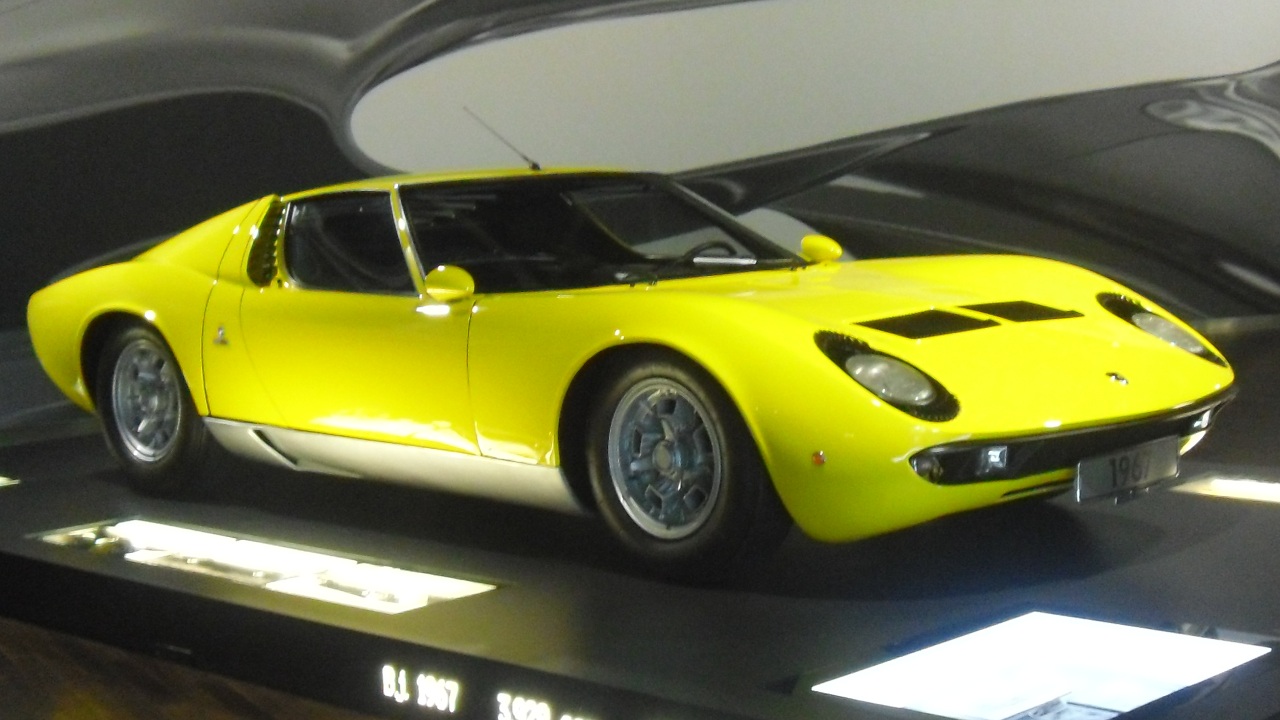
The 1967 Lamborghini Miura did not simply go faster than its rivals, it rewrote what a road car could look like, how it could be engineered, and who it was really for. In a few short years, this low, mid‑engined V12 coupe turned a niche Italian upstart into a benchmark and gave the supercar category its modern shape. I see its impact today every time a new flagship sports car is judged less on practicality and more on drama, layout, and sheer audacity.
By the late 1960s, the Miura had become a rolling manifesto for a new kind of performance car, one that put the engine behind the driver, the styling ahead of convention, and the owner at the center of a global spectacle. Its combination of radical engineering, theatrical design, and celebrity appeal set patterns that still define how supercars are conceived, marketed, and collected.
The radical layout that made “supercar” a category
When Lamborghini unveiled the Miura, the company was still a newcomer, yet it chose a configuration that even established brands treated as experimental. The car used a transversely mounted V12 engine placed behind the seats, a layout that concentrated mass within a short wheelbase and transformed weight distribution compared with front‑engined grand tourers. Factory history credits the young engineers Giampaolo Dallara and Paolo Stanzani with turning this concept into a workable road car, and their work on the Miura’s compact chassis and drivetrain packaging made mid‑engined performance feel attainable for wealthy customers rather than just racing teams.
That decision is why many experts now describe the Lamborghini Miura as the world’s first supercar in the modern sense, even though there had been fast, exotic machines before it. The combination of a mid‑engine layout, a multi‑cylinder engine derived from competition thinking, and a body designed purely for speed and spectacle created a template that later icons, from the Honda NSX to the McLaren F1, would refine rather than replace. By putting this architecture into standard production, the Miura shifted expectations so decisively that a flagship performance model without a mid‑mounted engine now feels like an exception.
Engineering ambition that pushed performance standards
The Miura’s engineering team, led by Gian Paolo Dallara, approached the project with the mindset of race car constructors rather than luxury tourer builders. They developed a chassis that was both light and stiff, with advanced suspension geometry tuned for high‑speed stability and quick responses. The compact wheelbase and careful weight distribution were not styling flourishes, they were deliberate choices to let the car exploit its power on twisting roads as well as long straights, and they signaled that Lamborghini was willing to prioritize performance even if it meant compromises in cabin space or refinement.
At the heart of that ambition sat Lamborghini’s V12, which set new performance standards for road‑going cars of the era. In Miura tune, the engine delivered around 370 horsepower at 7,700 rpm, a figure that, combined with the car’s low mass, pushed top speeds and acceleration into territory that had previously belonged to racing prototypes. Contemporary analysis of the Miura’s influence notes that this high‑revving V12 did more than generate numbers, it established a benchmark for how a supercar should sound and feel, with a power band that rewarded drivers who were willing to explore the upper reaches of the tachometer.
Design as theater, not just aerodynamics
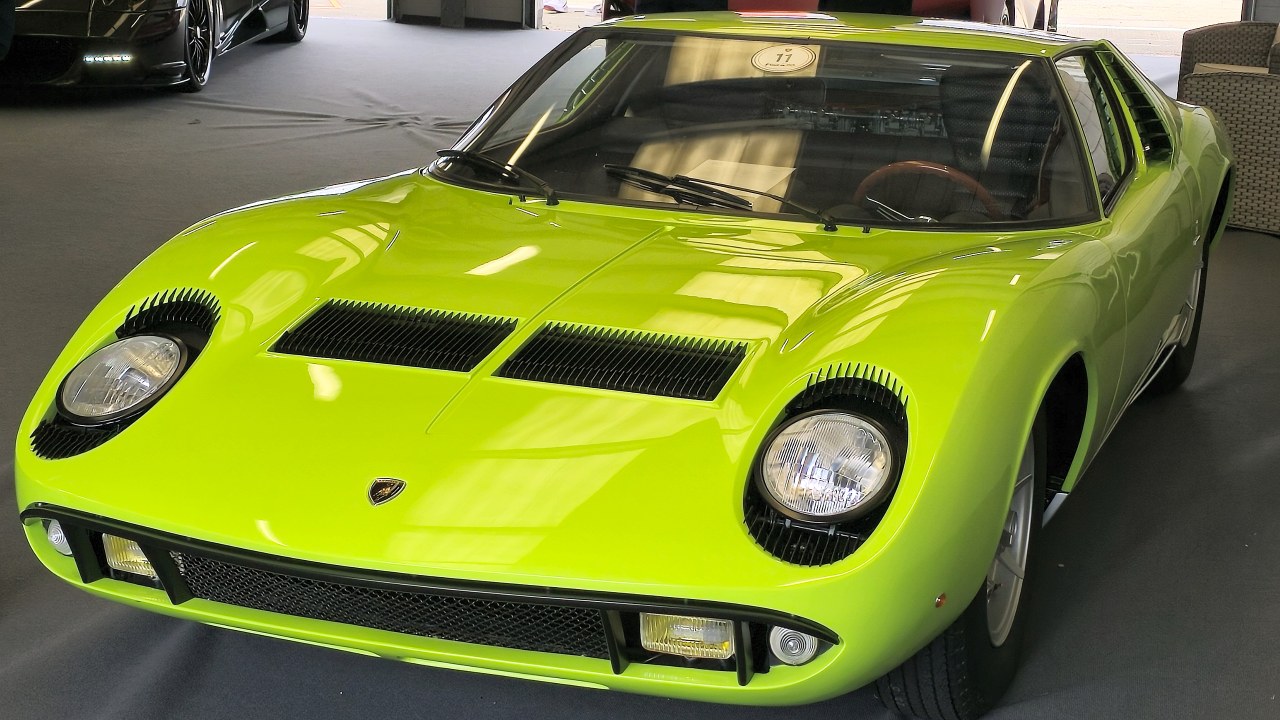
The Miura’s impact was as visual as it was mechanical, and that was no accident. The aluminum body gave designers the freedom to sculpt an extremely aerodynamic shape, with a low nose, flowing flanks, and a tail that tapered around the engine bay. Details like the “eyelash” headlamp surrounds and the way the doors, when opened, resembled horns turned the car into a piece of automotive theater. These touches did not add measurable speed, but they created an identity that owners could recognize across a crowded street and that photographers could not resist.
Inside, the Miura continued this focus on drama. Factory history describes an interior dominated by a central rev counter and speedometer, emphasizing that the driver’s relationship with the engine mattered more than luggage capacity or rear visibility. The cockpit wrapped around the driver in a way that made the car feel more like a racing machine than a grand tourer, and that approach has echoed through later supercars that treat the cabin as a stage for performance rather than a conventional passenger space. By making design a form of theater, the Miura helped fix the idea that a supercar must be instantly recognizable and slightly outrageous.
From engineering experiment to cultural symbol
What began as a bold engineering project quickly turned into a pop culture phenomenon. By the early 1970s, the Miura had become a symbol of success and excess, appearing in films, photo shoots, and the garages of high‑profile entertainers. Jazz legend Miles Davis and rocker Rod Stewart were among the owners who helped broadcast the car’s image far beyond traditional automotive circles, turning it into a shorthand for a certain kind of glamorous, risk‑embracing lifestyle. That visibility mattered, because it taught manufacturers that a supercar could be as much a cultural product as a mechanical one.
The Miura’s status as a cultural icon also fed back into Lamborghini’s identity. Company retrospectives describe the model as a milestone that defined the brand’s bold character, and later cars leaned into that reputation rather than softening it. Over time, the Miura’s limited production and high‑profile ownership turned it into a blue‑chip collectible, with pristine examples now treated as reference points for how far the supercar idea has evolved. Its journey from engineering experiment to cultural symbol showed that the most influential performance cars are the ones that capture imaginations as strongly as they conquer racetracks.
The Miura’s living blueprint in today’s supercars
Looking at modern supercars, I see the Miura’s fingerprints everywhere. The idea that a flagship performance car should have its engine behind the driver, a dramatic silhouette, and a cabin that prioritizes the driving experience over practicality has become standard practice. Analysts who trace this lineage argue that the Miura changed expectations across the entire supercar world, turning features that were once radical into baseline requirements. Even as materials have shifted to carbon fiber and electronics have taken over many driving tasks, the core blueprint of a low, mid‑engined, visually arresting machine remains intact.
The market’s reverence for the Miura reinforces that ongoing influence. Reports on the collector scene note that pristine Lamborghini Miura examples are treated as benchmarks, both for value and for how far designers and engineers can push boundaries while still honoring tradition. Factory histories emphasize that the Miura is considered a revolution, not just a successful model, and that more than half a century later it still shapes how the company and its rivals think about their most extreme cars. When I watch a new supercar debut, with its mid‑mounted engine, theatrical doors, and driver‑centric cockpit, I am essentially seeing a conversation that started in 1967, when the Miura quietly, and then very loudly, changed what a supercar could be.
More from Fast Lane Only: