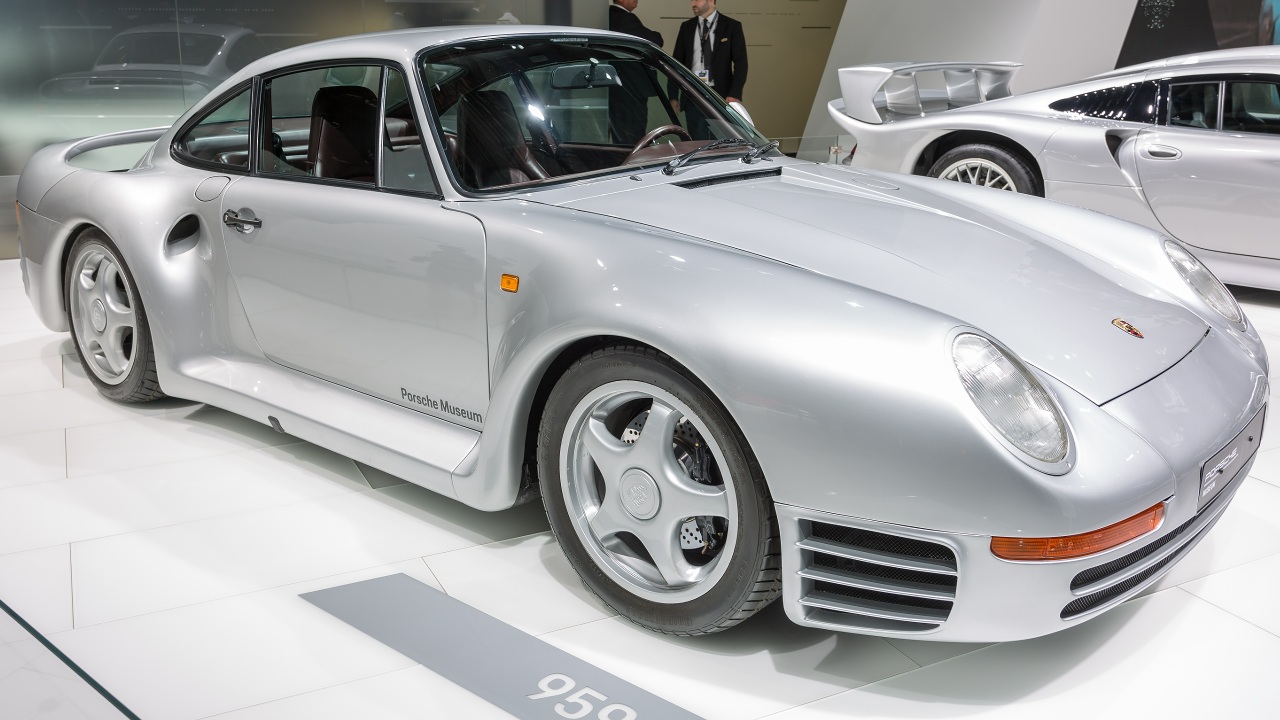
When the Porsche 959 appeared in 1986, it did not just look like a supercar from another decade, it behaved like one. Its blend of racing-derived hardware, digital control systems and everyday usability previewed the template that would define high performance cars long after the 1980s ended.
From its twin turbocharged flat-six to its adaptive all-wheel drive and electronically managed suspension, the 959 anticipated technologies that are now routine in everything from modern hypercars to all-weather sports coupes. I see it less as a museum piece and more as an early prototype for the way performance engineering would evolve.
From Group B experiment to road‑legal laboratory
The 959 began as a competition project, conceived to push Porsche into the extreme world of Group B rallying and circuit racing, then redirected into a road car that could showcase what the company had learned. The racing roots mattered, because they forced engineers to chase durability, traction and controllability rather than just headline power figures, which is why the production 959 felt so composed compared with the wild supercars of its era. Contemporary rivals were often described as noisy, intimidating machines that, as one analysis of 1980s exotics put it, terrified their drivers and had a habit of catching fire, while the 959 was engineered to be fast and stable even in poor conditions.
Underneath, the car used a sophisticated chassis with a lightweight structure, advanced suspension and a rally-inspired all-wheel drive system that had been honed in competition. Reporting on the model’s origins and ambitions describes how this blend of motorsport hardware and road tuning gave the 959 the ability to tackle tight corners and high speed runs with equal confidence. Later retrospectives on the car’s story and innovation underline that it was conceived from the outset as a technology demonstrator, a car that would force other manufacturers to respond.
A powertrain that forecast the turbo era
The 959’s engine package previewed the way turbocharging would move from racing specials into mainstream performance cars. It used a 2.85 litre turbocharged flat-six with water cooled cylinder heads and air cooled barrels, a complex layout that drew directly from Porsche’s endurance racing experience. This compact but highly stressed unit delivered power that rivalled much larger engines of the time, while also meeting the reliability demands of both road and competition use, which is why later technical guides describe the 959 as having changed the innovation and performance game.
Crucially, the car paired that engine with advanced engine management and a carefully calibrated twin turbo system, smoothing out the brutal lag that had defined earlier turbocharged 911 models. Contemporary overviews of the 959’s engineering note that this made its performance more accessible and predictable, a trait that would become central to later generations of turbocharged sports cars. Later commentators looking back at what made the Porsche 959 special argue that this balance of power and refinement helped set expectations for how modern forced induction engines should behave, from everyday sports coupes to present day supercars.
PSK all‑wheel drive and the birth of the usable supercar

If the engine hinted at the future, the 959’s all-wheel drive system practically dragged it into being. The car used a computer controlled setup known as PSK 4 wheel drive, which could vary torque distribution between the axles based on sensors and driver inputs. Technical analysis of the system describes it as inherently more sophisticated than other four wheel drive layouts of the time, with the ability to adapt in real time rather than simply locking differentials or relying on crude mechanical couplings. One deep dive into the true story of the Porsche 959 notes that this adaptability was not really comparable to other 4WD systems available then.
That technology did more than improve lap times, it made the 959 unusually approachable. Later commentators have contrasted it with the Ferrari F40, a contemporary rival that was essentially a race car with license plates and demanded constant vigilance from its driver. By comparison, the 959’s traction, stability and relatively forgiving handling meant it could be driven quickly in poor weather or on imperfect roads, which is why one modern video review highlights how usable it is unlike the Ferrari F40. Another retrospective on how the 959 inspired future models points out that this rally inspired all wheel drive system would go on to influence later Porsche road cars, helping to bring advanced traction technology to a much wider audience and turning the idea of a year round, all weather supercar into a realistic proposition.
Electronics, aerodynamics and the template for modern hypercars
Beyond its drivetrain, the 959 integrated electronics and aerodynamics in ways that were rare in the mid 1980s and are now taken for granted. The car featured adjustable suspension, multiple driving modes and a carefully sculpted body that balanced low drag with high speed stability, all coordinated by control systems that constantly interpreted sensor data. Period and retrospective coverage of the model emphasises that the 959 looked like it had come from the future, with one official history describing how, in the mid 1980s, Porsche unleashed a supercar so advanced it appeared to have jetted in from another era. Another detailed overview calls it a technological marvel decades ahead of its time, underlining how unusual this level of integration was in a road car.
Those systems did not exist in isolation. They were part of a holistic approach that treated the 959 as a rolling test bed for ideas that would later filter into the broader Porsche range and the wider industry. A feature that describes the car as a showcase of the future argues that it is often regarded as the father of modern supercars, precisely because it combined electronics, aerodynamics and mechanical grip into a cohesive package rather than chasing raw power alone. Another in depth brand history frames the 959 as a model that forced the competition to pull their socks up, noting that certain cars in history compel rivals to respond and that the 959’s basics, from its aero to its control systems, set new benchmarks that the current crop of supercars still echo.
A legacy that still feels current
Nearly four decades on, the 959’s influence is easiest to see when it is placed alongside much newer machinery. When test drivers brought a 959 to Willow Springs to compare it with a modern hybrid hypercar, the Porsche 918 Spyder, they found that the older car still felt remarkably composed and sophisticated. That comparison, which opened with Pobst and Lago taking the 959 around Willow Springs, highlighted how many of the 918’s core ideas, from advanced all wheel drive to integrated electronics, could be traced back to the 959’s blueprint. It reinforced the sense that the older car had been designed as if its engineers were thinking thirty years into the future.
That continuity is also clear in the way historians and enthusiasts now talk about the model. A detailed brand history describes the Porsche 959 as a sports car manufactured by German automobile manufacturer Porsche from 1986 to 1993, first as a homologation special and then as a limited production road car, and notes that its road version became one of the most technologically advanced vehicles of its time. Later analyses of how the 959 changed everything in the supercar world argue that it helped shift expectations away from raw, intimidating machines toward cars that could deliver extreme performance with a degree of security and everyday usability. When I look at the current generation of high performance models, from all wheel drive turbocharged sports cars to hybrid hypercars packed with software, I see the 959 not as a relic of the 1980s but as an early draft of the future that drivers now take for granted.
More from Fast Lane Only: