Every performance car engineer eventually faces the same tug-of-war. More power demands more stopping ability, more stopping ability demands bigger, heavier brakes, and heavier brakes work against the very speed the car was built to chase. Most road cars split the difference. A dedicated drift car doesn’t bother splitting anything. It just throws the whole equation out the window and shrinks the brakes down to the bare minimum, on the theory that a car built to stop by sliding sideways doesn’t need much help stopping in a straight line.
That is exactly the philosophy behind Red Bull’s 1,100-horsepower BMW M2 drift car, a build that took the factory S58 straight-six, tore out its twin-turbo setup, and replaced it with one enormous single turbo capable of pushing 1,200 Newton-meters of torque through the rear wheels alone. At roughly 1.2 tonnes, that kind of output should make almost any brake system work overtime. Instead, the car runs discs smaller than what came standard on the road-going version, a deliberate weight-saving decision built entirely around the idea that a car designed to slide doesn’t stop the way a normal car stops.
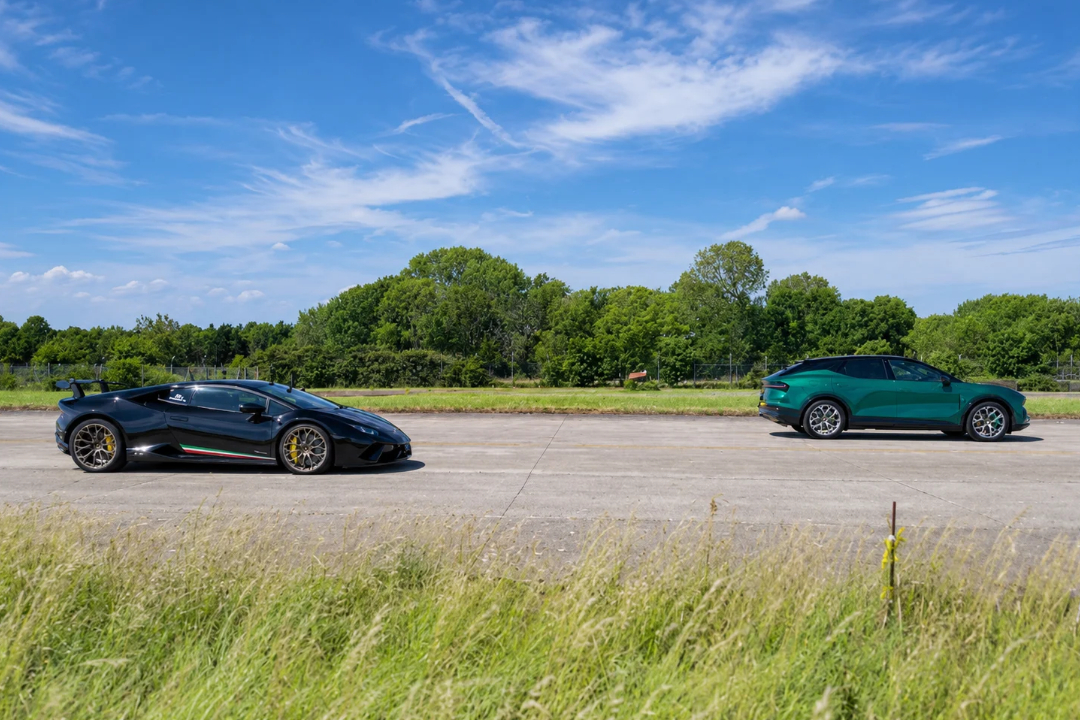
Testing that theory properly meant putting the drift car up against something built with the opposite priorities entirely: a Lamborghini Huracán Performante, all-wheel drive, launch control, and brakes sized for a car that actually needs to slow down in a hurry. Over the course of drag races, rolling races, and one deliberately brutal braking test, the M2’s downsized anchors were about to get exactly the kind of scrutiny they’d spent their whole design life avoiding.
A philosophy built entirely around not needing to stop
The logic behind the M2’s brakes is straightforward once you understand how drifting actually works. A drifter scrubs off speed by breaking rear traction and sliding through a corner sideways, using the tire’s slip angle as the primary braking force rather than pad clamping down on rotor. Every gram of unsprung weight removed from the corners improves how the car rotates and responds, so a serious drift build treats big brakes as dead weight rather than safety equipment. Smaller, lighter discs aren’t a compromise on a car like this. They’re the point.
That logic holds up fine on a drift track, where speeds stay manageable and stops are rarely sudden. It holds up much less convincingly the moment you’re asked to stop from 100 mph on a runway, side by side with a supercar that was never asked to make the same sacrifice. The Lamborghini hauled itself down in a drastically shorter distance, its brakes doing exactly what a road car’s brakes are built to do without complaint. The M2 needed considerably more runway to slow down, the direct and entirely predictable cost of a car that had spent its entire design process optimizing for anything but stopping power.
Nobody involved treated that outcome as a surprise. The tradeoff had been built in from the start, and the braking test simply put a number on something everyone already understood conceptually. What made the exercise worthwhile wasn’t proving the M2 stopped worse. It was watching just how much performance elsewhere in the car got bought with that sacrifice.
The other side of the ledger
That’s because the same weight savings and single-turbo power that left the M2 embarrassed under braking turned it into a completely different animal the moment grip stopped being a problem. In a cold-tire standing drag race, the drift car’s rear tires simply couldn’t cope with 1,100 horsepower arriving all at once, spinning uselessly while the all-wheel-drive Lamborghini launched clean and drove away. But shift to a rolling start from 50 mph in second gear, removing the launch entirely from the equation, and the M2 hooked up and walked straight past the Huracán, its raw power finally landing on the pavement instead of disappearing into wheelspin.
A second rolling test from just 10 mph told the same story in miniature. The M2 spun its tires hard at first, ceding ground to the Lamborghini, before finding grip partway down the runway and reeling the gap back in to nose ahead right at the line. Every time traction stopped being the deciding factor, the extra weight the M2 had shed everywhere else, brakes included, started paying dividends.
Even a warm-tire rematch against the Lamborghini in genuine standing-start drag races couldn’t fully overcome the launch disadvantage, with the drift car losing twice more despite the added heat in its rubber. A side benchmark against a stock, 480-horsepower M2 running factory launch control came down to the wire across three runs before the drift car’s driver finally nailed his throttle application and pulled away convincingly. The pattern held throughout the day. Whenever the contest came down to a standing start, the M2’s traction problems cost it. Whenever it didn’t, the car built around minimalism, right down to its brakes, hunted down everything in front of it.
The closest finish makes the whole point
The day’s final race brought the Lamborghini back for one more standing-start decider, and it played out almost exactly like the others. The Huracán launched first, its all-wheel drive doing what it had done all afternoon, and the M2 spent the entire quarter mile chasing rather than leading. This time the gap at the finish came down to a fraction of a car length, with both cars crossing in an identical 10.6 seconds.
The Lamborghini won every standing-start race it entered, and the tiny brakes never once got the M2 out of trouble it wasn’t already in. But that was always the deal this car was built around. Every gram saved on the brakes went somewhere else, into a power-to-weight ratio that could hang with a supercar the instant the fight moved past the launch. A car this committed to not stopping well was never going to win a contest that opens with a dead stop. The real question was always what it could do once it was already moving, and on that count, the tiny brakes turned out to be a fair trade.
More from Fast Lane Only
- Unboxing the WWII Jeep in a Crate
- 15 rare Chevys collectors are quietly buying
- 10 underrated V8s still worth hunting down
- Police notice this before you even roll window down
*Research for this article included AI assistance, with all final content reviewed by human editors.