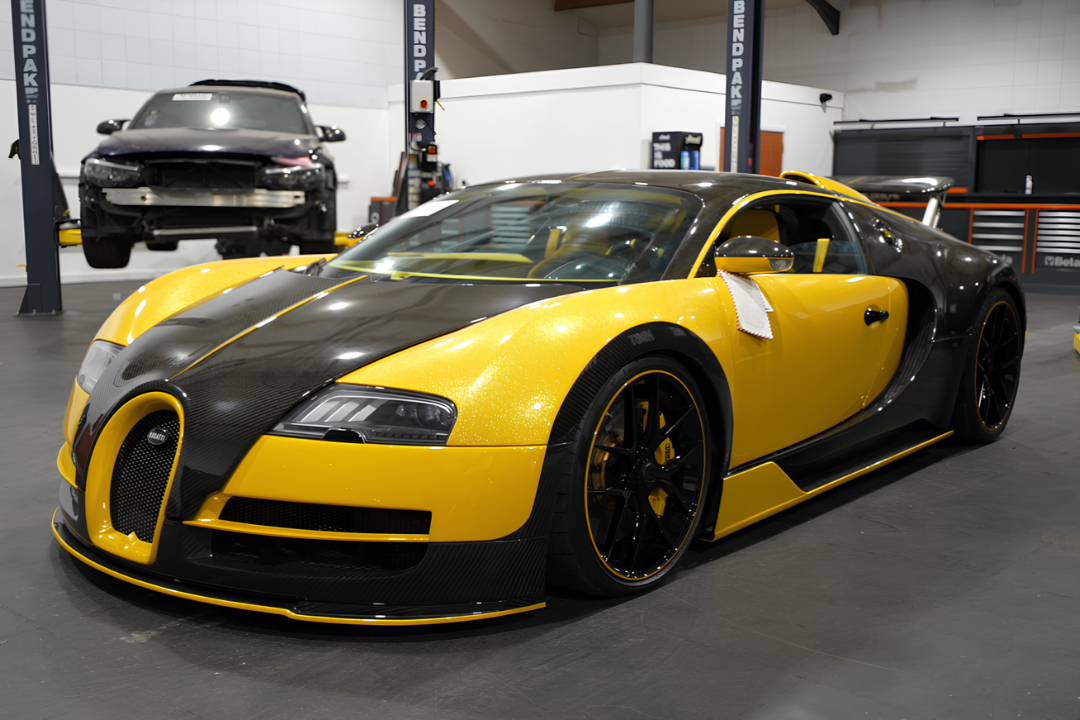
Some people collect stamps. Some collect vinyl. Mat Armstrong collects Bugatti Veyrons, and at this point his fanbase has started keeping score. Enough viewers have joked that he’s stockpiling Bugattis like they’re some kind of collectible superweapon that it’s basically become his brand. Somewhere out there, a certain purple supervillain is jealous he only needed six trinkets and not an entire fleet of French hypercars.
This is a man already mid-rebuild on a crash-damaged Bugatti Chiron, already the proud owner of a Veyron he pulled back from the brink, and yet somehow still saying yes when a second broken Veyron gets dangled in front of him. Most people look at a non-running hypercar with a six-figure repair risk attached and see a cautionary tale. Armstrong apparently sees a Tuesday.
To be fair, he had a reason to be confident that most buyers wouldn’t. The Veyron on offer had already scared off every serious buyer in Dubai, sitting quietly at the back of a dealership because nobody wanted to sell a faulty hypercar under their own name. But Armstrong had fixed this exact fault before, on his own car, and his audience has picked up on the habit of him casually cross-referencing one Bugatti to diagnose another, like it’s the most normal thing in the world to keep a spare hypercar around purely for parts knowledge.
The deal nobody else wanted
The Veyron’s problems were the kind that make sensible people walk away. It wouldn’t reliably start, it wouldn’t select reverse, and nobody in the region was willing to touch it, since insuring yourself to work on a car this rare is its own special kind of headache. That fear is exactly why the asking price had stalled out near $1.8 million with no takers. Armstrong ended up negotiating it down to roughly $1.1 million, against a healthy running Veyron’s value the dealer later pegged at just under $2.5 million.
Armstrong had spent maybe twenty minutes with the car before deciding to buy it, working almost entirely off a hunch built from experience rather than a full diagnosis. One viewer picked up on exactly this energy, noting how he seemed to be keeping a straight face while already knowing the fix in his head, the kind of poker face that only comes from having done this particular repair before. That is the whole show in one sentence. A man quietly clocking the fault while playing it cool enough not to tip off the seller.
Buying a stranded hypercar on a hunch is still a bet, though, and this one came with a twist nobody saw building.
The fix that almost fixed itself
By the time the Veyron made it from Dubai to the UK, something strange had already happened. The car needed its fuel tank drained before it could fly, and the company handling that job recognized the exact fault from one of Armstrong’s own videos. So they quietly swapped the perished fuel hoses themselves, free of charge, before the car ever touched a plane.
That should have been the end of it. The comment section was quick to shower praise on the strangers who attempted the fix without being asked or paid, treating them like unsung heroes of the whole saga. But the fix didn’t quite hold. The Veyron ran fine off the trailer, then started cutting out again almost immediately, like it had gotten cold feet about behaving itself in a new country.
The culprit turned out to be undersized clamps on the replacement hoses, unable to handle the pressure inside the tank. Close, but not close enough, which is basically the theme of hypercar repair work when strangers are doing you a favor without the right parts on hand.
Bugatti money, hardware store parts
The parts actually responsible for keeping a seven-figure car parked were almost insultingly cheap. Proper submersible fuel hose and the correct clamps. An ignition switch causing random no-start issues that turned out to be shared with a Volkswagen Transporter van, priced at roughly fourteen dollars once the right part number turned up.
Even the airbag fault, which sounds like the kind of thing that would demand an expensive specialist part, came down to a disconnected battery pyro fuse circuit and a pair of wires carrying the wrong resistance. Bridging in a proper 2.2-ohm resistor cleared the fault instantly, for pennies against parts elsewhere on the car that can run considerably higher.
None of this made the job easy. Getting to some of these fixes meant stripping half the interior and chasing wiring by hand rather than ordering a part and bolting it in. But there’s something almost comedic about a Bugatti Veyron being humbled by a van part and a fuse from the parts bin, and at least one viewer summed up the appeal by saying the whole saga beat their usual Sunday streaming lineup.
The stubborn last mile
The final holdout was the most frustrating of all. Even with the fuel system and ignition switch sorted, the car wouldn’t start consistently, sometimes firing first try and sometimes not at all. Tracking down the original key and swapping its battery helped, but the real gremlin stayed elusive enough that Armstrong ended up rewiring sections of the interior loom just to rule things out.
Once the car finally ran without complaint, a well-known supercar dealer valued it at around $1.9 million, against a total outlay near $1.5 million once import duty and repairs were factored in. That is a serious win by any measure, and it didn’t go unnoticed, with more than a few viewers pointing out how rare it is to get the entire journey, travel, inspection, shipping, diagnosis, and final cost breakdown, wrapped into one sitting instead of stretched out for engagement.
More from Fast Lane Only
- Unboxing the WWII Jeep in a Crate
- 15 rare Chevys collectors are quietly buying
- 10 underrated V8s still worth hunting down
- Police notice this before you even roll window down
*Research for this article included AI assistance, with all final content reviewed by human editors.