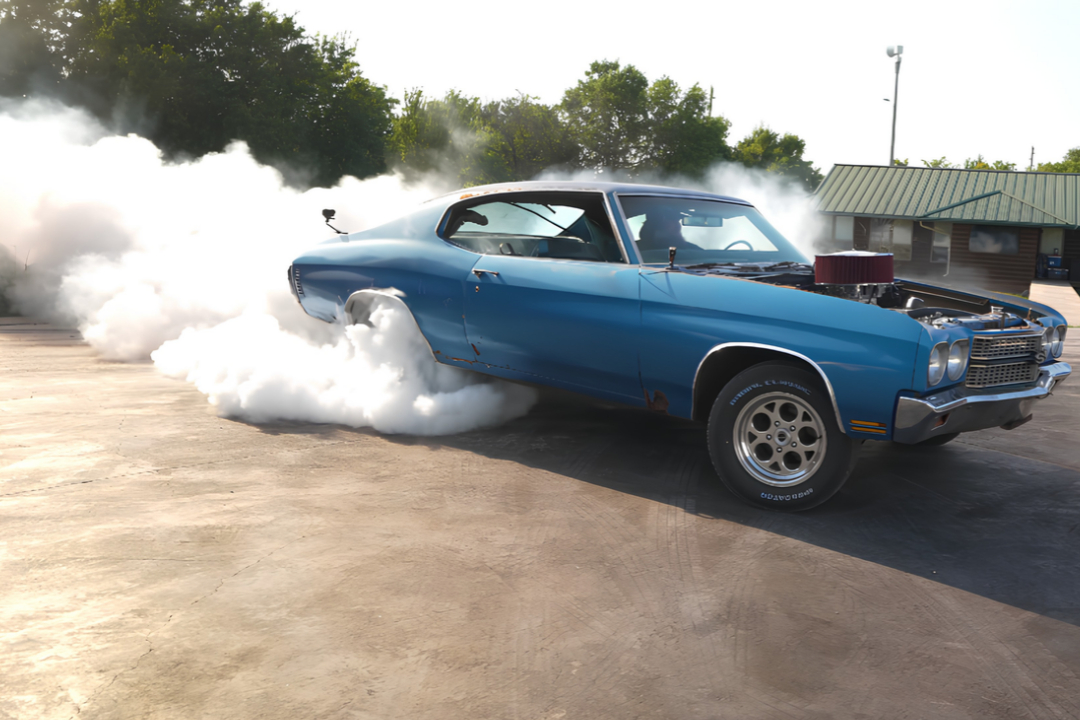
Picture an Airbnb host somewhere in Texas, pulling up a booking confirmation, expecting the usual quiet stay. What they may have gotten instead, if the video is anything to go by, was a brand-new engine hoist, a trailer with a 632-cubic-inch big block in it, and a crew whose new engine broke a factory heater box just by wiggling its way into place. If that host breathed a little easier watching Westen Champlin’s taillights finally head toward Kansas, it would be hard to blame them.
The car responsible for all this was a 1970 Chevrolet Chevelle SS that Westen had wanted for years, bought sight-unseen off a guy who’d already learned his own hard lesson about buying classic cars without looking at them first. The seller had paid nearly $20,000 for a car that turned out to be held together by rust and bondo, and he was more than happy to eat a loss just to be rid of it. Westen talked him down from $12,000 to an even $11,000 cash, threw in a treat for the man’s pet pig as a closing gesture, and drove away with a car that had a rotted frame, no back seat, and a headliner actively collapsing onto whoever sat in the driver’s seat.
The plan, as plans like this always are, sounded simple on a whiteboard. Get the Chevelle running just enough to limp it to a rented Airbnb, yank whatever was left of the original engine, drop in a freshly purchased 846-horsepower big block crate motor, and drive the finished product 340 miles home to Kansas before the Airbnb host started asking pointed questions. Four or five days, start to finish. What could go wrong.
Getting it running was the easy part, allegedly
Before any of the real chaos began, the crew first had to prove the Chevelle could move under its own power, which required a temporary fuel system built from a five-gallon gas can, an ignition coil hot-wired straight to the battery, and roughly $1,700 spent at a parts store on everything from fire extinguishers to gear lube. When the engine caught and idled, it felt like a genuine victory for a car that likely hadn’t run since the Nixon administration.
That victory lasted exactly fourteen miles. The Chevelle started dumping oil-contaminated coolant onto the highway, backfired loudly enough to startle a small crowd, and eventually gave up entirely, the apparent victim of a cracked head or blown gasket. The crew trailered it the last three miles to the Airbnb, which barely mattered, because that engine was always scheduled for the scrap pile anyway. It had exactly one job, get the car to the driveway, and it completed that job on fumes and spite.
The engine that fought back at every turn
If there’s a lesson buried in this build, it’s that ordering the biggest engine that will physically fit and ordering the biggest engine possible are two very different decisions, and Westen’s crew accidentally made the second one. The new 632 big block’s valve covers slammed into the brake booster on one side and the factory heater box on the other almost immediately, forcing the team to sacrifice the heater box outright, which cracked apart on its own the moment the crew wiggled the new engine into place, and jury-rig spacers out of two wrenches wedged behind the booster bracket just to tilt it back far enough to clear.
The headers weren’t any more cooperative, catching on the steering shaft, the oil filter mount, and the control arm through several rounds of trial, error, and creative repositioning before finally sliding home. The oil pan hung low enough to interfere with the steering linkage, which the crew solved the way any reasonable Airbnb-driveway mechanic would: repeated, confident applications of a hammer to the frame around it. Somewhere in the middle of all this, a brand-new rubber motor mount tore apart under the strain of just being test-fit, which is not usually a great sign for a part that hasn’t even started its job yet.
None of it was pretty. All of it eventually worked, which by this point in the build felt less like an engineering outcome and more like a genuine mercy.
Ignition, sparks, and one very expensive noise
Getting the new engine to actually start came with its own gauntlet. A loose ground wire on the ignition distributor caused an immediate stall on the first real attempt, and the restart that followed produced a violent kickback that sheared the internal gears right out of the starter motor, a repair nobody budgets time for on day four of five. A quick parts run fixed it, and when the big block finally caught and held, the crew’s celebratory first drive ended in an accidental burnout the moment it was shifted into gear, which is either an alarming sign or exactly the kind of send-off this build deserved. Given everything else, probably both.
The road trip nobody should have bet on
Somehow, the plan to drive 340 miles home the very next morning survived contact with reality, though not without a fight. Missing bolts on the steering shaft required an emergency stop at an auto parts store before the highway even started. A brand-new ignition coil overheated and failed on an incline, only to be replaced mid-trip by the more than 40-year-old coil pulled off the original, discarded engine, which fired right back to life like it had something to prove. A permitted burnout at a gas station drew a police visit over reported donuts, resolved without incident once the officer confirmed it had happened with the property owner’s blessing. Along the way, both front wheels ran mysteriously hot, the high-gear clutch inside a factory transmission rated for roughly 200 horsepower started slipping under the strain of nearly four times that output, and the car still, somehow, averaged six to seven miles per gallon and made it the full distance home.
More from Fast Lane Only
- Unboxing the WWII Jeep in a Crate
- 15 rare Chevys collectors are quietly buying
- 10 underrated V8s still worth hunting down
- Police notice this before you even roll window down
*Research for this article included AI assistance, with all final content reviewed by human editors.