The Ford Model A that arrived in late 1927 did more than replace an aging best seller. It marked the moment when Henry Ford acknowledged that the original formula had run its course and then showed that mass-market cars could be modern, stylish, and mechanically sophisticated without abandoning affordability. In doing so, the Model A reset expectations for what an everyday car should be and quietly rewrote the rules of the global auto business.
Almost a century later, the story of that car still shapes how automakers think about product cycles, brand loyalty, and what happens when a legend stays in showrooms too long.
From Model T fatigue to a new Ford identity
To understand why the 1927 Model A mattered, it helps to remember the shadow it lived in. The Ford Model T, launched in 1908, had turned the automobile from a luxury toy into a tool of daily life. By relentlessly simplifying design and standardizing parts, Henry Ford drove costs down until a factory worker could realistically buy the car he built. The T became so dominant that it reshaped roads, work, and leisure across the United States.
That revolution depended on another innovation. In Highland Park, Ford introduced a moving assembly line that broke vehicle building into small, repeatable tasks and slashed the time to assemble a car. The moving line turned Ford from a niche manufacturer into an industrial giant and made the Model T the default car for a generation.
For years, Henry Ford refused to tamper with that winning formula. The Model T stayed simple, utilitarian, and largely unchanged while rivals experimented with electric starters, better brakes, and more comfortable bodies. The company’s own historical archives, preserved in facilities around Dearborn, show how deeply Ford’s identity was tied to that single model. The company history vault is full of Model T production records, tooling, and marketing that treated the car almost as a permanent fixture rather than a product with a life cycle.
By the mid 1920s, that confidence had become a liability. Buyers wanted smoother engines, safer brakes, and fresher styling. General Motors and others were happy to provide it. The Model T’s once revolutionary simplicity started to look dated, and sales softened. Ending production meant retooling factories that had been optimized for one car and one way of building it, a decision that carried real financial risk.
Shutting down the Model T line in 1927 was therefore an act of corporate courage. It meant walking away from a car that had defined the brand and the industry. The Model A that followed had to prove that Ford could be more than a single breakthrough frozen in time.
How the 1927 Model A rewrote the mass-market car
The Model A did not try to be a slightly nicer Model T. It was a clean-sheet answer to a new competitive landscape, and that is where its historical weight comes from.
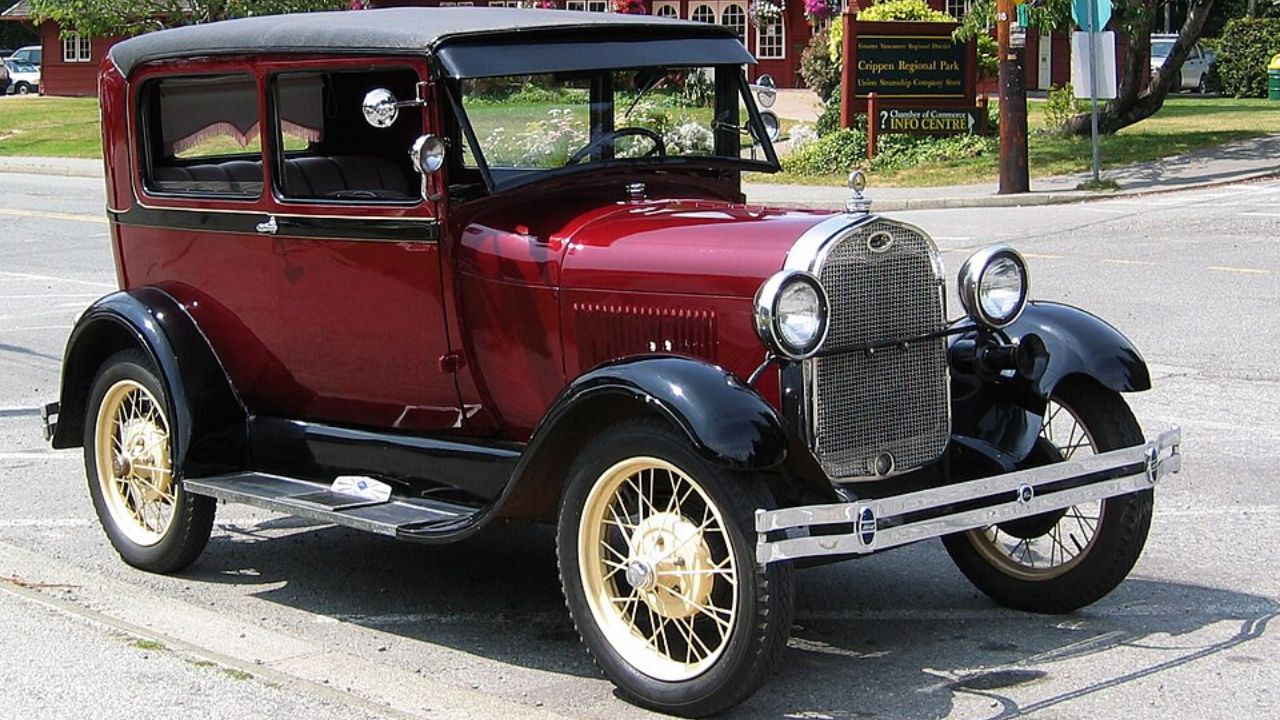
Mechanically, the car moved Ford closer to what buyers already expected from rivals. The Model A used a more powerful four-cylinder engine, offered improved lubrication, and adopted a conventional control layout that felt far less agricultural than the T’s idiosyncratic pedals and levers. It introduced better brakes and stronger frames that could handle higher speeds on improving roads. The message was clear: Ford would no longer ask customers to trade modern comfort for low price.
Styling mattered just as much. Where the T had been boxy and utilitarian, the Model A wore lower, more graceful bodywork, brighter paint, and a recognizable radiator shell that gave it visual identity. Buyers could choose from body styles that felt aspirational, including coupes, roadsters, and town sedans. It looked like something a young family or small business owner could be proud to park at the curb.
Under the skin, the Model A also showed that Ford had learned from its own manufacturing revolution. The same commitment to standardized parts and flow production that had made the T possible carried over into the new car, but now it was applied to a more complex and refined product. Henry Ford’s broader push to simplify work, cut waste, and pay higher wages so employees could afford the products they built had already changed industrial society. His effort to reorganize work and gave the Model A a ready-made audience of middle-class drivers.
The launch also marked a shift in how Ford thought about its own history. The Model T had turned factories into icons, from River Rouge in Michigan to satellite plants in places like Jacksonville, Florida. Some of those sites still stand as reminders of early mass production, although not all will survive. The planned demolition of a historic Model T in Florida underlines how physical traces of that era are disappearing even as the company’s archives preserve the story of how it moved on to the Model A.
What made the 1927 car so significant was not that it introduced a single headline feature, but that it bundled modern engineering, better safety, and real style into a package still priced for everyday buyers. It proved that mass production could adapt, and that a company built on one epoch-defining product could reinvent itself without losing its core audience.
Why the Model A’s reinvention playbook still matters
The 1927 switch from Model T to Model A is now a case study in how to retire a legend without destroying a brand. Ford had to balance nostalgia with realism, then convince dealers and drivers that the future would be better than the past, not just different.
Modern automakers face similar crossroads. Electric vehicles, software-defined cabins, and stricter emissions rules are forcing companies to rethink platforms that once felt permanent. The Model T’s rise shows how a breakthrough product can dominate a market. The Model A’s arrival shows what happens when that product finally hits its limits.
Corporate memory plays a role here. Ford’s multiple headquarters and archival centers in and around Dearborn serve as more than museums. The record of the and the later transition to the Model A give current executives a detailed map of what worked, what did not, and how customers reacted when the company asked them to leave a familiar car behind.
There is also a cultural dimension. The Model A helped normalize the idea that cars would change shape and character every few years. That expectation of regular replacement became central to the business model of the twentieth century auto industry, as documented in broader timelines of motor industry development that track the shift from early pioneers to annual model updates. The decision to move on from the Model T was the moment Ford accepted that permanence was an illusion.
For enthusiasts and historians, the Model A stands at the hinge between two eras. On one side sits the raw, experimental age of brass radiators and hand-cranked engines. On the other side lies the modern car, with standardized controls, safety features, and a design language that still feels familiar. The 1927 Ford sits right at that pivot point.
What the Model A’s legacy suggests about the next automotive reset
Looking ahead, the Model A story offers a template for how the industry might navigate the current shift to electric and connected vehicles. The lesson is not that every company should simply copy Ford’s choices from the 1920s. It is that timing, humility, and investment in new tooling matter as much as any single technology.
Ford waited too long to replace the Model T, but when it finally moved, it committed fully. Lines were shut, factories were retooled, and the company accepted a period of lower output in exchange for a car that could compete on modern terms. That willingness to pause and retool may be harder in a global market that demands constant quarterly growth, yet the underlying logic still applies.
More from Fast Lane Only
- Unboxing the WWII Jeep in a Crate
- 15 rare Chevys collectors are quietly buying
- 10 underrated V8s still worth hunting down
- Police notice this before you even roll window down
*Research for this article included AI assistance, with all final content reviewed by human editors