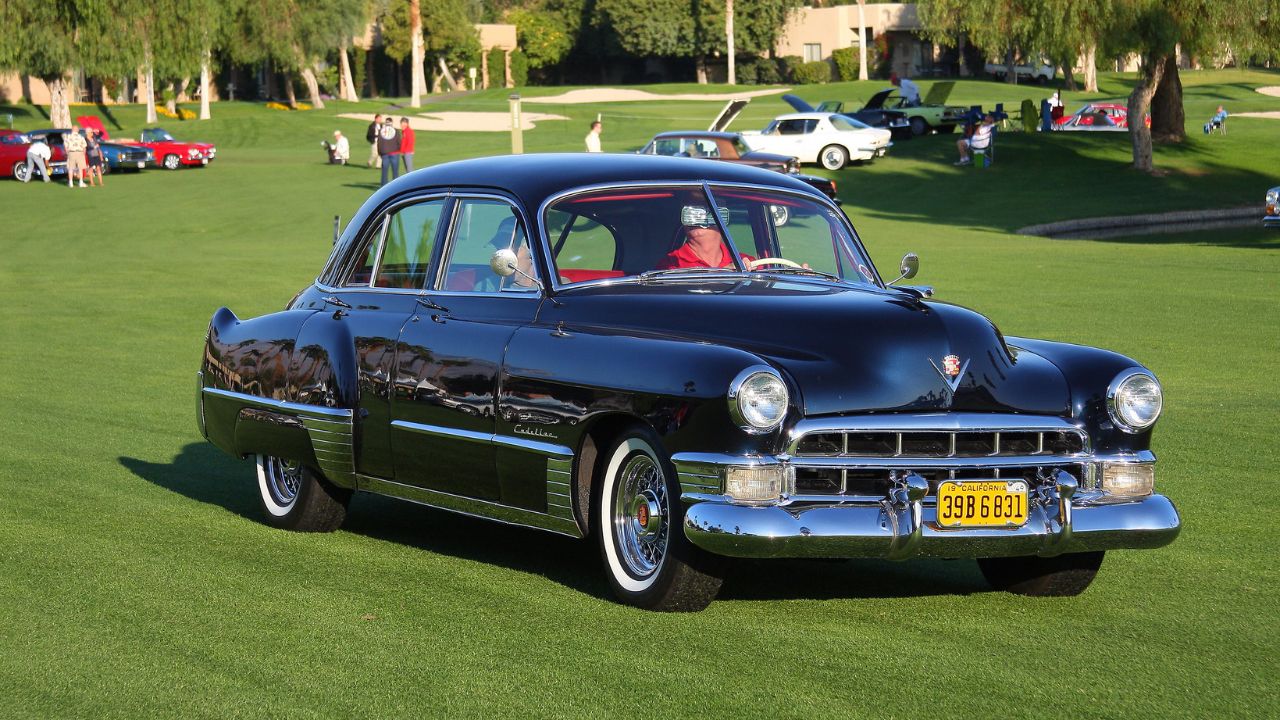
The 1949 Cadillac Series 62 arrived at a moment when Detroit needed to prove that American luxury could be both glamorous and technically advanced. With its new overhead-valve V8 and clean, modern styling, the car reset expectations for what a postwar Cadillac should be and helped steer the Motor City away from prewar habits. That single model year became a reference point for engineers, stylists, and marketers, who saw in it a blueprint for Detroit’s next chapter.
From conservative cruiser to modern luxury flagship
Before 1949, Cadillac had already built a reputation for refinement, but much of its hardware still traced back to prewar thinking. The Series 62 changed that balance. Under the hood sat a new 331 cubic inch overhead-valve V8 that was lighter, more powerful, and more efficient than the flathead engines it replaced. The change was not just about extra speed; it allowed Cadillac to package more power in a smaller, lighter block, which improved drivability and opened space for future styling and chassis experiments.
On the surface, the Series 62 looked familiar enough to loyal Cadillac buyers, yet it carried a different attitude. The body was lower and sleeker, with a longer hood that visually advertised the new V8 and a cabin that felt more open and modern than the tall, upright sedans of the early 1940s. Chrome was still abundant, but it was used to emphasize horizontal lines and a sense of motion rather than to mimic classical ornament. Overall, the car read as optimistic and forward looking, matching the mood of a country shifting from wartime austerity to peacetime prosperity.
The transformation was not purely theoretical. Surviving examples, including a Triumph Blue Series 62 highlighted as a driver-grade survivor, show how the model blended glamour with real-world usability. That particular car, finished in a deep blue over a light interior, still carries its original overhead-valve V8 and automatic transmission, and its mix of patina and presence illustrates how Cadillac aimed to deliver both style and durability in the first year of its new powertrain strategy, even if age has revealed hidden flaws beneath the glossy paint.
How engineering ambition repositioned Detroit
The technical leap inside the 1949 Series 62 signaled that Detroit was willing to invest in more than sheetmetal changes. The overhead-valve layout improved breathing and combustion, which translated into stronger acceleration and smoother highway cruising. For Cadillac, that meant the brand could claim a performance edge without sacrificing the quiet, isolated character that its customers expected. The car’s automatic transmission, power-assisted features, and careful noise insulation turned the new V8 into an effortless companion rather than a raw performance statement.
That balance mattered for the broader Detroit industry. General Motors engineers were not alone in pursuing overhead-valve designs, but Cadillac’s execution arrived at precisely the moment when returning veterans and growing middle-class families were ready to trade up. The Series 62 gave dealers a tangible story to tell about engineering progress. Buyers were not just purchasing more chrome or a longer wheelbase; they were buying a different kind of engine, one that promised better performance on the new interstate-style roads that were starting to spread across the country.
Inside, the car supported that story with details that made long-distance travel feel less tiring. A broad front bench, clear instrumentation, and improved ventilation created a cabin that felt like a rolling living room rather than a repurposed prewar shell. The result was a car that could carry a family from city to suburb or across state lines with less effort, reinforcing Detroit’s role in reshaping American mobility patterns at midcentury.
Design language that set the tone for postwar luxury
The 1949 Series 62 also helped crystallize a new design vocabulary for American luxury cars. While the tailfin era would not fully explode until the mid 1950s, the model already hinted at the jet-age influences that would define the decade. Subtle fin-like elements, integrated rear fenders, and a grille that suggested motion rather than static grandeur all pointed toward a future in which cars would borrow imagery from aircraft and rockets.
Cadillac stylists used the new, more compact V8 as an opportunity to lower the hood line and stretch the body visually. That change made the car look longer and more planted, a contrast with the taller, boxier proportions of earlier luxury sedans. The Triumph Blue example shows how color and trim amplified that effect. The deep exterior paint, contrasted with bright chrome and a light interior, created a layered look that felt both formal and modern. Even decades later, the car’s stance and proportions still read as aspirational, which helps explain why collectors continue to seek out original or lightly restored Series 62s.
Detroit’s other luxury competitors took notice. The combination of a modern V8, an automatic transmission, and streamlined styling quickly became the template for high-end American cars. As brands chased Cadillac’s formula, the Motor City shifted away from the conservative silhouettes of the 1930s and toward a more expressive, technology-forward identity that would define the 1950s and early 1960s.
Why the 1949 Series 62 still resonates with Detroit and collectors
More than seven decades later, the 1949 Series 62 continues to matter because it represents a turning point in how Detroit connected engineering, design, and marketing. For the city’s automakers, the car validated the idea that investment in advanced powertrains could pay off in showroom traffic and brand prestige. For collectors and historians, it marks the beginning of a modern era in which American luxury cars were expected to innovate under the skin as aggressively as they did on the surface.
Current market interest reflects that legacy. Enthusiasts who track postwar Cadillacs often point to 1949 as a key cutoff year, with values and attention rising for cars that retain their original overhead-valve V8s and factory-correct details. The Triumph Blue Series 62, despite rust issues and aging trim, still draws attention because it captures the first-year configuration in a largely unmodified state. Its mix of originality and wear shows how these cars were used as daily transportation before they became collectibles, and how their engineering allowed them to survive decades of regular driving.
For Detroit itself, the car’s story feeds into a broader narrative about reinvention. The city has spent recent years trying to balance its heritage as the Motor City with new roles in mobility technology and design. The 1949 Series 62 reminds local institutions, museums, and car clubs that Detroit’s most celebrated moments often came when it embraced change rather than clung to tradition. That lesson continues to shape how the region presents its automotive history to visitors and investors.
Preservation, reinterpretation, and what comes next
The future of the 1949 Cadillac Series 62 sits at the intersection of preservation and reinterpretation. On one side are purists who want to maintain these cars exactly as they left the factory, from the overhead-valve V8 to the period-correct fabrics. On the other side are builders who see the Series 62 body as a canvas for modern drivetrains, upgraded brakes, and contemporary comfort features. The Triumph Blue car, with its combination of original hardware and hidden structural issues, illustrates the choices that owners face. Restorers must decide whether to chase authenticity, performance, or a compromise that keeps the car on the road without erasing its character.
As environmental regulations and driving habits change, the way people experience cars like the Series 62 will also evolve. Some cities are tightening rules on older combustion vehicles in dense urban cores, which may push classic Cadillacs toward weekend and event use rather than daily commuting. At the same time, advances in synthetic fuels, improved engine tuning, and better maintenance practices can help reduce emissions and extend the life of original V8s. Museums and private collections are experimenting with curated drives, where visitors can ride in or occasionally drive historic cars on controlled routes instead of only viewing them behind ropes.
More from Fast Lane Only
- Unboxing the WWII Jeep in a Crate
- 15 rare Chevys collectors are quietly buying
- 10 underrated V8s still worth hunting down
- Police notice this before you even roll window down
*Research for this article included AI assistance, with all final content reviewed by human editors