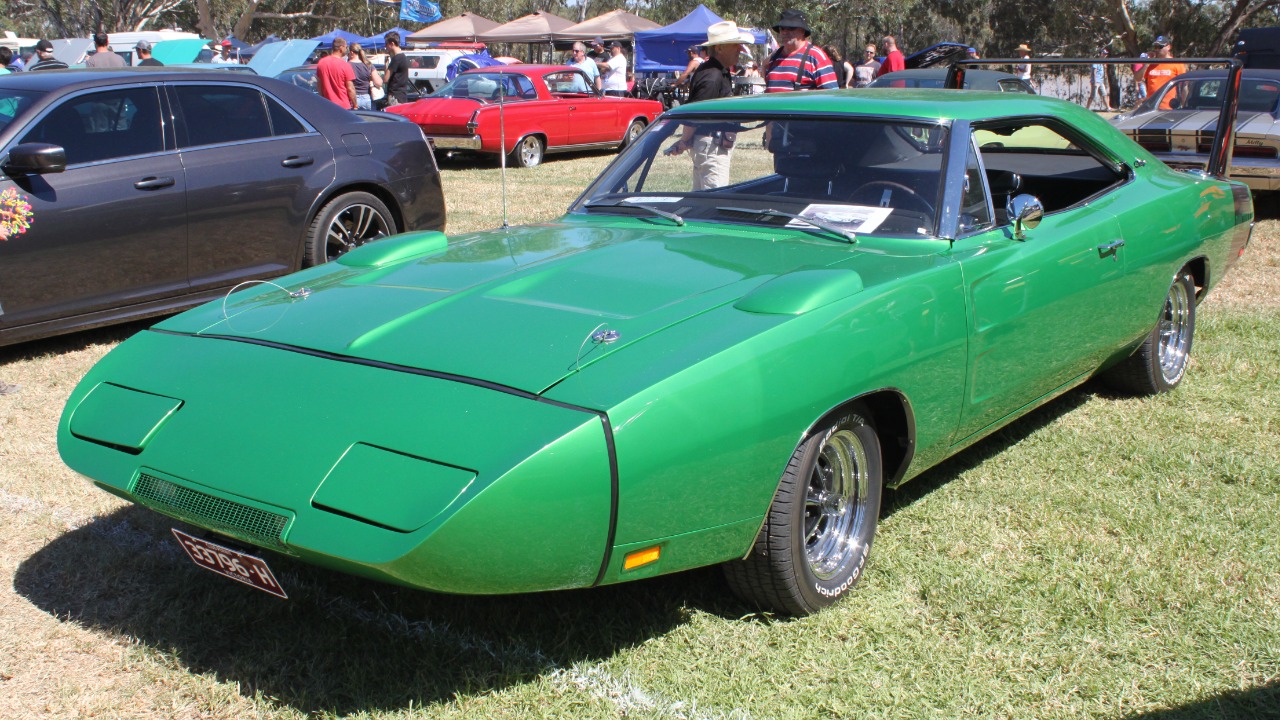
Few cars in automotive history look as outrageous as the 1969 Dodge Charger Daytona.
At first glance, the car seems almost cartoonish. Its pointed nose stretches nearly 19 inches beyond the front bumper, while a towering rear wing rises high above the trunk. Even among the wild machines of the muscle car era, the Daytona looked like something from the future.
For decades, many people assumed the nose cone was simply a styling gimmick—a dramatic design exercise intended to attract attention in showrooms and on race tracks.
The reality was far more practical.
The Charger Daytona’s unusual nose cone existed for one reason: speed.
What looked bizarre on city streets was actually one of the most effective aerodynamic solutions ever applied to an American stock car.
Dodge Had a Problem in NASCAR
To understand why the Daytona received its distinctive front end, it’s important to understand the state of NASCAR racing during the late 1960s.
At the time, NASCAR’s fastest venues were giant superspeedways such as Daytona International Speedway and Talladega Superspeedway. On these long, high-banked tracks, horsepower alone wasn’t enough to win races.
Aerodynamics mattered.
The standard Dodge Charger already possessed one advantage over many rivals thanks to its sleek fastback roofline. However, Dodge engineers noticed a significant flaw during wind-tunnel testing and high-speed evaluations.
The car’s front end generated aerodynamic lift.
As speeds increased, air flowing beneath and around the nose created forces that reduced front-end stability. Drivers reported that the cars could feel light and unsettled at the extreme speeds reached on NASCAR’s fastest tracks.
In racing, instability is the enemy.
The engineers needed a solution.
The Limits of Traditional Styling
The production Charger’s front grille was attractive, but it wasn’t particularly aerodynamic.
Its recessed design created turbulence as air struck the front of the vehicle. The exposed surfaces disrupted airflow and increased drag.
At everyday highway speeds, the effect wasn’t especially important.
At 190 mph, it became a major problem.
Dodge engineers realized they needed to reshape the front of the car so air could flow around it more smoothly.
Rather than allowing airflow to collide with a relatively blunt front fascia, they wanted to guide it around the vehicle with as little disturbance as possible.
That goal led to one of the most recognizable pieces of sheet metal in NASCAR history.
Designing the Nose Cone
The Daytona’s pointed front section wasn’t added to make the car look futuristic.
It was built to reduce drag and improve high-speed stability.
Engineers created an elongated aerodynamic nose that extended well beyond the Charger body’s original front end. The cone-shaped design helped smooth airflow around the vehicle while reducing the amount of turbulent air generated at high speed.
The effect was dramatic.
Wind resistance dropped significantly compared to the standard Charger.
Equally important, the new design reduced front-end lift.
Drivers gained confidence because the car felt more stable as speeds climbed.
The unusual shape may have appeared strange to spectators, but every inch of it served a purpose.
This wasn’t styling for styling’s sake.
It was engineering.
The Influence of Aviation
The Daytona emerged during a period when many automotive engineers were studying concepts borrowed from aviation.
Aircraft designers had spent decades learning how airflow affected speed, stability, and efficiency. Racing teams increasingly realized that the same principles could apply to automobiles.
The Daytona became one of the clearest examples of that thinking.
Its pointed nose functioned much like an aircraft component, managing airflow in a controlled manner rather than simply allowing it to collide with the vehicle’s front surfaces.
The result was a stock car that behaved differently from almost anything else on the track.
The Daytona wasn’t merely powerful.
It was slippery.
The First NASCAR Car to Break 200 MPH
The aerodynamic improvements worked even better than Dodge anticipated.
When the Daytona arrived on NASCAR’s superspeedways during the 1969 season, it immediately demonstrated a clear speed advantage.
Drivers could maintain higher speeds on long straightaways while enjoying greater stability through the banking.
The most famous milestone came in March 1970 when Buddy Baker became the first driver in NASCAR history to exceed 200 mph during a closed-course run.
His Daytona recorded a speed of more than 200 mph at Talladega, a remarkable achievement for the era.
The pointed nose cone played a major role in making that accomplishment possible.
Without the aerodynamic improvements, such speeds would have been far more difficult to achieve.
Why Dodge Built Street Versions
NASCAR rules required manufacturers to sell a certain number of race-derived vehicles to the public before those designs could compete.
This process, known as homologation, forced Dodge to build street-legal Daytonas equipped with the same distinctive aerodynamic features.
As a result, customers could purchase a car that looked remarkably similar to the machines dominating NASCAR.
The street versions retained the elongated nose cone, making them some of the most visually dramatic vehicles ever offered by an American manufacturer.
Buyers suddenly found themselves driving cars developed largely for success on the race track.
Whether neighbors understood the engineering behind the design was another matter entirely.
Too Successful for Its Own Good
The Daytona’s aerodynamic advantage quickly inspired competitors.
Plymouth responded with the equally dramatic Plymouth Superbird, which used many of the same aerodynamic concepts.
Together, these so-called “winged warriors” transformed NASCAR.
They were also becoming too effective.
As speeds continued to rise, NASCAR officials grew concerned about safety and escalating development costs. The sanctioning body eventually introduced rule changes that effectively ended the dominance of the aero cars.
Their competitive lifespan proved surprisingly short.
Yet their impact was permanent.
A Design That Became an Icon
Today, the Daytona’s nose cone remains one of the most recognizable design elements in automotive history.
What once looked strange has become legendary.
Collectors prize original Daytonas not only because of their rarity but also because they represent a unique moment when race-car engineering directly shaped production-car design.
The nose cone serves as a reminder that some of the most unusual automotive features were never intended to make a fashion statement.
They existed because engineers were chasing performance.
The Shape of Speed
The 1969 Dodge Charger Daytona wore its unusual nose cone because Dodge wanted to win races.
The design reduced drag, improved stability, and helped create one of the fastest stock cars NASCAR had ever seen. What appeared excessive on the street made perfect sense on the race track.
Far from being a styling gimmick, the Daytona’s pointed front end was a carefully engineered solution to a high-speed problem.
The fact that it looked spectacular was simply a bonus.
More than half a century later, the nose cone remains one of the boldest examples of function shaping form in American automotive history—a reminder that sometimes the strangest designs are also the smartest.
More from Fast Lane Only