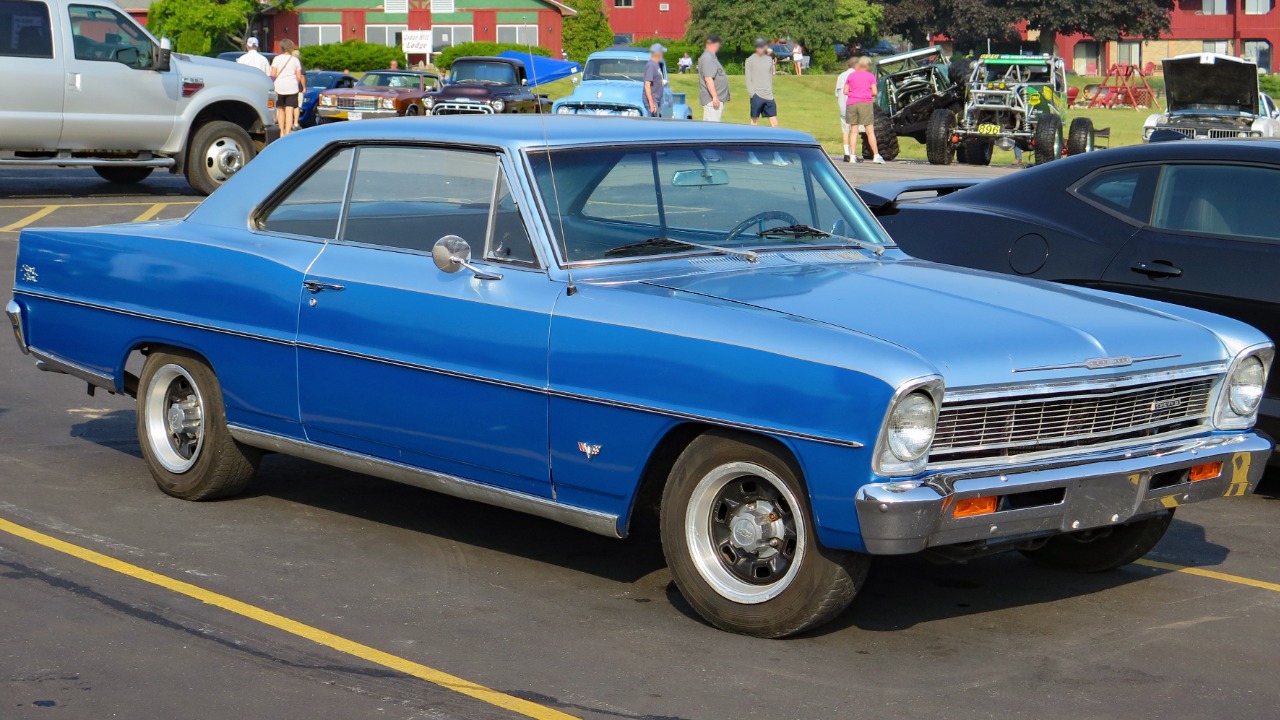
The Chevrolet Nova was never originally designed to become a legendary performance machine. Built as a practical compact car, it gained an unexpected reputation among enthusiasts because of its lightweight body, simple construction, and ability to accept powerful engines. Over time, the Nova became a favorite among street racers who recognized its hidden performance potential.
A Lightweight Platform With Serious Potential
When Chevrolet introduced the Nova in 1962, it was created as an affordable and practical compact car designed for everyday transportation. However, its simple design and relatively lightweight construction made it an excellent foundation for performance upgrades.
Unlike larger muscle cars, the Nova offered a smaller body that could be transformed into a surprisingly quick machine with the right engine combination. Its compact dimensions allowed enthusiasts to achieve impressive power-to-weight ratios without the added size and weight of traditional muscle cars.
As Chevrolet expanded the Nova lineup, buyers gained access to stronger engines and performance options. The availability of small-block V8 engines gave racers an affordable starting point for building faster cars.
This combination of affordability, simplicity, and potential made the Nova increasingly attractive to performance enthusiasts.
The Small-Block V8 Changed Its Reputation
The Nova’s image changed dramatically when Chevrolet began offering V8 engines in the platform. The lightweight chassis paired exceptionally well with engines like the 327 and later the powerful 350 small-block V8, creating a car capable of surprising much larger performance models.
Street racers appreciated how easily the Nova could be modified. Engine swaps, suspension upgrades, improved brakes, and drivetrain changes were relatively straightforward compared with more complicated vehicles.
The car’s compact size also helped it launch quickly, making it competitive in drag racing environments where acceleration mattered most. Many enthusiasts discovered that the Nova could deliver muscle car performance without the higher cost of more famous models.
Its reputation grew through real-world results rather than expensive marketing campaigns.
Simple Engineering Made Custom Builds Easier
One of the Nova’s greatest strengths was its straightforward mechanical design. Unlike some performance cars with complex systems, the Nova used proven Chevrolet components that were widely available and easy to modify.
This simplicity encouraged creativity among racers and builders. Owners could customize nearly every aspect of the car, from engine combinations to suspension setups, depending on their goals.
The large aftermarket support for Chevrolet small-block engines further increased the Nova’s popularity. Parts were affordable, knowledge was widely available, and countless performance combinations could be created.
For many street racers, the Nova represented the ideal balance between cost, capability, and customization.
It became a blank canvas for enthusiasts looking to build a fast and reliable performance car.
A Sleeper Legend That Earned Respect
Unlike famous muscle cars that attracted attention immediately, the Chevrolet Nova often surprised people with its performance. Its modest appearance allowed it to become a classic sleeper car, capable of outperforming vehicles that looked far more aggressive.
The Nova’s reputation continued growing through decades of racing, customization, and enthusiast culture. Collectors and builders still value the platform because it represents an era when creativity and mechanical knowledge could transform an ordinary vehicle into something extraordinary.
Today, restored and modified Novas remain popular among muscle car fans and street performance communities. Their appeal comes from the same qualities that made them successful decades ago: simplicity, affordability, and unlimited potential.
The Chevrolet Nova became a street racing favorite because it proved that a legendary performance car does not always need a famous name—it only needs the right combination of engineering and opportunity.
More from Fast Lane Only
- Unboxing the WWII Jeep in a Crate
- 15 rare Chevys collectors are quietly buying
- 10 underrated V8s still worth hunting down
- Police notice this before you even roll window down
*Research for this article included AI assistance, with all final content reviewed by human editors