The 1969 Camaro Z/28 was not built to cruise boulevards or win stoplight drag races. It existed for a single purpose: to turn Chevrolet’s pony car into a winner in the Sports Car Club of America’s Trans-Am road racing series, and to let you buy that capability right off the showroom floor. Everything that makes the car legendary today, from its high-strung small-block to its heavy steering and firm ride, flows from that one job description.
When you look past the stripes and spoilers, you find a machine that treats you less like a casual driver and more like a teammate. The 1969 Chevrolet Camaro Z/28 asked you to work for its speed, then paid you back with balance, feedback, and a race-car feel that modern track specials still chase.
Built to beat Mustang at the track
If you want to understand the Z/28, you start with rivalry. Chevrolet executives watched the Ford Mustang dominate early pony-car sales, and as one detailed history notes, decided that if they could not beat the Mustang in the showroom, they would at least beat it on the track. That thinking produced the Camaro program, internal project XP-836, and ultimately the Z/28 package that turned a two-door coupe into a homologation special for the SCCA Trans-Am Series. The Trans-Am rulebook capped engine displacement at 5.0 liters, so Chevrolet engineers had to think like racers, not marketers.
That is why the Z/28 did not get a big-block, even though big cubes sold on the street. Instead, Chevrolet created a special 302 cubic inch small-block that slid under the Trans-Am displacement limit while revving hard enough to stay in the fight with anything Ford could field. The Sports Car Club of America’s rules shaped everything from compression ratio to induction, and as one technical breakdown notes, this configuration allowed Chevrolet to comply with the SCCA Trans-Am series displacement limit while still building a street-legal car you could register, insure, and drive to work.
The 302 that lied about its power
When you slide behind the wheel of a ’69 Z/28, the engine defines the experience. On paper, the high-revving 302 cubic inch V8 was rated at 290 horsepower, a figure that looks modest next to later muscle cars. But period testing and modern analysis have long argued that the number was sandbagged. One deep dive into the car’s quirks points out that the 1969 Chevrolet Camaro Z/28 carried a 290 horsepower rating when it actually made well over 300, with some estimates comfortably clearing the 300 mark. Keeping the official number low helped Chevrolet slide the car past insurance companies and internal politics that favored big-block flagships.
What you feel from the driver’s seat is not a torque monster but a classic small-block screamer. Contemporary coverage described the 1969 Chevrolet Camaro Z28 as drawing on its road-racing roots, with power that came alive as the tach needle swept past the midrange. A later performance summary of the Camaro RS Z28 notes that the 302 Cubic Inch Engine When tested at the track pushed the Camaro RS to 60 in 7.4 seconds and through the quarter mile in 14.8, numbers that still feel brisk for a car you can wrench on in your own garage.
Hardware that turns a pony car into a weapon
Chevrolet did not stop at the engine. To turn the Z/28 into a true circuit car, engineers and what one account calls Savvy option manipulators leaned on the order sheet. If you wanted the strongest setup for racing, you could specify the RPO JL8 four-wheel disc brake package and a Heavy-duty suspension that transformed the car’s stopping power and durability. Enthusiasts still talk about that race-bred JL8 system with reverence, and one feature on a particularly well-preserved example notes that Camaro enthusiasts tend to agree the race bred RPO JL8 option remains one of the most impressive high-performance upgrades available on a first-generation Camaro.
Underneath, the Z/28’s unique powertrain was paired with serious driver’s gear. Many cars left the factory with a Muncie 4-speed manual, and auction notes on a Hugger Orange example highlight how the Z/28’s engine was paired with a Muncie 4-speed manual transmission that rewarded anyone who valued mechanical feedback. Another period-style description notes that the Z/28’s unique powertrain was paired with a precision-tuned M21 close-ratio 4-speed manual transmission, ensuring smooth shifting and maximum control for drivers who treated every on-ramp like a qualifying lap, a detail preserved in a community write-up on the transmission options.
Trans-Am style you could park in your driveway
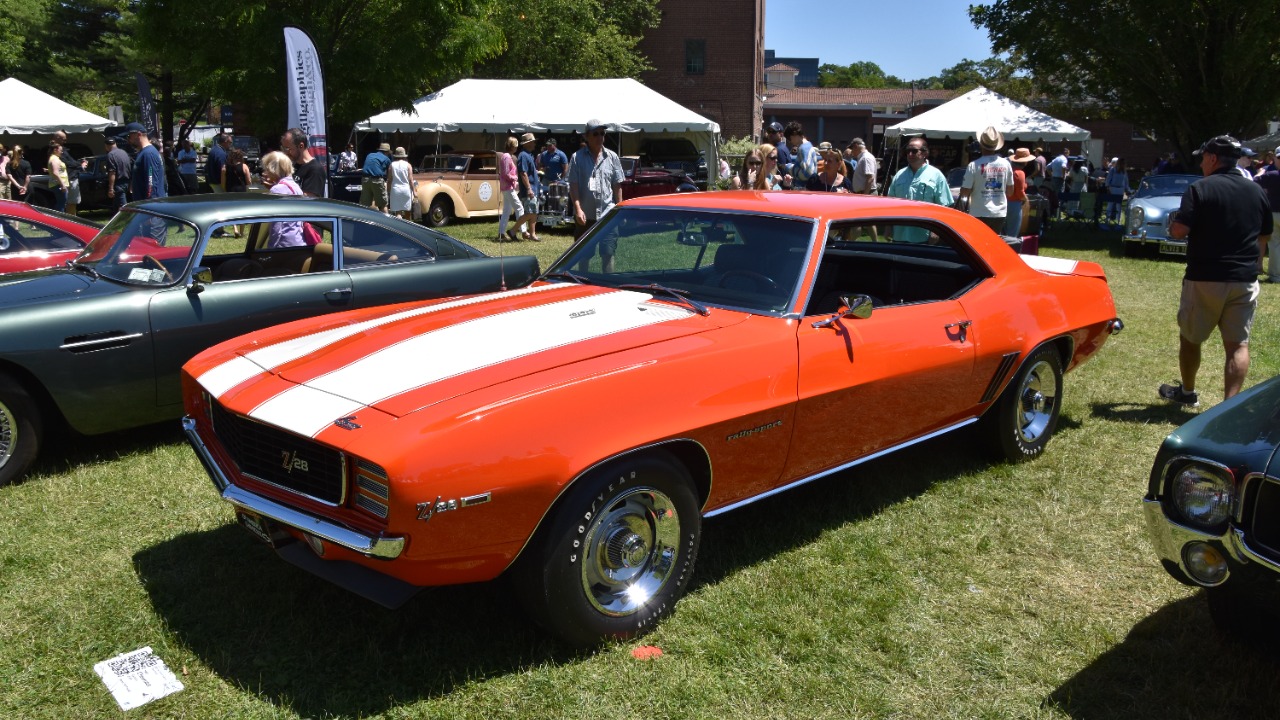
Even if you never saw a green flag, the Z/28 made you feel like part of the grid. The car was designed with the SCCA Trans-Am series in mind, and one enthusiast listing notes that this 1969 Chevrolet Camaro Z/28, with its iconic stripes, rally wheels, and cowl-induction hood, was built for performance fans who wanted both style and speed. Another overview calls the 1969 Chevrolet Camaro Z/28 a legend among American muscle cars, an aggressive, track-bred performer with unmistakable style that still turns heads at shows from New York to small-town cruise nights.
That visual aggression was not just for show. A detailed feature on a Cross Ram Coupe points out that the 1969 Chevrolet Camaro Z/28 used its stance, spoilers, and optional cross-ram induction to create a Trans-Am look that matched its intent. Museum displays echo that message, describing the car as a true race car that brought the spirit of the SCCA Trans-Am Series to the street and pitted it directly against Mustangs, Camaros, Trans Ams, Javelins and other rivals in fender-to-fender combat, a rivalry preserved in the exhibits at Newport.
From brutal race tool to everyday classic
Living with a Z/28 today, you quickly discover that its race-first mission still shapes every drive. One long-term owner profile puts it bluntly: the 1969 Chevrolet Camaro Z/28 was never designed to live an easy life, because Chevy built it to satisfy Trans-Am homologation rules, not to coddle commuters. Yet that same story shows how, in the right hands, the car can be daily driven for decades, its firm suspension and heavy controls turning every errand into a reminder of what a purpose-built machine feels like. Another enthusiast write-up calls the 1969 Chevrolet Camaro Z/28 an iconic muscle car built for the Trans-Am racing series, a blend of performance, style, and racing heritage that still makes sense on modern roads.
That dual personality, brutal on track yet usable on the street, is why collectors chase these cars so hard. A modern buyer’s guide describes the 1969 Chevrolet Camaro Z/28 as a street-legal race car born to dominate the Trans-Am series, with a high-revving V8, performance suspension, and front disc brakes that make it feel more like a vintage GT car than a typical muscle machine. Another overview of the broader Camaro lineage calls the Chevrolet Camaro Z/28 the most famous performance variant in the nameplate’s history, noting that every element, from its aggressive aerodynamics to its stripped-down cabin, serves a purpose as a track machine.
More from Fast Lane Only