Most of us remember a car we wish we had parked somewhere dry and simply left alone. In Sweden, one Saab 99 got exactly that treatment. It rolled into a barn in 1995, and nobody touched it for three decades.
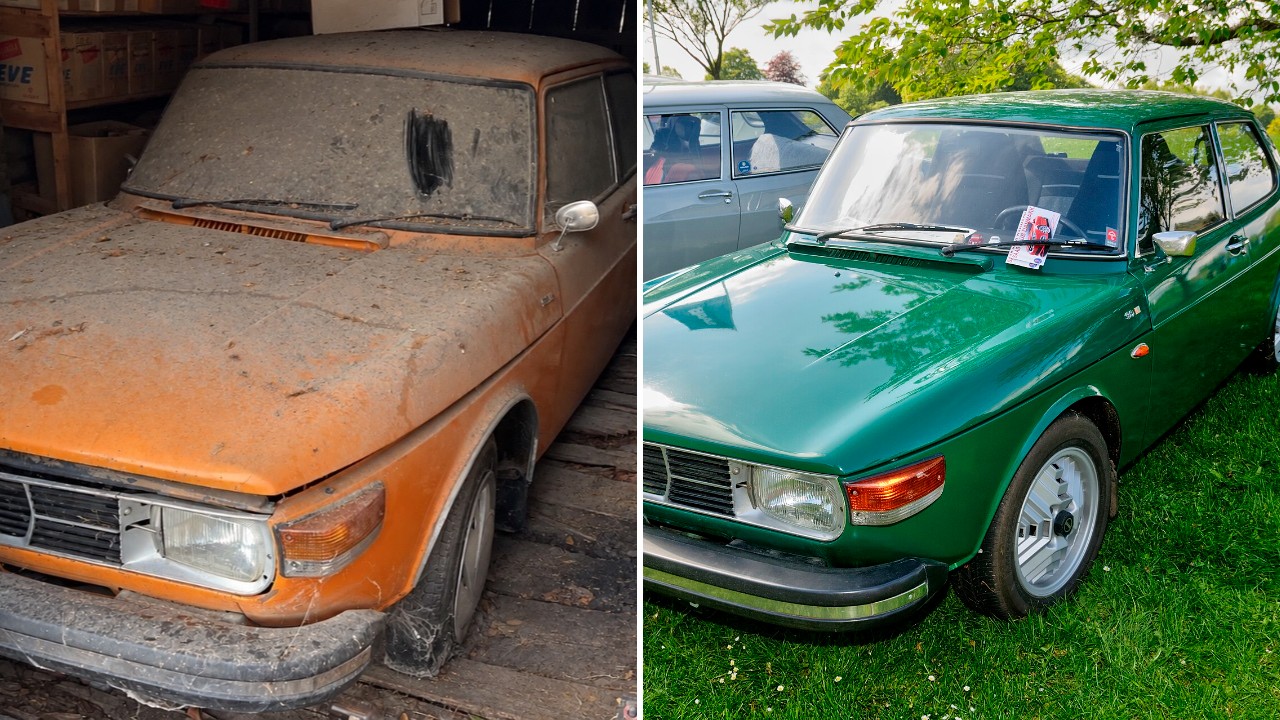
The man who finally pulled it out posts his restorations as @Hampus_Granstrom. His latest project is a 1975 Saab 99, a version he calls the 99 X7 and describes as a very rare model. His captions explain that it was meant to serve as a parts car, yet nobody ever took a single part from it.
A Saab 99 That The Weather Saved
“The Saab has been sitting in this barn since 1995,” reads the first caption. And it looks it, but in a good way. He notes that the car never saw road salt, because nobody salted the roads around Vemdalen back then.
The interior has mould, but the shell is solid. Meanwhile, the odometer shows 130,000 kilometres. Remarkably, all four tyres still hold air, and none of the brakes have seized. So a Volvo tows the Saab 99 out of the barn and over to the workshop.
There was one warning sign, though. According to the captions, the engine had overheating issues when he says it went into storage in 1995.
First Start In More Than 30 Years, Then Bad News
He starts with the basics: fresh oil and a filter, new spark plugs, cleaned contact points, a new distributor cap and a new battery. Fuel comes from a separate tank. Even with starting fluid, though, the engine gets no fuel, so a new fuel pump goes in. After that, the Saab runs for the first time since 1995.
The good news does not last. Old, clogged oil coats the inside of the engine, so he runs an additive and changes the oil again. Then the water pump starts leaking, and he finds water in the oil.
“This might have to do why it overheated in 1995,” he writes.
Off Comes The Cylinder Head
The fix is a new head gasket, so the cylinder head comes off. Underneath, the pistons and cylinders look good. Meanwhile, the water pump housing is in bad shape, so he finds a better one on the same engine at a junkyard.
Then the parts get the full treatment. He wet-blasts the housing, cleans and resurfaces the head, and torques it down in the correct order. The carburettor goes through an ultrasonic cleaner and comes out looking almost new. By the end, the engine is on its fourth oil change, and the test start runs great.
The rest of the car needs just as much patience. First, he drains the stale fuel and replaces a hose that dried out in the barn. Next, the clutch slave cylinder piston will not move, so he pushes it out with a grease gun, then hones the bore and fits a new seal. The brakes get new hoses and discs, and he sandblasts and paints the rear calipers. One snag: the new discs are too thick, so he takes about two millimetres off them before they fit.
Thirty Years Of Dust Comes Off
Next, the Saab drives out of the workshop under its own power for the first time. Then it gets a deep clean with a degreaser, an iron fallout remover and a cold degreaser. In his words, it is 30 years of dust washed away.
The paint is clean but very matte, so he polishes it with a random orbital polisher, which he says is much gentler on old paint. A set of Saab Ronal wheels replaces the tired originals, and he scrubs the mould out of the interior.
What This Saab Teaches Anyone Reviving A Long-Parked Car
His step-by-step approach is a useful checklist for anyone waking up a car that has sat for years:
- Find out why the owner stopped driving it. An old overheating problem rarely fixes itself.
- Change the oil more than once. Sludge loosens up as the engine runs.
- Check the oil for water before you trust the head gasket.
- Run it from a clean fuel source rather than old fuel in the tank.
- Go through the brakes and hydraulics completely, even if nothing looks seized.
Where Things Stand
At the end of the video, the Saab heads out for its first test drive since 1995. “It runs and drives really well!” the caption says. After three decades in a barn, this 99 is a working car again.
More from Fast Lane Only