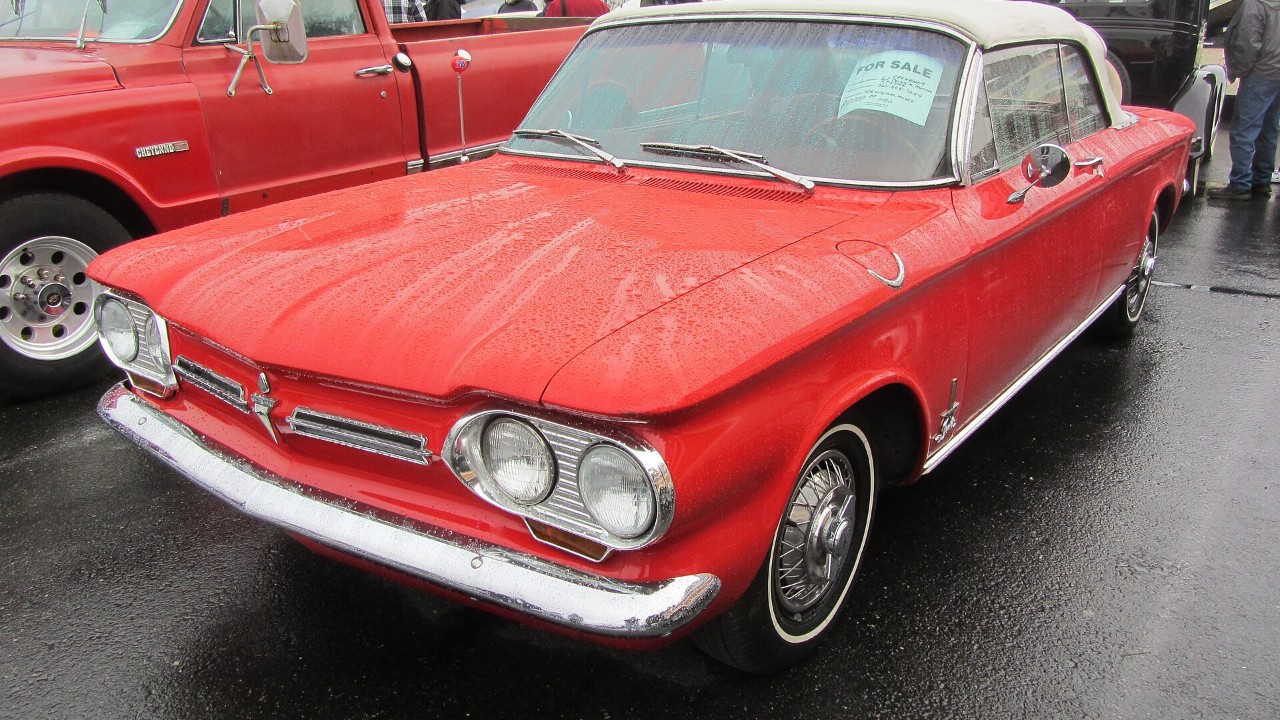
Chevrolet’s 1962 Corvair Monza Spyder bolted a turbocharger to an air-cooled flat-six and sold it to everyday buyers. The Corvair Spyder turbo engine made 150 horsepower. It did that without a wastegate to bleed off boost. Instead, the turbo system had its own built-in limit.
The Corvair was already the odd one out at Chevrolet. Its six-cylinder engine sat in the back, cooled by air, with the cylinders laid flat in two banks. The sporty Monza version had given the car a real following. The Spyder option then aimed that following at drivers who wanted more speed.
A turbocharger uses exhaust gas to spin a turbine. That turbine drives a compressor, which pushes extra air into the engine. Most modern turbo engines manage that boost with a wastegate, a valve that lets exhaust bypass the turbine. In 1962, however, Chevrolet kept things simpler.
How the Corvair Spyder turbo made its power
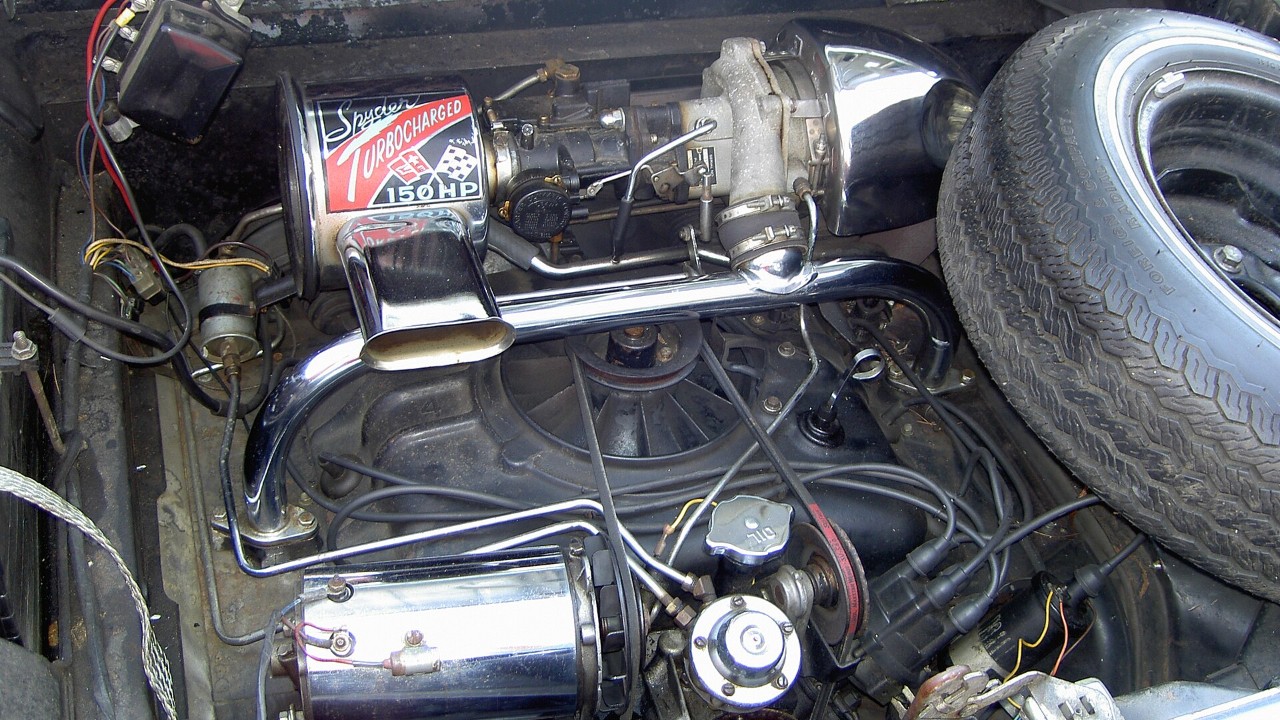
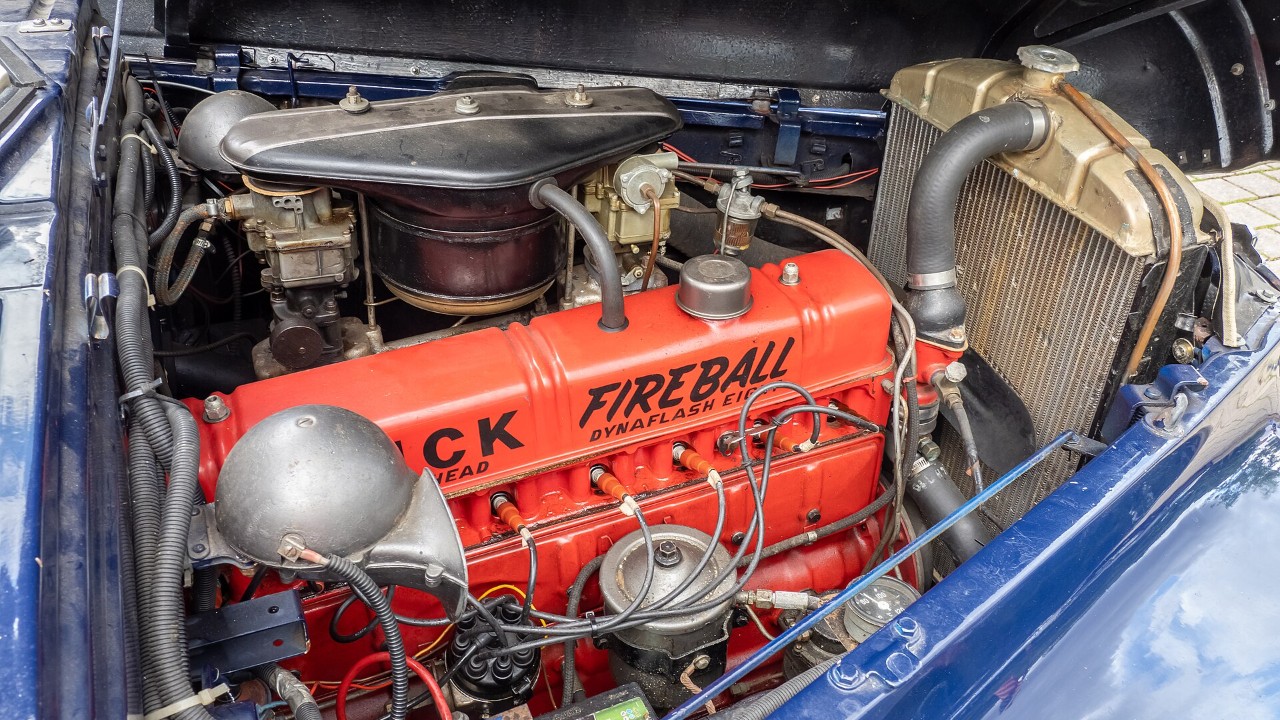
Mac’s Motor City Garage dates the Spyder’s debut to the Chicago Auto Show in February 1962. Its engine started as the Corvair’s 145-cubic-inch flat-six. The turbo came from a division of TRW, and it shared the engine’s oil supply. Meanwhile, a one-barrel Carter YH sidedraft carburetor fed the engine, the same model used on the original six-cylinder Corvettes.
Chevrolet also lowered the compression ratio from 9:1 to 8:1 with redesigned pistons. As a result, output rose from 102 horsepower in the stronger regular engine to 150 at 4,400 rpm. Torque climbed to 210 lb-ft at 3,300 rpm, which Mac’s calls a 56 percent increase.
No wastegate, just a built-in limit
The Spyder had no wastegate and no boost valve. According to Mac’s, the system instead had a built-in limit of 10 psi. So the hardware itself set the ceiling, with no valve to step in.
Detonation, however, was the bigger worry. Chevrolet fought it with the lower compression and an ignition retard unit. A pressure-retard can took the place of the usual vacuum advance, and it pulled the timing back 10 degrees at 2 psi of manifold boost.
Oldsmobile took another route with its own turbocharged Jetfire that same year. By comparison, Mac’s says Olds used limited boost and water-alcohol injection to keep detonation in check. Two GM divisions, in other words, solved the same problem in two different ways.
Gauges, gearbox and price
Hagerty notes that the four-speed manual was mandatory on the Spyder in 1962 and 1963. Air conditioning, the three-speed manual and the Powerglide automatic were all off the list. Mac’s adds a 3.55:1 final drive in place of the standard 3.27:1.
That changed for 1964, when the four-speed became an option on the Spyder. Hagerty lists it at $92 extra that year. In 1962, by comparison, every Spyder buyer got the four-speed whether they asked for it or not.
Inside, meanwhile, the dash told the driver what the turbo was doing. The Spyder cluster carried a 6,000-rpm tachometer and a 120-mph speedometer, per Mac’s. It also had a manifold pressure gauge calibrated in inches of mercury and a cylinder-head temperature gauge. Outside, Spyder logos on the front fenders and spider logos on the wheel covers marked the car.
Hagerty lists the Spyder option at $317.45 in 1962, or roughly $2,735 in today’s money. Mac’s gives the same price for RPO 690, added to a Monza 900 coupe at $2,273 or a convertible at $2,483. Car Life timed one from 0 to 60 mph in 10.8 seconds in August 1962, Mac’s reports. A Corvair with Powerglide, by contrast, needed 21.6 seconds.
Turbo lag, sales and a 180-hp sequel
The boost came on late. The Audrain Automobile Museum says the Monza Spyder earned a reputation for “turbo lag,” with sluggish low-rpm response in town. For 1964, Chevrolet stretched the engine to 164 cubic inches. Hagerty says the 150 horsepower then arrived at 4,000 rpm, which helped low-speed torque and trimmed the lag somewhat.
Even so, buyers took to the car. Hagerty counts 6,894 Spyder coupes and 2,574 convertibles for 1962. Sales then jumped to 11,267 coupes and 7,472 convertibles in 1963, before falling to 6,480 and 4,761 in 1964.
Handling took some care, too. The Audrain museum notes the rear-engine car tended toward oversteer. To counter it, Chevrolet specified different tire pressures front and rear. Still, the museum says the sales figures suggest buyers treated the Spyder as an “American Porsche.”
The turbo outlived the Spyder name. For the redesigned 1965–66 Corsa, Hagerty says the standard engine was a four-carburetor flat-six rated at 140 horsepower. A revised turbo engine, rated at 180 horsepower, cost just $161 more.
Finally, you can see one in person. The Audrain Automobile Museum in Newport, Rhode Island, shows a 1962 Monza Spyder in its Begovich Collection exhibition. The museum lists the car with its 150-horsepower turbocharged six at 4,400 rpm and a four-speed manual.
More from Fast Lane Only