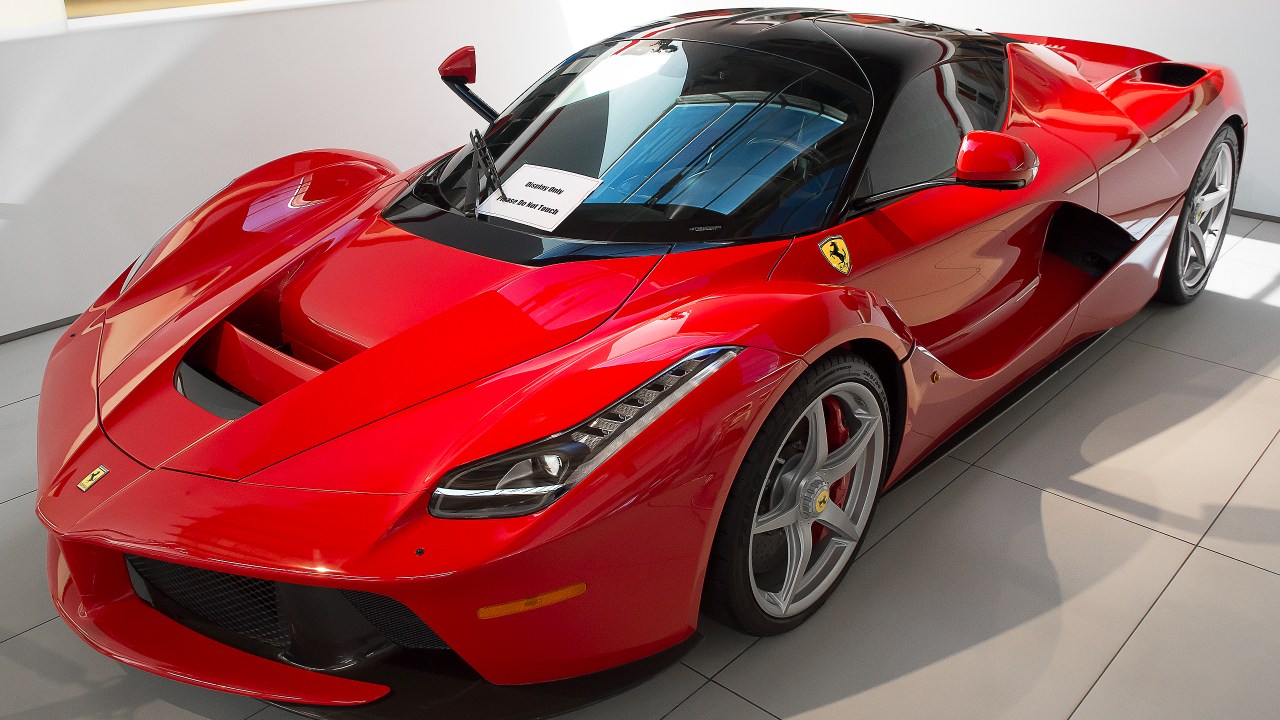
The 2013 LaFerrari marked a turning point for Maranello, pairing a screaming V12 with electric assistance to create the first hybrid road car in Ferrari history. Positioned at the top of the range, it was conceived not just as a flagship but as a proof of concept that hybrid technology could enhance, rather than dilute, the brand’s most extreme performance car. More than a decade later, it still defines the modern hypercar era and shapes how I think about every electrified Ferrari that has followed.
From Maranello halo car to “holy trinity” icon
Ferrari built the LaFerrari as a limited production halo model, assembled in Maranello, Italy, with a 2-door Berlinetta body that distilled the company’s Formula 1 learning into a road car. Designed by Ferrari Centro Stile, it sat above the contemporary V8 and V12 range as a technology demonstrator that would never be repeated in quite the same form. The car’s role was clear from the outset: showcase the most advanced powertrain, aerodynamics, and chassis know-how the Prancing Horse could muster, then let that knowledge filter down to future series-production models.
That ambition quickly elevated the LaFerrari into what enthusiasts now call the hypercar “holy trinity,” a trio that also includes rival hybrid flagships from other European marques. Contemporary analysis framed the LaFerrari as one of the greatest moments in modern Ferrari history, a car that proved hybrid systems could coexist with the brand’s most emotive V12 without sacrificing character. Later commentary on the model’s place in that “holy trinity hybrid” group underscores how decisively it reset expectations for what a top-tier Ferrari could be in the hybrid age.
Hybrid powertrain as a performance multiplier
At the heart of the LaFerrari is a 6.3 liter V12 paired with an electric unit in a configuration described as a 6.3L Naturally-Aspirated Hybrid V12 with a HY-KERS unit. The internal combustion engine alone delivers towering output, and when combined with the electric motor the system produces 949 bhp (708 kW) and 663 lb⋅ft (900 N·m) of torque. I see that blend of displacement, revs, and instant electric shove as the key to why the car still feels like a traditional Ferrari while delivering performance that, at launch, bordered on race-car territory.
The hybrid system is derived from KERS technology used in motorsport, adapted for road use to harvest energy under braking and redeploy it under acceleration. Rather than chasing efficiency as a primary goal, the LaFerrari’s HY-KERS layout treats the electric side as a performance multiplier, filling torque gaps and sharpening throttle response. The mid-engine Layout, combined with the compact packaging of the battery and motor, helps keep weight centralized and low, which in turn supports the car’s agility and stability at extreme speeds. In practice, that means the hybrid hardware is not a compromise but an integral part of how the car achieves its headline numbers.
Chassis, aerodynamics, and F1 transfer
Ferrari’s engineers approached the LaFerrari’s structure with the same mindset they apply to a Formula 1 single-seater, using advanced composites and race-derived construction techniques. The carbon-fiber tub integrates different weave types and curing methods to optimize stiffness and crash performance without unnecessary mass. In crafting the LaFerrari, the team explicitly drew on the pinnacle of Prancing Horse innovation, to the point that the company itself describes the car as the closest link yet between a road-going Ferrari and an F1 single-seater.
The aerodynamics follow the same philosophy, with active elements that adjust to driving conditions to balance drag and downforce. Features such as an active rear spoiler and movable diffusers respond to speed, steering angle, and other parameters, giving the car a dynamic aero profile that would have been unthinkable on earlier road Ferraris. This integration of active aero with the hybrid powertrain and chassis electronics creates a cohesive package where every system works toward the same goal: extracting maximum performance while preserving the driver engagement that defines the brand.
Market values and collector psychology
When the LaFerrari was new, its original selling price was around CHF 1.2 m, a figure that already placed it firmly in ultra-exotic territory. That number now looks almost conservative compared with the car’s current market trajectory, where examples have sold at auction for several million. One report notes a LaFerrari achieving a price in the region of several million at a major auction house, a result that reflects both the car’s limited production and its status as Ferrari’s first hybrid flagship.
Recent listings and sales data show that anyone dreaming of getting their hands on a LaFerrari must be prepared for asking prices that have climbed far beyond the original CHF 1.2 m level. Analysis of current offerings describes the car as commanding a premium that, in the eyes of committed collectors, is worth every penny. I see that willingness to pay as rooted in more than scarcity. Buyers are paying for a specific moment in Ferrari history, when the company first fused its classic V12 formula with cutting-edge hybrid technology, and for the perception that this combination will never be replicated in quite the same analog-meets-digital way again.
Legacy in Ferrari’s hybrid future
Looking back from today’s landscape of plug-in hybrid and fully electric performance cars, the LaFerrari reads like an early manifesto for how Ferrari would navigate electrification. The car proved that hybrid systems could serve the brand’s core mission of speed and emotion, rather than simply meeting regulatory demands. Later models with electrified powertrains, from mid-engined hybrids to front-engined grand tourers, all trace some part of their philosophy to the groundwork laid by the LaFerrari’s HY-KERS architecture and its integration into a mid-engine Layout.
That legacy extends beyond hardware into how enthusiasts and collectors perceive hybrid Ferraris. Because the LaFerrari sits in the hypercar “holy trinity” and carries the aura of a Maranello halo car, it has helped normalize the idea that batteries and electric motors can belong in the same conversation as a high-revving V12. I find that the car’s enduring desirability, reflected in its strong market values and continued cultural relevance, shows how decisively it defined the early hybrid hypercar era and set expectations for every electrified Prancing Horse that followed.