Every Ford pickup fan knows the big F-Series stories. The trucks that sold by the millions get the attention, the anniversary badges and the magazine covers. Meanwhile, a lot of smaller ideas from Ford’s truck side, from the late 1950s to the early 2000s, have slipped out of the conversation.
Some were experiments that went further than anyone expected. Others were trim packages or body styles that made a familiar truck better at one job. A few changed how Ford built trucks for decades, even if the specific model faded away.
These are our picks, seven forgotten Ford trucks that we think over-achieved. Each one gets the facts that earn its place, followed by our take on why it deserves more credit.
1. 1959 Ford F-250 4×4
For years, a Ford pickup buyer who wanted four-wheel drive had to go through an outside converter. That changed when Ford added a factory four-wheel-drive option to the F-Series, offered on both the half-ton F-100 and the three-quarter-ton F-250. Before that, Ford had outsourced the job to Marmon-Herrington. Ford became the first of the Big Three to build four-wheel-drive trucks itself.
The hardware was simple and stout. Off Road Xtreme’s look at a surviving 1959 F-100 4×4 calls it the first Ford truck offered with factory-installed four-wheel drive. That truck uses a Dana Spicer Model 24 divorced transfer case, a closed-knuckle Dana 44 front axle and a Ford 9-inch rear. Buyers in 1959 could choose the 223 inline-six or the 292 Y-block V8.
Our take: the F-250 version was the heavier-duty half of Ford’s first in-house 4×4 effort. In our view, it is the ancestor of every heavy-duty four-wheel-drive Ford sold since. Yet these trucks rarely come up when people list important Fords. We think that’s a big miss. The owner featured by Off Road Xtreme says he had never seen another factory 1959 4×4 except in pictures, which hints at how scarce they have become.
2. 1961 Ford F-100 Unibody (integrated pickup)
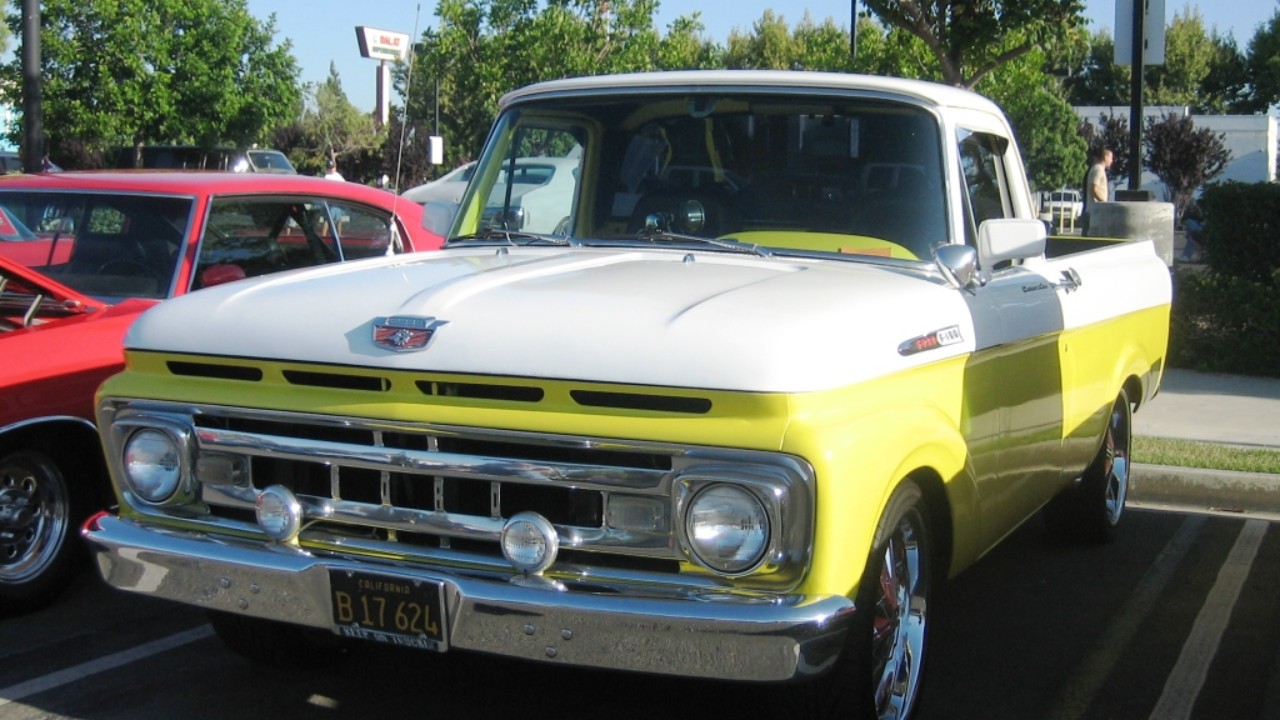
For 1961, Ford welded the cab and bed of its F-100 and F-250 Styleside trucks into one body. Ford called it an integrated pickup, though The Autopian points out that “unibody” is not quite right, since a separate frame sat underneath. Ford wanted a more carlike truck for suburban buyers. It also marketed 16 percent more cargo area than the 1960 models.
The idea had problems under heavy loads. Owners who worked their trucks near the limit reported body flex, and some found doors stuck shut. Ford added extra mounts and bracing, but complaints continued. Buyers could not get the integrated body with four-wheel drive at all. By 1963, the separate-bed trucks were outselling the integrated ones two-to-one, and Ford dropped the design.
Our take: this truck over-achieved as an idea rather than a sales hit. The Autopian notes that later trucks such as the Chevrolet Avalanche made an integrated body work, which suggests Ford was simply early. Nice unmodified examples reportedly sell for under $20,000. In our view, that makes it one of the most interesting cheap classic Ford pickups around. If you want a plainer 1960s F-100 project, our piece on why 1965 F-100 owners upgrade brakes first is worth a read.
3. 1966 Ford Bronco Half Cab
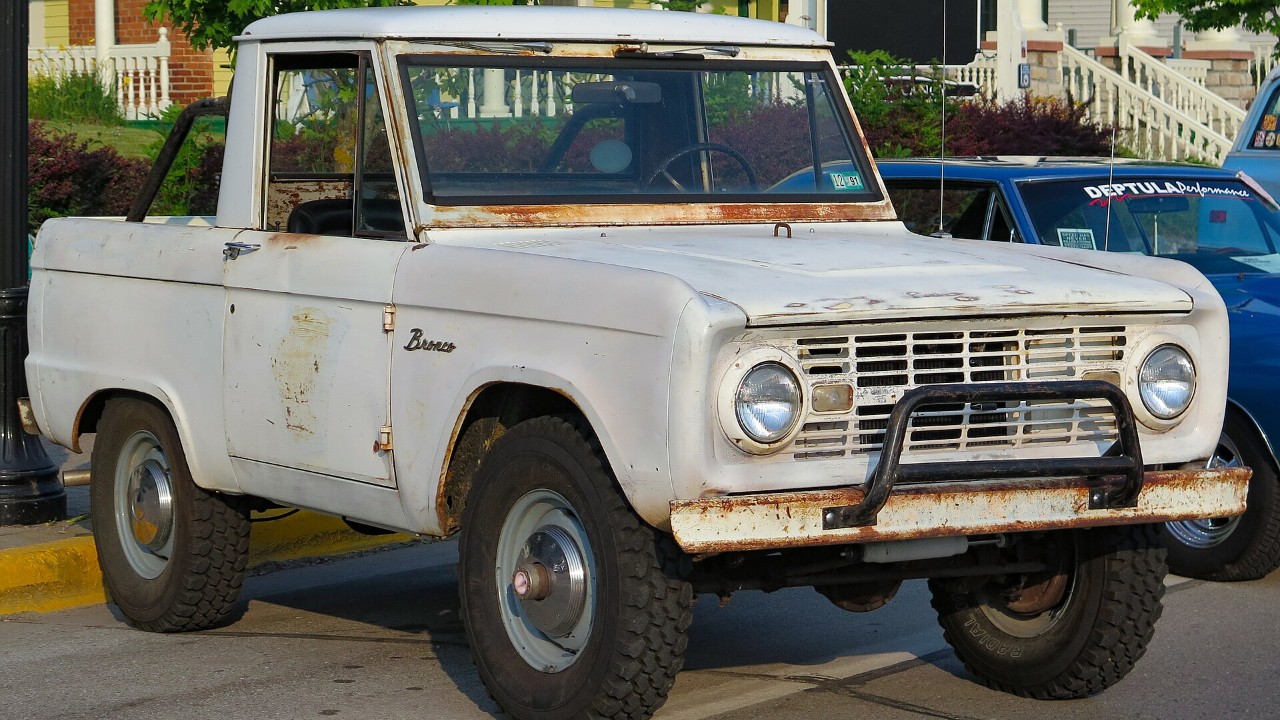
When the Bronco arrived for 1966, Ford offered it three ways. Equipment World lists the U13 roadster, built from 1966 through 1968, the U15 wagon, offered through 1977, and the U14 half-cab. That last one was a tiny pickup with a short cab roof and an open bed behind it, sold from 1966 through 1972.
The very first Bronco pickup has a story of its own. According to Equipment World, Shelby turned that six-cylinder truck into one of the first V8 Broncos. Its second owner, Vinnie Yakubanski, paid Shelby $100 for it in 1979. Decades later, experts valued it at “at least $100,000,” and Gateway Bronco bought it before showing it at Barrett-Jackson in Scottsdale.
Our take: the half-cab is the Bronco people forget, because the wagon became the icon. Yet a short-wheelbase 4×4 with a usable bed was a clever package, and it lasted seven model years. In our view, it over-achieved by doing pickup work in a body small enough for trails. For more on the bigger picture, see how the Ford Bronco became an American off-road icon.
4. 1977 Ford F-250 Highboy

The Highboy got its name from how tall it stood. Ford’s F-250 4×4 used a “divorced” transfer case, mounted apart from the transmission and linked by a short driveshaft. That layout needed more room, so the truck rode high at both ends. It sat nearly 3 inches above an F-100 or F-150 4×4, and nearly 6 inches above a two-wheel-drive F-250.
Ford backed that height with 3-inch front springs, 9-leaf rear springs and a 4-inch rear axle lift. In 1977, the 360 V8 gave way to the 351M and 400 V8s, with the 300 inline-six also listed. Trim levels ran Custom, Ranger and Ranger XLT, all with a long bed. Then, as a running change during 1977, Ford switched to a “married” transfer case bolted to the transmission. That ended the divorced setup and the Highboy’s extra height.
Our take: the 1977 truck is the last of a breed, a factory-lifted Ford pickup built for function rather than looks. In our view, it over-achieved because owners got serious ground clearance straight from the factory. If you shop for one, confirm whether it has the divorced case, since that is what makes it a true Highboy. Our earlier story on the 1975 Ford F-250 covers the same generation from another angle.
5. 1986 Ford Ranger STX

The Ranger was Ford’s compact pickup for the 1983 model year. The first one rolled off the Louisville line on January 18, 1982, and the first 1983 Ranger carried a $6,203 price. Ford then sharpened it with the STX. The STX arrived in 1985 for Ranger 4x4s on the West Coast and became fully available for 1986.
The package added a sport suspension, larger tires and bucket seats. Also for 1986, Ford’s Ranger lineup offered a 2.9-liter Cologne V6 rated at 140 horsepower. The same engine later powered the Ranger GT, which Ford marketed from 1987 to 1989. That combination arrived just before the Ranger’s long run as America’s best-selling compact truck, a title it held from 1987 to 2004.
Our take: the STX gave a small, sensible truck some personality. It looked sporty and had the 4×4 hardware to back it up. In our view, it helped turn the Ranger from a work tool into something younger buyers actually wanted. That role is easy to forget now. Today, a clean early STX makes a fun way into 1980s Ford trucks, as long as you sort out any rust and tired suspension parts.
6. 1991 Ford F-150 Nite

The Nite was a 1991 appearance package with a strong look. Ford offered it on the 1991 F-150, and only on V8 trucks. Every Nite was black. It added blacked-out exterior trim, a pink or blue-purple stripe, and a “Nite” decal on each side of the cargo box.
That was the whole recipe. There was no special engine and no unique suspension. Instead, the package relied on color and graphics to make a regular full-size pickup stand out. As a result, it showed how much visual attitude a factory package could add without changing the mechanical parts underneath.
Our take: the Nite over-achieved because it made an ordinary Ford pickup look like a custom truck, straight from the dealer. In our view, it also hinted at the blacked-out sport packages that pickup buyers love today. It may be the most collectible-looking F-150 of its generation. If you find one, check that the stripe and decals are original, because that is most of the value. The good news is that the mechanical side is regular F-150 V8 hardware, so the running gear is familiar to any Ford mechanic.
7. 2001 Ford Explorer Sport Trac
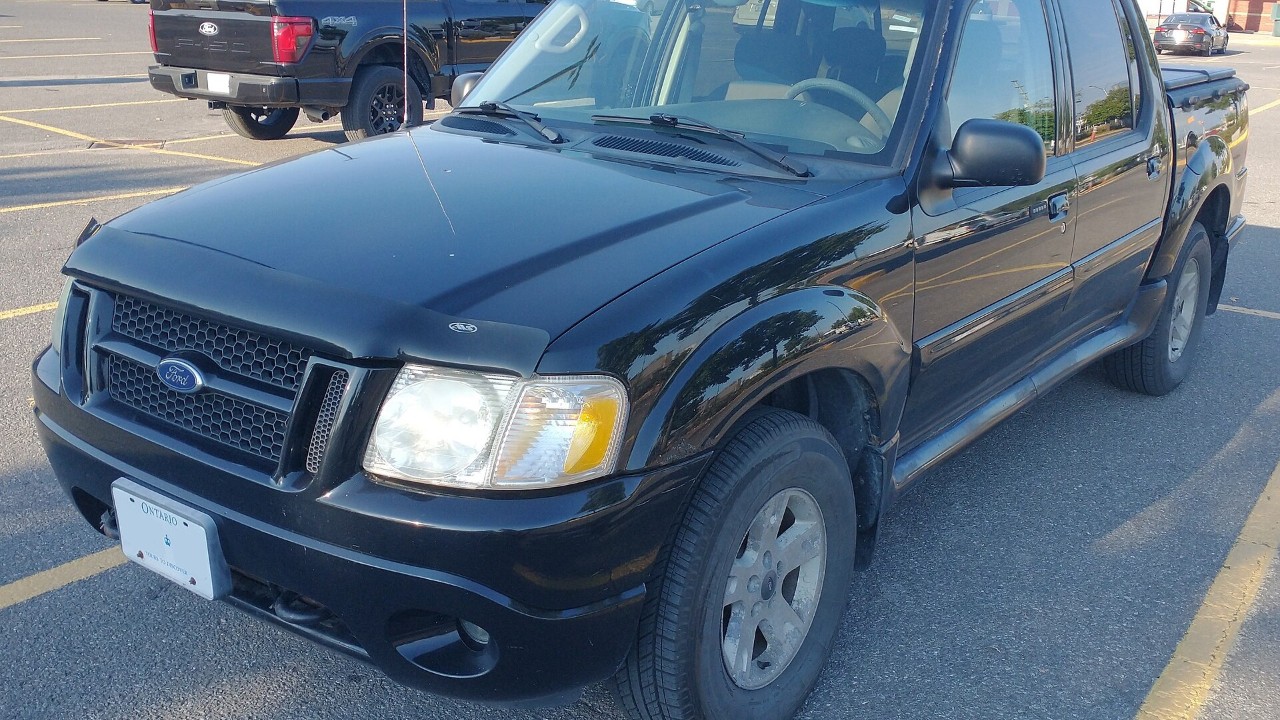
The Sport Trac arrived in February 2000 as an early 2001 model. Ford built it on the Explorer, stretching the wheelbase from 111.6 inches to 125.9 inches. That matched the Ranger SuperCab. Behind the four-door cab sat a 50-inch bed made entirely of plastic composite, with a metal load extender available.
Power came from one engine only: a 210-horsepower SOHC 4.0-liter V6. Ford also gave it a power-retractable rear window, which it called the Breezeway, in place of a sliding glass panel. The first generation ran from 2001 to 2005, and Ford built it at its Louisville Assembly Plant in Kentucky.
Our take: the Sport Trac mixed SUV comfort and a small pickup bed before crew-cab midsize trucks became normal. In our view, it over-achieved by proving that families wanted four doors and an open bed in one compact package. The composite bed was also ahead of its time. For us, the Breezeway window is the detail that sells it, since dropping the glass connects the cab to the bed. For a buyer today, it is a practical used truck with a story most people have forgotten.
More from Fast Lane Only