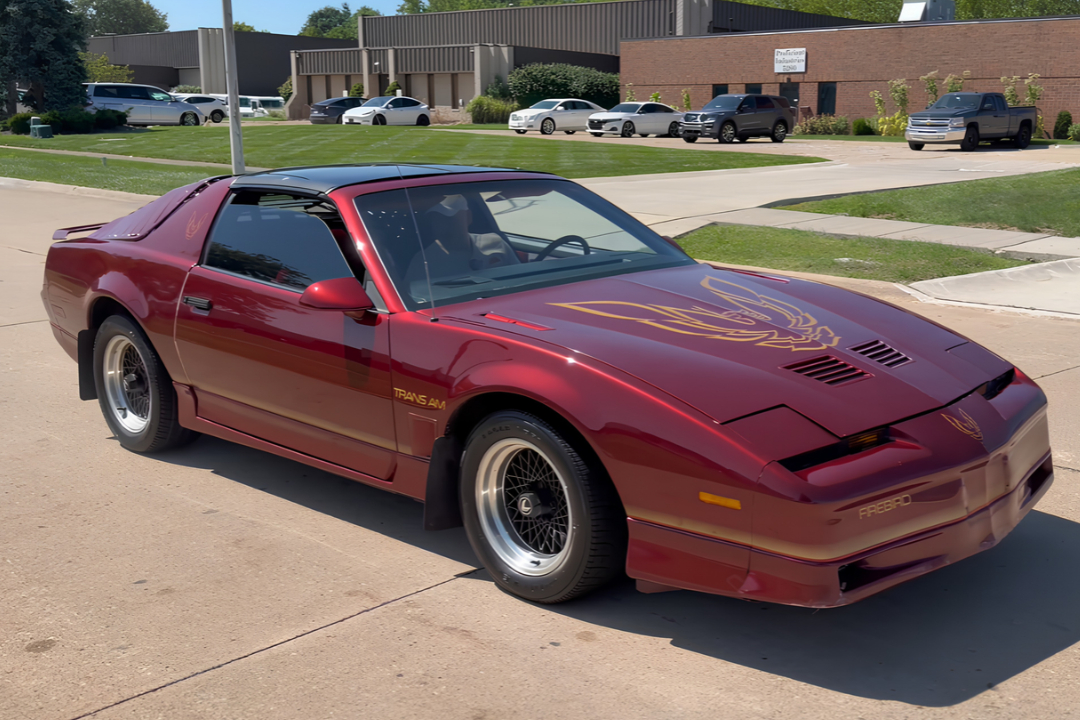
Some 83-year-olds spend their golden years birdwatching. This one apparently spent his hooning a Pontiac Trans Am hard enough that he’ll happily admit to having a heavy foot, 83 years old or not. When his daughter Candace decided he deserved one more spin behind the wheel, she didn’t book him a cruise. She called in a detailing crew to dig his 1986 Firebird out of retirement.
The car in question was no ordinary garage relic. Bought brand new with barely two thousand miles on it, this Trans Am belonged to the third generation of Firebirds, the era when Pontiac decided muscle cars should also learn some manners. Engineers ran the body through wind tunnels, chased down every bit of drag they could find, and gave the thing a flush-mounted windshield and pop-up headlights that looked less like a bruiser and more like it wanted to be taken seriously at a sports car convention. All of that engineering pedigree, however, had spent the last several years buried under dust, silence, and, as the crew would soon discover, wildlife.
Because that is the thing about cars left sitting for years. They do not just gather dust. They gather roommates.
A door that fought back and an unwelcome landlord
Getting the Firebird out of the garage was step one, and step one immediately went sideways. The driver’s door had frozen shut solid, forcing the crew to wedge an inflatable airbag into the door jamb and douse the latch in penetrating oil just to convince it to open. It was the automotive equivalent of trying to wake someone up who really, really does not want to go to work.
Things got weirder once the car reached the shop. Popping the hood revealed a fully furnished opossum nest, complete with dry leaves, pine needles, and a suspicious quantity of plastic bags, all packed into the engine bay like it was a five-star rental. Before anyone could so much as think about a hose, the whole mess had to be dry vacuumed out piece by piece, since blasting it with water first would have shoved debris deeper into the wiring and invited rust to the party.
The mechanical side turned out kinder than expected. The fuel tank was already bone dry, which spared everyone a much bigger headache, and fresh gas got the fuel pump humming again without complaint. Chewed spark plug wires got swapped using spares borrowed from a nearly identical IROC Camaro the shop’s mechanic happened to own, at least under the hood. The engine turned over and ran, but with a stumble bad enough to raise eyebrows. The culprit was almost comically simple: a missing air intake housing meant the sensor had no idea how much air the engine was actually breathing in, leaving the whole fuel mixture guessing.
The mouse that almost cost a mustache
Just when the mechanical drama calmed down, the Firebird revealed it had been running an unofficial boarding house. A live mouse bolted across the hood mid-wash, having clearly claimed the car as home for who knows how long, and it took several increasingly chaotic minutes of chasing before the crew managed to relocate their new friend outside. He was not the only tenant. A second, less fortunate mouse turned up later beneath the rear seats, tucked in alongside nesting material stuffed into the factory carpet.
That discovery meant the interior work became as much about biohazard control as detailing. An ozone machine ran through the cabin to kill lingering bacteria and odor before anyone touched the upholstery directly. The seats came out entirely for a deep extraction, sprayed down with an enzyme cleaner built specifically to break down organic mess at a level plain soap and water simply cannot reach, then finished with a hot water extractor to pull years of grime straight out of the fibers.
Even the car’s personality quirks got their moment. The rear window sported a set of paint-matched louvers, an aftermarket dealer add-on rather than something Pontiac shipped from the factory, and one side was being held in place by, of all things, a shoestring standing in for whatever fastener had given up years earlier. The crew carefully pulled them off to clean the glass underneath before reinstalling them, shoestring and all.
Cleaning up decades in a color nobody remembers
By the time the polish stage arrived, the hard part was already behind them. The Flame Red Metallic paint, a shade reportedly rare enough that it landed on only about one in ten Trans Ams from that era, had survived four decades in surprisingly good shape, needing nothing more than a light polish to knock down oxidation and minor scratches rather than any real correction work. The wheels came off for a proper cleaning and a set of fresh tires, since the old rubber had gone bald and brittle enough that driving on it would have undone every bit of mechanical progress made earlier. A brand new center cap, replacing one that had gone missing long before the shop ever laid eyes on the car, went on as the last small detail nobody but the owner would ever notice.
None of that mattered nearly as much as what happened when the car went home. The crew staged a brief bit of fake trouble getting it started, milking the moment for all it was worth, before letting that V8 rip to life in front of its owner. He did not need an explanation. He recognized the sound instantly, climbed in, and took his daughter for the promised lap around the block. Then, in a move that says everything about who this man is, he drove straight to his own mechanic afterward instead of parking it back in the garage. Eighty-three years old, freshly reunited with his dream car, and already thinking about the next tune-up. Some things never change, and honestly, that is exactly the point.
More from Fast Lane Only
- Unboxing the WWII Jeep in a Crate
- 15 rare Chevys collectors are quietly buying
- 10 underrated V8s still worth hunting down
- Police notice this before you even roll window down
*Research for this article included AI assistance, with all final content reviewed by human editors.