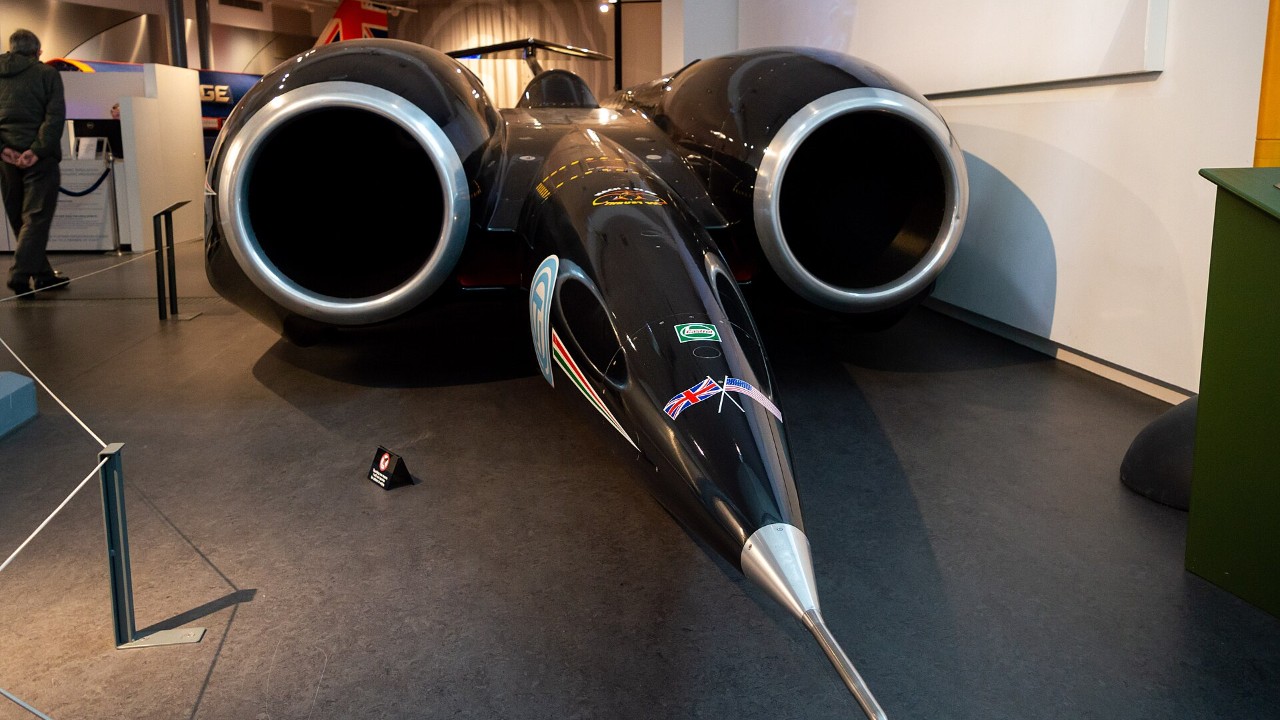
On October 15, 1997, RAF fighter pilot Andy Green drove ThrustSSC across Nevada’s Black Rock Desert at an average of 763.035 mph. That run broke the sound barrier on land, and it still stands as the official land speed record.
No car has bettered it since. Because the record is also the first supersonic one, it remains the only land speed record ever set faster than sound. Nearly three decades on, the car lives in a museum in Coventry, England.
Here is what the British team built, how the record runs unfolded and where you can see the car today.
What made ThrustSSC go
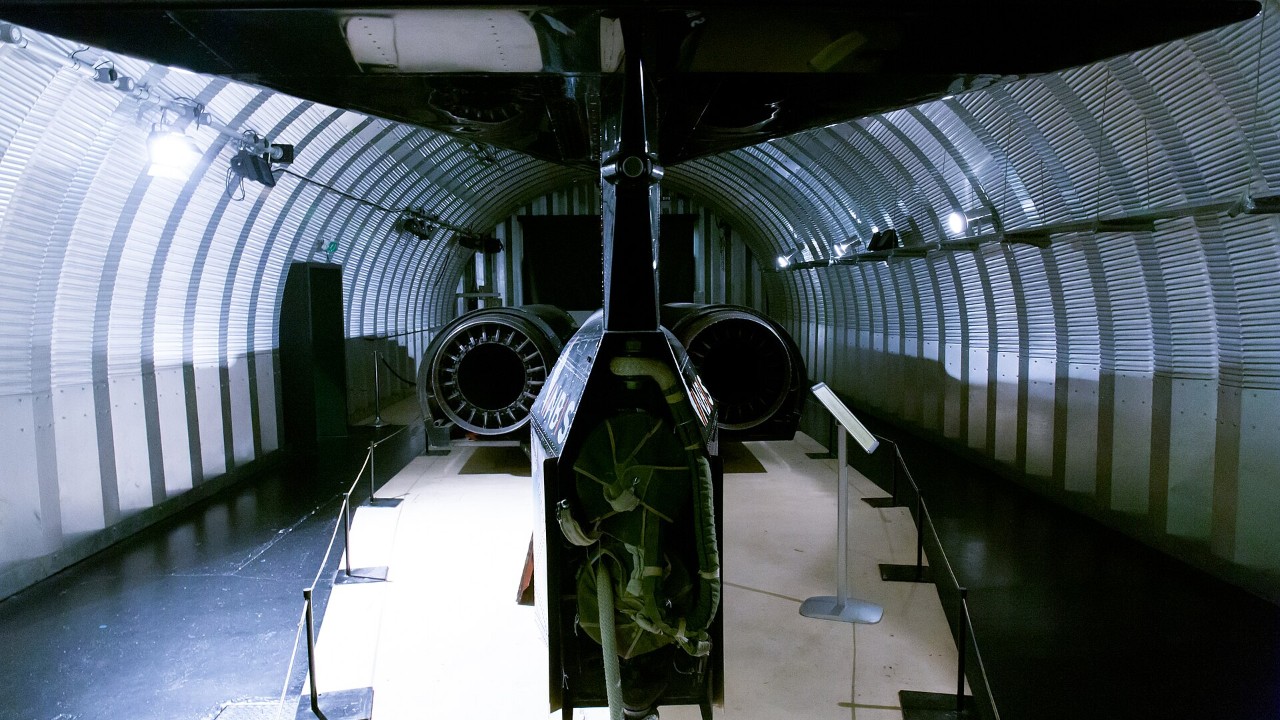
ThrustSSC used two Rolls-Royce Spey turbofan engines, the same type fitted to British F-4 Phantom II jet fighters. Together they made 223 kN, or about 50,000 pounds of thrust, according to the Coventry Transport Museum. At full power, they burned around 18 liters of fuel every second.
The car was huge. It measured 16.5 meters, or 54 feet, long and 3.7 meters, or 12 feet, wide. It also weighed 10.5 tons. The museum credits the design to Richard Noble, Jeremy Bliss, Ron Ayres and Glynne Bowsher. Incidentally, the name stands for SuperSonic Car.
Speed chasers on salt and sand have a long history, and our look inside the world of Bonneville speed record chasers covers the culture this car came from.
Keeping a 10-ton car on the ground
Running faster than sound on the ground raised problems nobody had solved before, the engineers’ own plaque suggests. For that reason, the team relied on computational fluid dynamics and wind tunnel testing. They used that work to design an active suspension system, the American Society of Mechanical Engineers says.
Even so, the car was hard work to drive. Between 500 and 600 mph, Green described it as “a massive handful, bordering on uncontrollable,” according to Guinness World Records. Still, he kept it straight long enough to make history.
The record before ThrustSSC
Noble had held the land speed record himself. In 1983, he drove the jet-powered Thrust2 to 634.051 mph at the same Black Rock Desert, Guinness records. That mark lasted for nearly 14 years.
Then, on September 25, 1997, Green took ThrustSSC to 713.990 mph. That beat Thrust2’s record, but it was still below the speed of sound. So the team kept going. Road cars chase very different numbers, as our story on how the Bugatti Veyron shattered speed records shows.
Breaking the sound barrier on land
During trial runs on October 13, 1997, ThrustSSC went past Mach 1. Two days later came the official attempt. The official figure is an average of two runs over a measured mile.
On October 15, Green’s two-way average was 763.035 mph. After adjusting for conditions at the site, that worked out to Mach 1.020, according to the Guinness World Records entry. Aerial photos showed a shockwave stretching about 300 feet behind the car.
Other photos of the run show visible distortions in the air, known as Schlieren, which the supersonic shockwaves caused. In other words, the camera caught the air itself bending around the car. At the time, the museum notes, Green held the rank of Squadron Leader in the Royal Air Force.
The date carried extra weight. Chuck Yeager had first broken the sound barrier in the Bell X-1 rocket plane. In fact, Green’s record came 50 years and one day after Yeager’s flight.
Why ThrustSSC still holds the record
The Guinness listing for the fastest car names ThrustSSC and Andy Green. Its official land speed record, measured over one mile, is still 763.035 mph at Mach 1.020. Since that record is also the first supersonic car on the books, no other land speed record has been set above the speed of sound.
In addition, the engineering itself earned recognition. In 2014, ASME named ThrustSSC a Historic Mechanical Engineering Landmark. The plaque says the team “solved novel mechanical, aerodynamic, and control problems.” With it, the car joined a list of more than 250 engineering achievements that ASME has honored.
Where to see ThrustSSC today
ThrustSSC retired after 20 days of running in 1997, Guinness says. Today it sits in the Coventry Transport Museum, alongside Noble’s Thrust2. The museum calls itself home to the world’s two fastest cars. Better still, visitors can get up close to both of them.
ASME held its landmark ceremony there on March 15, 2014. Today, the car’s 763.035-mph run from October 15, 1997, remains the official land speed record.
More from Fast Lane Only