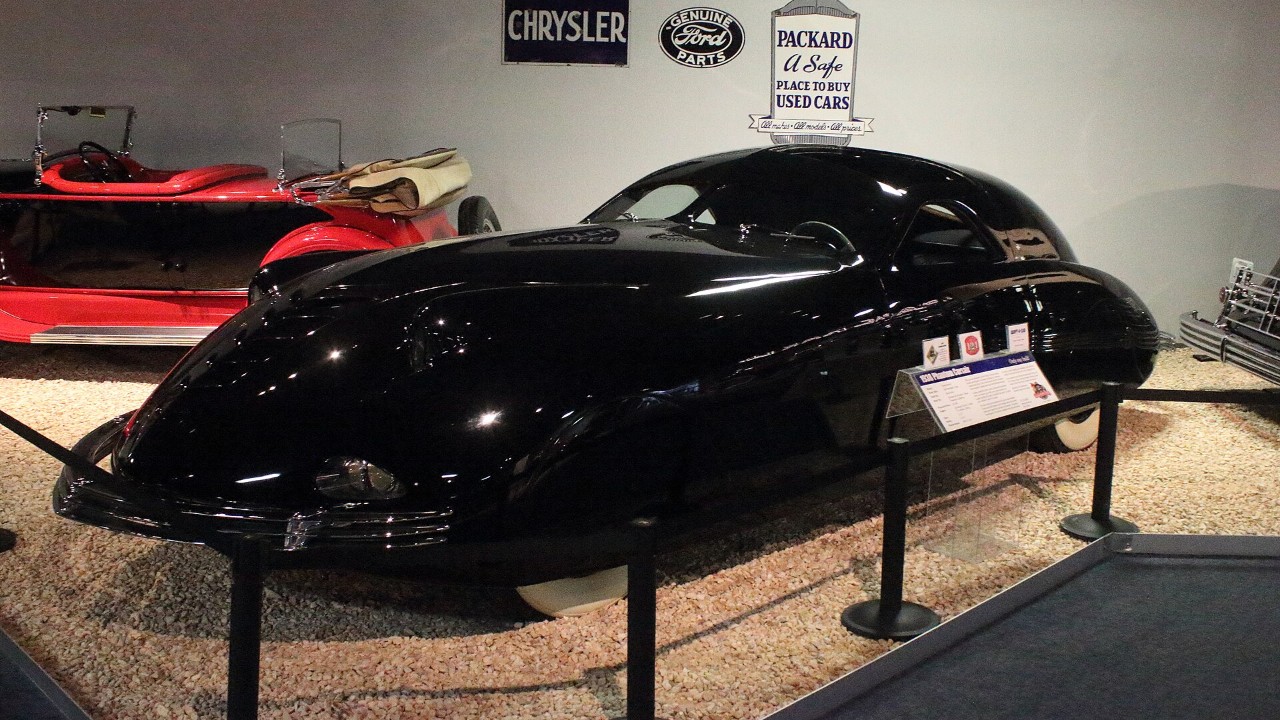
Rust Heinz wanted to sell a car of tomorrow in the late 1930s. What he left behind was a single prototype, the 1938 Phantom Corsair. It rode on the front-drive hardware of a Cord 810, and its front bench seated four people across.
Heinz came from the family behind the famous Pittsburgh food company. However, he had his own ideas about where to spend his time. He studied naval architecture at Yale and raced speedboats before he turned to cars.
Here is how a young designer and a Pasadena coachbuilder turned a new Cord into one of the strangest-looking cars of its decade.
From Yale sketches to a Pasadena coachbuilder
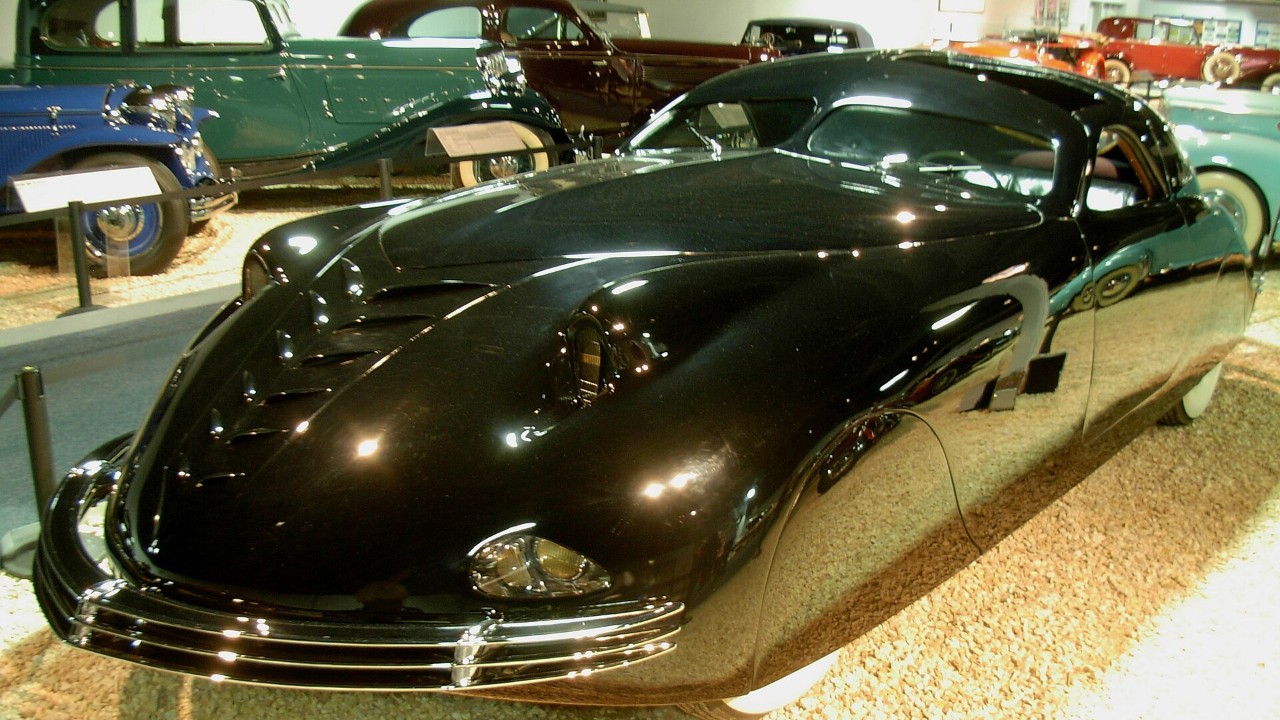
Heinz had sketched a dream car while at college. He left Yale in 1936, moved to California and opened an industrial design studio while living with an aunt in Pasadena, according to Classic & Sports Car.
For the build, he turned to Bohman & Schwartz. Swedish-born Christian Bohman and Austrian Maurice Schwartz ran the shop. They already built custom cars for movie stars, including Clark Gable’s Duesenberg roadster. Work began in early 1936 with wood and clay scale models. Schwartz made the wooden formers, while Bill Williams did most of the metal shaping.
The Phantom Corsair sits alongside other 1930s design leaps. Our feature on why the 1936 Cord 810 remains one of history’s most advanced-looking cars covers the car that donated its hardware.
What the Phantom Corsair took from the Cord 810
Heinz had bought a new Cord 810 sedan in 1936. That car gave up its engine and its front-wheel-drive subframe. A local firm in Vernon, California, then built a new cross-braced chassis to carry the Cord front-drive assembly.
The car kept the Cord’s 125-inch wheelbase. Still, the body grew much wider than a standard Cord, because its sides had to cover the front wheels. In the end, the body weighed 700 pounds more than the donor sedan, and the finished car came in at just over two tons, Classic & Sports Car reports.
California heat caused trouble, too. To stop the engine overheating, the builders fitted two Lincoln radiators. Heinz claimed 190 bhp, against the stock Cord’s 125 bhp, and an optimistic 120 mph. Later restoration work, however, found that the engine had no special tuning.
A front seat for four
Inside, the Phantom Corsair broke with convention. A broad front bench could seat four people. There was also room for two more passengers in the back, though Classic & Sports Car calls that space claustrophobic. Motor1 describes the layout as six seats in a 4+2 arrangement.
The equipment list read like science fiction for its day. It included flush electric push-button doors and triple-layer green-tinted safety glass. Hydraulic impact bumpers guarded each end. Meanwhile, the aviation-style dashboard carried a compass and an altimeter. A multi-wave radio and thermostatically controlled heating and air conditioning completed the package.
Plans for production, and what stopped them
Heinz did not see the car as a one-time showpiece. Instead, he planned limited production. He even announced a price of $14,700, which Classic & Sports Car notes was twice the cost of a Cadillac V16 coupe. Motor1 puts the targeted price at almost $15,000, while some other accounts give a lower figure.
Building the prototype was expensive. Estimates of the cost vary from $24,000 to $35,000, according to Classic & Sports Car. Similarly, Motor1 says Heinz spent more than $24,000.
Publicity came early. Esquire ran a full-page color drawing of the car in its July 1937 issue. Later, Heinz had the car photographed at Warner Brothers’ studio and repainted from black to a light sand color. It also appeared in the film The Young in Heart, renamed “The Flying Wombat.” Then, in 1939, Heinz died, and the production plans ended with him. As a result, the Phantom Corsair remained a one-off, like the cars in our list of rare concept cars that never made production.
Owners, changes and a museum home
Before the car vanished into storage, it went on show at the New York World’s Fair as “the car of tomorrow,” staying into 1939. Then, in 1942, Henry Heinz II gave the car to Lou Maxon.
During the 1940s, it changed hands several times. Andy Granatelli owned it for a while and had it resprayed metallic bronze in Chicago. In the early 1950s, comedian Herb Shriner bought it. For him, designer Albrecht Goertz reworked the front end and added a taller windscreen, targa-style roof panels and gold-and-black paint.
Shriner later loaned the car to Ed Jarvis’s museum in Florida, then took it back. After Tom Barrett bought Shriner’s estate at auction, he sold the car to Bill Harrah. Harrah had it restored to its 1938 look, and it joined his collection of 1,453 cars.
Where to see the Phantom Corsair today
After Harrah died in 1978, his collection became the National Automobile Museum in Reno, Nevada. The Phantom Corsair is still on display there, according to Classic & Sports Car and Motor1. It also made a 2026 appearance at Pebble Beach, its first there since 2007, reports The Autopian.
More from Fast Lane Only