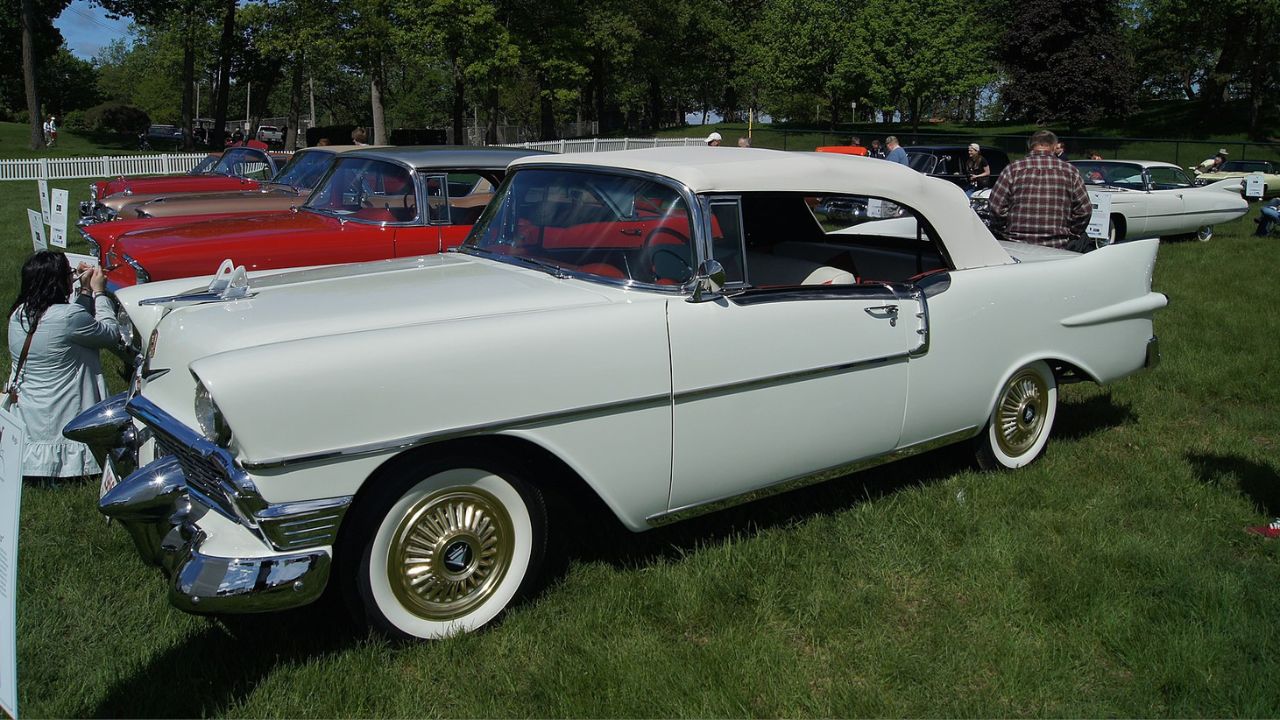
The Chevrolet El Morocco started with one man who loved his Cadillac. Reuben Allender, a Canadian-born businessman in Detroit, owned a 1955 Cadillac Eldorado, and he wanted that look at a Chevrolet price. So he took new Bel Airs, added fins and pointed bumpers, and sold them under a name of his own.
He never got close to the volume he planned. Only about 32 cars left his shop across the 1956 and 1957 model years. Even so, the idea was clever, the timing was right, and the result looked more like a scaled-down Eldorado than anything Chevrolet itself offered.
Here is how a surplus-goods dealer ended up running his own tiny car company, what he changed on each car, and why the project stopped after two seasons.
How a surplus dealer built the Chevrolet El Morocco
Allender was not a car designer. According to SlashGear’s history of the car, he moved from Hamilton, Ontario, to Detroit in 1913. Then he made his money buying surplus goods and reselling them, including parachutes after World War I.
That business mattered later, because his warehouses held a lot of odd parts. Hagerty says Allender was fond of Cadillacs and owned several, including the 1955 Eldorado that inspired the project. Robert Thompson and Cyril Olbrich helped him customize the first Bel Air. SlashGear adds that Allender worked with Creative Industries, an independent firm that also built the Packard Panther show car, and that Olbrich served as lead production engineer.
The first attempt came early. Hagerty notes that a 1955 prototype existed, but it never reached production because the 1956 Bel Airs arrived first. As a result, the real cars started with 1956 Chevrolets. Allender also borrowed the name from the El Morocco, a popular Manhattan nightclub.
What Allender changed on each Bel Air
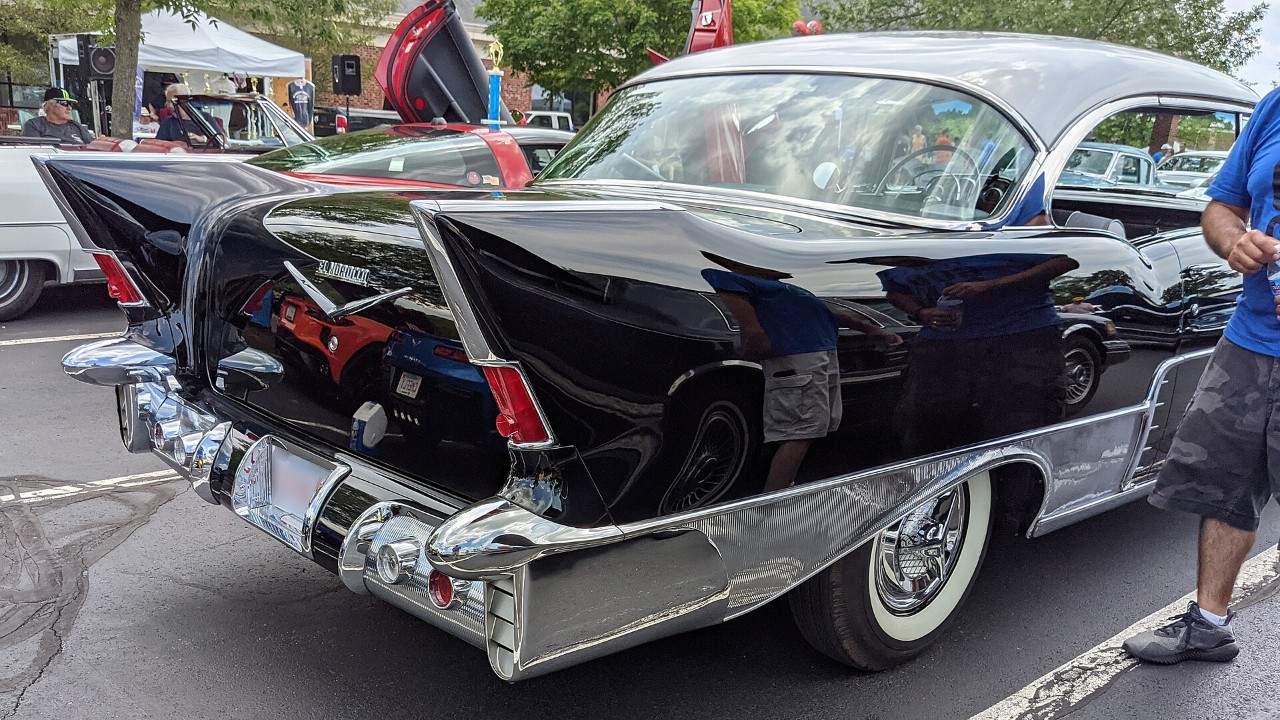
The conversion focused on the parts people noticed first. Hagerty describes fiberglass fender extensions that copied the fins of the 1955 Eldorado. At the front, Allender’s crew mounted 1937 Dodge headlight pods backward to mimic the Cadillac’s pointed bumpers. Those pods gave the little Chevy the same “Dagmar” look that Cadillac buyers paid for.
The badges changed, too. The hood kept the Bel Air’s V-shaped emblem, but block letters reading “El Morocco” replaced the Chevrolet script, Hagerty says. For 1957, the crew removed the Chevy grille’s center bar and fitted a crosshatch pattern instead.
Much of the rest came from Allender’s own shelves. SlashGear reports that the gold hood badge was a Kaiser horn button, and the hubcaps came from a J.C. Whitney catalog. Meanwhile, surplus Dodge lenses served as taillamps, and the paint schemes copied the Eldorado’s. Inside, by contrast, the cars stayed close to stock. SlashGear quotes Motor Trend’s verdict that the interiors were “barely touched.”
Price, power and the Chevy dealer deal
The pitch was simple: Cadillac style for far less than Cadillac money. Hagerty puts the Bel Air’s sticker at $2,275 and says the conversion added around $1,000. That price filled the gap between an ordinary Chevy and an entry-level Cadillac.
SlashGear lists slightly different figures from the period. It gives the 1956 car at $3,250. In addition, it quotes a 1957 Allender & Company brochure at $3,125 for the two-door hardtop, $3,175 for the four-door and $3,275 for the convertible. For comparison, SlashGear says a 1957 Cadillac Eldorado Brougham cost $13,074.
Under the hood, the El Morocco used regular Chevrolet V8s. SlashGear lists a 265-cubic-inch V8 for 1956 and a 283-cubic-inch V8 for 1957, both with Powerglide automatics. Each car also wore its own legal identity. According to SlashGear, Allender registered the cars under the El Morocco name, and local Chevy dealers sold them with the full factory warranty.
Why the run stopped at about 32 cars
Allender aimed high. SlashGear says he planned to build ten cars a day in a three-story Detroit warehouse, but he never came close. Hagerty puts the total at about 32 converted 1956 and 1957 Bel Airs.
The exact split is still debated. SlashGear writes that Olbrich told a collector who owns three of the cars that the shop built 16 cars in 1956 and 18 in 1957, while other sources claim 20 and 14. Either way, the total stays in the low 30s.
The ending was more about money than about the cars. SlashGear reports that Allender’s grandson told Motor Trend that Allender ran out of money. Weak demand also played a part, and Chevrolet likely ended the dealer arrangement. In our view, the El Morocco was a smart idea that arrived without the budget a car company needs.
Where the Chevrolet El Morocco survivors are now
Hagerty says around half of the roughly 32 cars survive. It also describes one fully restored 1956 convertible that showed 108 miles since its overhaul. Mecum later offered it at Kissimmee in 2021 from a private collection, together with a 1957 hardtop and a 1957 convertible.
Another 1956 convertible crossed the block a year later. The Barrett-Jackson lot listing calls it one of only two known 1956 convertibles, from an estimated 16 built. According to the listing, a 1956 El Morocco appeared on the cover of Motor Trend in September 1956. This car later turned up in a Pennsylvania backyard before an award-winning restoration.
That car carries the 265-cubic-inch V8 and Powerglide, just as Allender sold it. Barrett-Jackson offered it with no reserve as Lot 1326 at Scottsdale in 2022.
More from Fast Lane Only